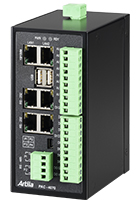
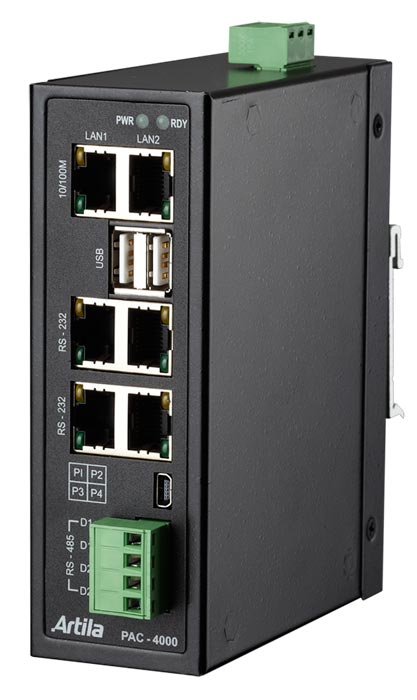
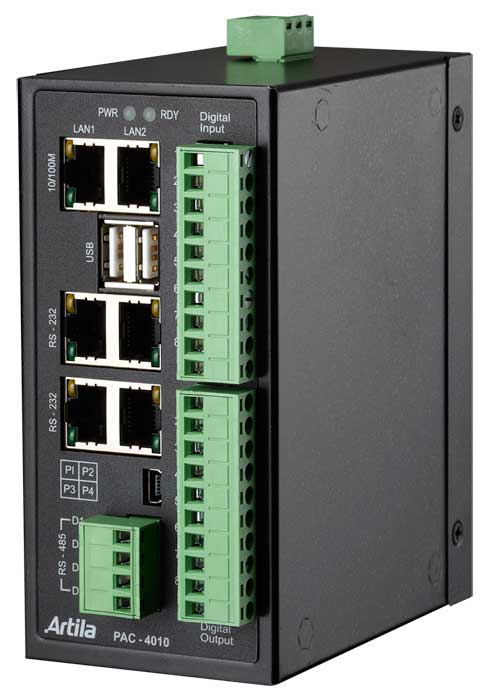
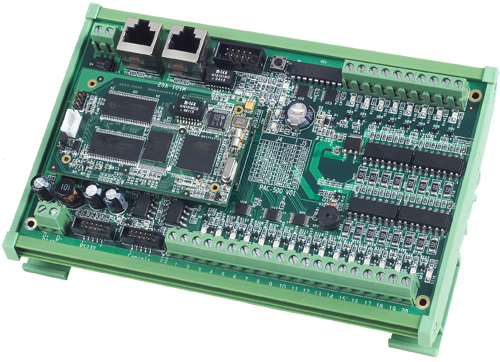
1. Product Overview
Product Name: PAC-5010
Model: PAC-5010
Series: ARM9-based Linux Programmable Automation Controller Series
Article Number: PAC-5010
Manufacturer: Artila Electronics Co., Ltd.
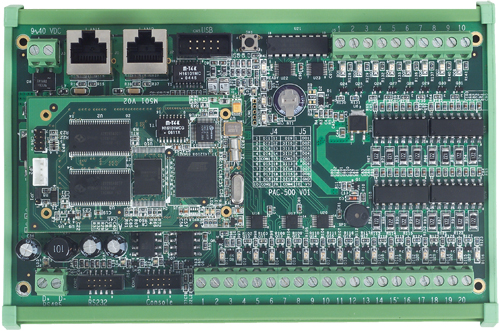
The Artila PAC-5010 is a compact, fanless, ARM9-based Linux automation controller designed for industrial control, monitoring, and data acquisition applications. It integrates a 180 MHz Atmel AT91RM9200 ARM9 processor, dual Ethernet interfaces, multiple serial ports, isolated digital I/O channels, and USB host ports in a DIN-rail mountable enclosure. The controller runs an embedded Linux 2.6.x operating system and provides a full GNU C/C++ development environment, enabling engineers to develop, deploy, and manage automation applications using open-source tools.
2. Key Features
- ARM9 Industrial Computing Platform:
Powered by an Atmel AT91RM9200 ARM920T processor running at 180 MHz (200 MIPS) with integrated MMU, 16 KB instruction cache, and 16 KB data cache.
- Pre-installed Linux OS:
Ships with Linux kernel 2.6.x, U-Boot 1.1.2 bootloader, and a full file system supporting JFFS2, EXT2/EXT3, VFAT/FAT, and NFS.
- Rich I/O Interfaces:
Includes 16 opto-isolated digital inputs (2.5 kV isolation) and 8 Darlington-pair digital outputs (500 mA max per channel, 5–50 VDC source voltage).
- Networking and Connectivity:
Dual 10/100 Mbps Ethernet ports (RJ-45), one RS-232 port with full modem control, one RS-485 port with hardware direction control, and two USB 2.0 host ports (12 Mbps).
- Expandable Storage:
One internal SD 1.0-compliant socket supporting up to 4 GB SD cards for data logging and application storage.
- Web and Network Services:
Integrated web server (Boa), FTP, Telnet, SSH, SNMP, and firewall (iptables) for remote monitoring and control.
- Open Development Environment:
Includes GNU C/C++ cross-compilation toolchain for Linux and Windows (CygWin), POSIX libraries, and BusyBox utilities.
- Industrial Design:
Fanless, DIN-rail mountable, wide 9–40 VDC power input, 0–70 °C operating temperature, CE/FCC Class A compliance.
- Security and Management:
Supports SSL, SSH 1.0/2.0, and user-level access control. Includes watchdog timer, real-time clock, and buzzer for system monitoring.
3. Technical Specifications
Processor & Memory
- CPU: Atmel AT91RM9200 ARM9 (ARM920T core)
- Clock Speed: 180 MHz (200 MIPS)
- Cache: 16 KB instruction, 16 KB data
- SDRAM: 64 MB
- Flash Memory: 16 MB
Networking
- Ethernet: 2 × 10/100 Base‑T (RJ‑45 connectors)
- Protocols: IPv4, ICMP, ARP, DHCP, NTP, TCP, UDP, FTP, Telnet, HTTP, PPP, PPPoE, CHAP, PAP, SMTP, SNMP v1/v2, SSL, SSH
Serial Interfaces
- RS‑232: 1 port (10‑pin header, full modem control)
- Signals: Tx, Rx, RTS, CTS, DSR, DTR, DCD, GND
- RS‑485: 1 port (screw terminal)
- Signals: Data+, Data‑, GND
- Console: 1 port (10‑pin header, Tx, Rx, GND)
- Baud Rate: up to 921.6 kbps
- Parity: None, Even, Odd, Mark, Space
- Data Bits: 5–8
- Stop Bits: 1, 1.5, 2
- Flow Control: RTS/CTS, XON/XOFF, None
USB Host Ports
- 2 × USB 2.0 Full‑Speed (12 Mbps)
- Connector: 10‑pin header
- Supported Devices: Flash disks, Wi‑Fi (IEEE 802.11b/g), RS‑232 adaptors
Digital I/O
- Inputs: 16 × opto‑isolated channels
- Logical High: 5–24 VDC
- Logical Low: 0–1.5 VDC
- Input Resistance: 1.2 kΩ @ 0.5 W
- Response Time: 20 µs
- Isolation: 2500 Vrms
- Outputs: 8 × Darlington‑pair channels (UDN2981A Allegro)
- Source Voltage: 5–50 VDC
- Max Output Current: 500 mA per channel
- Built‑in transient suppression diodes
Storage
- Internal SD 1.0 socket (supports up to 4 GB SD card)
Power
- Input Voltage: 9–40 VDC
- Power Consumption: 800 mA @ 12 VDC
- Protection: Auto‑polarity and surge protection
Environmental
- Operating Temperature: 0 – 70 °C (32 – 158 °F)
- Dimensions: 160 × 104 × 32 mm
- Mounting: DIN‑rail
- Compliance: CE Class A, FCC Class A
Indicators & Controls
- Power LED (green)
- Ready LED (system boot status)
- LAN1/LAN2 LEDs (link/activity)
- Serial Port LEDs (TX/RX status)
- User LEDs (LD1/LD2, dual‑color, programmable)
- Reset Button (hardware reset)
4. Functionality
The PAC‑5010 functions as a compact, embedded Linux automation controller capable of handling digital I/O operations, serial communications, and network‑based control tasks. It operates as a standalone industrial computer with built‑in web and network services, enabling remote configuration, monitoring, and data acquisition.
Use Cases & Applications:
- Industrial automation and process control
- Remote monitoring and data logging
- Building management systems (BMS)
- Machine control and relay actuation
- IoT gateway and edge computing node
- Networked sensor/actuator interface
Operation:
The controller boots from onboard flash using U‑Boot, loads the Linux 2.6.x kernel, and mounts its file system (RAMDISK + Flash Disk). Users can log in via Telnet, SSH, or serial console to configure network parameters, manage I/O, and deploy applications.
Compatibility:
- Supports standard Linux utilities and POSIX‑compliant applications.
- Compatible with USB Wi‑Fi adapters using Ralink RT2571 (rt73) chipset.
- Works with standard SD cards and USB mass storage devices.
- Accessible via any OS supporting SSH/Telnet/FTP.
5. Components & Accessories
Included Items:
1. PAC‑5010 Controller
2. CBL‑F10M9‑20 Cable (10‑pin header to DB9 male for RS‑232)
3. Artila CD (includes GNU tool chain, utilities, examples, and documentation)
4. User’s Guide
Optional Accessories:
- 4 GB SD Card (for data storage expansion)
- USB Wi‑Fi adapter (Ralink RT2571/rt73 chipset)
- USB RS‑232 adapters
- DIN‑rail mounting hardware (if not pre‑installed)
Connectors:
- Power Input (J3): +9 – 40 VDC with auto‑polarity protection
- Digital Input (J4): 16 channels grouped in 4 commons (COM1–COM4)
- Digital Output (J5): 8 channels (DO1–DO8) + VS (voltage source) + GND
- RS‑232/RS‑485/Console headers (10‑pin)
- USB header (10‑pin)
6. Installation & Setup
Power Requirements:
Supply 9–40 VDC to the J3 connector. The controller includes reverse polarity and surge protection.
Mounting:
DIN‑rail mountable enclosure (160 × 104 × 32 mm). Ensure adequate ventilation for fanless operation.
Initial Configuration:
- Default LAN1 IP: 192.168.2.127
- LAN2: DHCP enabled
- Login credentials: guest/guest (Telnet), root/root (SSH)
- Boot time: ~30 seconds
Network Setup:
Modify `/disk/etc/rc` to set static IP or enable DHCP:
- Static: `ifconfig eth0 192.168.2.127 netmask 255.255.255.0`
- DHCP: `dhcpcd eth1 &`
Wireless LAN Setup:
Insert USB Wi‑Fi adapter (Ralink RT2571). Use commands:
```
ifconfig wlan0 up
iwconfig wlan0 essid <SSID> key <KEY> mode managed
dhcpcd wlan0 &
```
Serial Console Access:
Use CBL‑F10M9‑20 to connect to PC RS‑232 port via null modem adapter.
Terminal settings: 115200 bps, 8N1, ANSI mode.
File System Structure:
- Root file system: RAMDISK (8 MB)
- User disk (/disk): Flash storage (~11 MB) for programs and configurations
- Files outside /disk are volatile and lost after power off.
Restoring Factory Defaults:
Copy files from `/default` to `/disk` to restore factory settings.
7. Performance & Capabilities
Processing Performance:
- 180 MHz ARM9 CPU delivering ~200 MIPS for real‑time control tasks.
- Efficient Linux kernel 2.6.x optimized for embedded applications.
I/O Performance:
- Digital input response time: 20 µs.
- Digital output current capacity: 500 mA per channel (5–50 VDC).
- Opto‑isolation ensures noise immunity in industrial environments.
Networking Performance:
- Dual 10/100 Mbps Ethernet interfaces support redundant or segmented networks.
- Supports TCP/IP stack with SSL and SSH for secure communication.
Storage Capacity:
- 16 MB onboard Flash for system and user disk.
- Expandable via SD card (up to 4 GB) and USB mass storage.
System Reliability:
- Watchdog timer for automatic recovery from system hangs.
- Real‑time clock for timestamping and scheduled operations.
- Fanless design reduces mechanical failure points.
Limitations:
- No analog I/O channels (natively digital only).
- USB ports limited to Full‑Speed (12 Mbps).
- Internal storage (16 MB Flash) may require external SD for large applications.
8. Standards & Compliance
- Electrical Safety: Opto‑isolation 2500 Vrms on digital inputs.
- EMC Compliance: CE Class A, FCC Class A.
- Environmental: 0 – 70 °C operating range for industrial environments.
- Software Standards: POSIX‑compliant libraries, GNU tool chain.
- Network Protocols: IPv4, TCP/IP, SNMP v1/v2, SSL, SSH 2.0.
9. Additional Information
Warranty & Support:
Artila provides standard manufacturer warranty and technical support for the PAC‑5010. Firmware updates, utilities, and documentation are available via the Artila support portal and included CD.
Maintenance:
- Periodically check power connections and DIN‑rail mount stability.
- Use the `update` utility to upgrade bootloader, kernel, or file system images.
- Use `update --FORMAT` to format user disk if necessary (supervisor mode only).
Software Utilities:
- update: Firmware and file system update tool.
- setuart: Configure serial port parameters and modes.
- gpioctl: Control digital I/O channels (DO1–DO8 and DI1–DI16).
- manager.jar: Java‑based network discovery and configuration utility.
- busybox, tinylogin, bash, ftp, telnet: Standard Linux utilities.
Development Environment:
- GNU C/C++ cross‑compiler (GCC) for Linux and CygWin.
- GLIBC POSIX library.
- Example programs and Makefiles included on Artila CD.
- Supports remote deployment via FTP and execution via SSH/Telnet.
Time Synchronization:
- Manual RTC adjustment via `date` and `hwclock –w`.
- NTP client utility available for automatic time synchronization.
Web Server Configuration:
- Web pages stored in `/home/httpd`.
- Configuration file: `boa.conf`.
- Default home page: `index.html`.
Device Drivers:
- SD/MMC, UART, RTC, Buzzer, Digital I/O, Ethernet, Watchdog.
- USB drivers for Flash disk, Wi‑Fi (IEEE 802.11b/g), RS‑232 adapters.
Device Nodes (/dev):
- ttyS0 (console), ttyS1 (RS‑485), ttyS2 (RS‑232)
- mmc0–mmc2 (SD card), sda–sde (USB storage)
- ttyUSB0–ttyUSB1 (USB serial adapters)
- rtc (Real Time Clock), gpio (Digital I/O)
System Recovery:
- Hardware reset button for manual reboot.
- Factory default files in `/default` directory.
Summary:
The Artila PAC‑5010 is a robust, Linux‑based programmable automation controller engineered for industrial applications requiring networked control, data acquisition, and remote management. Its ARM9 architecture, dual Ethernet interfaces, isolated digital I/O, and open‑source software environment make it a flexible solution for system integrators and automation engineers seeking a compact, reliable, and programmable platform for industrial automation and IoT deployments.


 LOOKING FOR THE RIGHT
 ds_ipac5010.pdf
PDF Catalog
ds_ipac5010.pdf
PDF Catalog
 Warranty Declaration.pdf
PDF Catalog
Warranty Declaration.pdf
PDF Catalog
 PAC_5010_user_guide.pdf
Manual
PAC_5010_user_guide.pdf
Manual