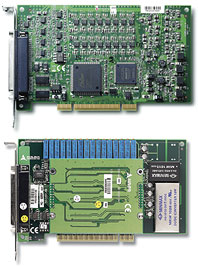
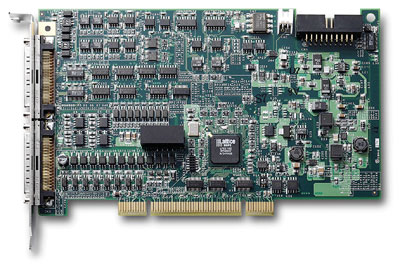
ACLD-9188
SUCHEN SIE DIE PASSENDE
INDUSTRIELLE LÖSUNG?
Entdecken Sie Embedded-, Kommunikations- und Automatisierungslösungen für Ihre Anwendung.
- Bus Interface: 32-bit PCI bus, compatible with both 3.3 V and 5 V signaling.
- Analog Output Channels: 8 independent channels supporting both voltage and current output.
- Resolution: 16-bit D/A conversion for voltage output; effective 15-bit resolution for current output.
- Output Ranges:
- Voltage: ±10 V bipolar range.
- Current: 0–20 mA, 4–20 mA, 5–25 mA (software programmable).
- Settling Time: 17 µs typical for current output (20 mA step); 130 µs typical for voltage output (20 V step).
- Slew Rate: 1.3 mA/µs (current output); 26 V/µs (voltage output).
- Output Drive Capability: ±5 mA maximum for voltage output.
- Digital I/O: 4 TTL-compatible digital inputs and 4 TTL-compatible digital outputs.
- Plug and Play: Fully PCI Plug-and-Play compliant; automatic resource allocation by BIOS.
- Software Support: Compatible with Windows 7/8 (x86/x64) and Linux; drivers and SDKs available for LabVIEW™, MATLAB®, C/C++, Visual Basic, and Visual Studio .NET.
- Form Factor: Standard PCI card (175 mm × 107 mm).
- Connector: One 37-pin D-sub female connector for analog and digital I/O.
- Power Supply: +5 V and +12 V DC rails from PCI bus; onboard DC/DC converter for current output circuitry.
- Calibration: Factory-calibrated with precision DMM; supports re-calibration for long-term accuracy.
- Safety and Reliability: Designed for industrial environments with 0–50°C operating range and 5–95% non-condensing humidity tolerance.
- Analog Output Channels: 8 independent channels supporting both voltage and current output.
- Resolution: 16-bit D/A conversion for voltage output; effective 15-bit resolution for current output.
- Output Ranges:
- Voltage: ±10 V bipolar range.
- Current: 0–20 mA, 4–20 mA, 5–25 mA (software programmable).
- Settling Time: 17 µs typical for current output (20 mA step); 130 µs typical for voltage output (20 V step).
- Slew Rate: 1.3 mA/µs (current output); 26 V/µs (voltage output).
- Output Drive Capability: ±5 mA maximum for voltage output.
- Digital I/O: 4 TTL-compatible digital inputs and 4 TTL-compatible digital outputs.
- Plug and Play: Fully PCI Plug-and-Play compliant; automatic resource allocation by BIOS.
- Software Support: Compatible with Windows 7/8 (x86/x64) and Linux; drivers and SDKs available for LabVIEW™, MATLAB®, C/C++, Visual Basic, and Visual Studio .NET.
- Form Factor: Standard PCI card (175 mm × 107 mm).
- Connector: One 37-pin D-sub female connector for analog and digital I/O.
- Power Supply: +5 V and +12 V DC rails from PCI bus; onboard DC/DC converter for current output circuitry.
- Calibration: Factory-calibrated with precision DMM; supports re-calibration for long-term accuracy.
- Safety and Reliability: Designed for industrial environments with 0–50°C operating range and 5–95% non-condensing humidity tolerance.
Comprehensive Product Summary – ADLINK PCI-6208A 8-Channel 16-Bit Analog Output Card
### 1. Product Overview
Product Name: PCI-6208A
Model: PCI-6208A
Series: 6208/6216-GL Series (Multi-Channel Analog Output Cards)
Article Number: PCI-6208A
Manufacturer: ADLINK Technology Inc.
Product Type: 8-Channel 16-Bit Analog Output PCI Card with Voltage and Current Output
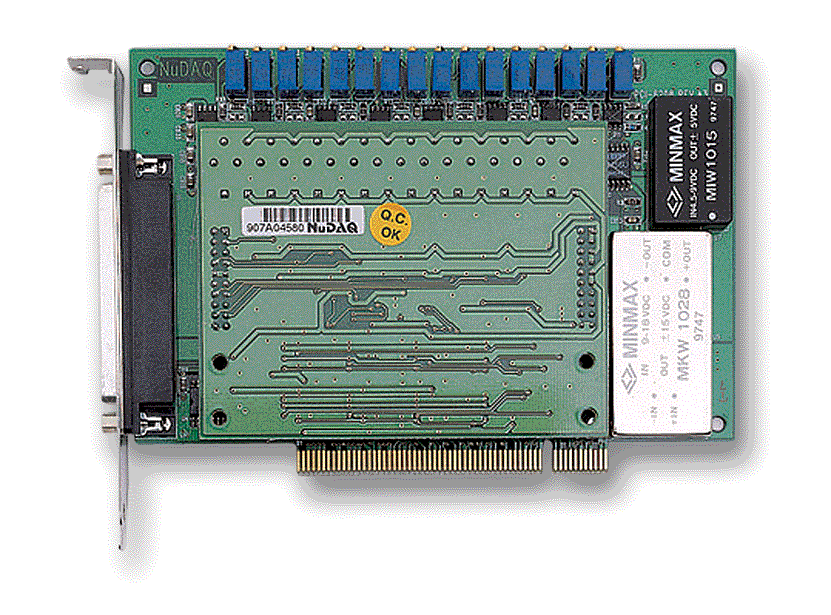
The ADLINK PCI-6208A is a high-performance analog output card designed for PCI bus systems. It belongs to the ADLINK 6208/6216-GL Series, which includes 8- and 16-channel analog output cards supporting both voltage and current output modes. The PCI-6208A specifically provides eight 16-bit analog output channels capable of delivering programmable current ranges (0–20 mA, 4–20 mA, 5–25 mA) and bipolar voltage outputs (±10 V). It is engineered for industrial process control, signal generation, and automation applications requiring precise and stable analog signal generation.
### 2. Key Features
- Bus Interface: 32-bit PCI bus, compatible with both 3.3 V and 5 V signaling.
- Analog Output Channels: 8 independent channels supporting both voltage and current output.
- Resolution: 16-bit D/A conversion for voltage output; effective 15-bit resolution for current output.
- Output Ranges:
- Voltage: ±10 V bipolar range.
- Current: 0–20 mA, 4–20 mA, 5–25 mA (software programmable).
- Settling Time: 17 µs typical for current output (20 mA step); 130 µs typical for voltage output (20 V step).
- Slew Rate: 1.3 mA/µs (current output); 26 V/µs (voltage output).
- Output Drive Capability: ±5 mA maximum for voltage output.
- Digital I/O: 4 TTL-compatible digital inputs and 4 TTL-compatible digital outputs.
- Plug and Play: Fully PCI Plug-and-Play compliant; automatic resource allocation by BIOS.
- Software Support: Compatible with Windows 7/8 (x86/x64) and Linux; drivers and SDKs available for LabVIEW™, MATLAB®, C/C++, Visual Basic, and Visual Studio .NET.
- Form Factor: Standard PCI card (175 mm × 107 mm).
- Connector: One 37-pin D-sub female connector for analog and digital I/O.
- Power Supply: +5 V and +12 V DC rails from PCI bus; onboard DC/DC converter for current output circuitry.
- Calibration: Factory-calibrated with precision DMM; supports re-calibration for long-term accuracy.
- Safety and Reliability: Designed for industrial environments with 0–50°C operating range and 5–95% non-condensing humidity tolerance.
### 3. Technical Specifications
Analog Output (Voltage Mode):
- Channels: 8
- Resolution: 16-bit
- Monotonicity: 15-bit typical
- Output Range: ±10 V
- Slew Rate: 26 V/µs typical
- Settling Time: 130 µs typical (20 V step)
- Gain Error: ±0.2% maximum
- Differential Nonlinearity (DNL): ±1 LSB typical
- Output Drive: ±5 mA maximum
- Output Initial State: 0 V after power-on or reset
- Data Transfer: Programmed I/O
Analog Output (Current Mode):
- Channels: 8 (software-selectable)
- Resolution: 15-bit typical
- Monotonicity: 14-bit typical
- Output Ranges: 0–20 mA, 4–20 mA, 5–25 mA
- Slew Rate: 1.3 mA/µs typical
- Settling Time: 17 µs typical (20 mA step)
- Span Error: ±0.3% typical
- Output Initial State: 4 mA after reset or power-on
- Data Transfer: Programmed I/O
Digital I/O:
- Channels: 4 inputs, 4 outputs
- Logic Level: 5 V TTL compatible
- Input Voltage: Low ≤ 0.8 V, High ≥ 2.0 V
- Output Voltage: Low ≤ 0.4 V, High ≥ 2.4 V
- Drive Capability: Sink 8 mA, Source 0.4 mA
- Data Transfer: Programmed I/O
General:
- Connector: One 37-pin D-sub female
- Operating Temperature: 0°C to 50°C
- Storage Temperature: -20°C to 80°C
- Humidity: 5–95% RH, non-condensing
- Dimensions: 175 mm × 107 mm (6.82" × 4.17")
- Weight: Approx. 200 g (typical)
- Power Requirements:
- +5 V @ 670 mA typical
- +12 V @ 380 mA typical
### 4. Functionality
The PCI-6208A functions as a precision analog output interface for PC-based control and measurement systems. Each channel includes a dedicated 16-bit digital-to-analog converter (DAC) for voltage output and a precision current transducer (BB XTR110 or equivalent) for current output. The card supports both unipolar and bipolar output modes, allowing flexible signal generation for various industrial and laboratory applications.
Typical Use Cases:
- Industrial process control (e.g., actuator or valve control)
- Servo motor control and motion systems
- Signal simulation and waveform generation
- Automated test equipment (ATE)
- SCADA and HMI systems
- Reference voltage/current generation
Compatibility:
- Fully compatible with PCI 2.2 standard
- Supported operating systems: Windows 7/8 (32/64-bit), Linux
- Supported development environments: LabVIEW™, MATLAB®, Visual Studio, C/C++, Visual Basic
### 5. Components & Accessories
Included Components:
- PCI-6208A analog output card
- ADLINK All-in-One Software CD (drivers, SDKs, utilities)
- User’s Manual (digital or printed)
Optional Accessories:
- DIN-37D-01: Terminal board with one 37-pin D-sub connector and DIN-rail mounting.
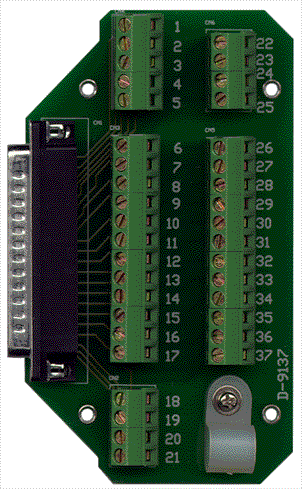
- ACLD-9137-01: General-purpose terminal board with one 37-pin D-sub male connector.
- ACLD-9137F-01: General-purpose terminal board with one 37-pin D-sub female connector.
- ACL-10137-1MM: 37-pin D-sub male-to-male cable, 1 meter.
- ACL-10137-1MF: 37-pin D-sub male-to-female cable, 1 meter.
These accessories facilitate easy wiring and integration into control panels or test benches.
### 6. Installation & Setup
System Requirements:
- Available 32-bit PCI slot with bus-mastering capability
- Compatible motherboard supporting 3.3 V or 5 V PCI signaling
- Supported OS: Windows 7/8 (x86/x64) or Linux
Installation Steps:
1. Power off the host PC and disconnect all peripherals.
2. Insert the PCI-6208A into an available PCI slot.
3. Secure the card using the chassis screw.
4. Connect the 37-pin D-sub cable to the terminal board or external device.
5. Power on the system; the BIOS will automatically assign resources.
6. Install ADLINK DAQPilot or legacy PCIS-DASK drivers from the All-in-One CD.
7. Verify installation using DAQMaster or the included utility software.
Configuration:
- Fully Plug-and-Play; no manual jumper settings required.
- Device resources (I/O address, IRQ) are automatically assigned by BIOS.
- Software utilities allow channel configuration, range selection, and calibration.
### 7. Performance & Capabilities
Analog Output Performance:
- High-resolution 16-bit DACs ensure fine granularity and low noise.
- Fast settling time (17 µs for current, 130 µs for voltage) enables rapid signal updates.
- High slew rates (1.3 mA/µs and 26 V/µs) support dynamic waveform generation.
- Low gain and span errors ensure accurate signal reproduction.
Digital I/O Performance:
- TTL-compatible I/O allows synchronization with external digital systems.
- Useful for triggering, status monitoring, or control signaling.
Efficiency and Limitations:
- Designed for precision rather than high-speed waveform generation.
- Maximum output drive limited to ±5 mA for voltage outputs.
- Current output limited to 25 mA maximum per channel.
### 8. Standards & Compliance
- Bus Interface: PCI Local Bus Specification Revision 2.2 compliant.
- Form Factor: Standard PCI card (175 × 107 mm).
- CompactPCI Compliance: PICMG 2.0 R2.1 (for related cPCI models).
- Electrical Safety: Designed for industrial environments with ESD protection.
- Software Standards: Compatible with major development environments and APIs.
- Environmental Compliance: RoHS-compliant manufacturing.
- Operating System Support: Windows 7/8 (x86/x64), Linux kernel driver support.
- Certifications: CE and FCC Class A (typical for ADLINK industrial cards).
### 9. Additional Information
Calibration & Maintenance:
- Factory-calibrated using precision 6½-digit DMM.
- Calibration data stored in onboard flash memory.
- Recommended re-calibration interval: 1 year.
- Calibration utility available on the ADLINK All-in-One CD.
Warranty:
- Standard ADLINK limited warranty (typically 2 years).
- Covers defects in materials and workmanship under normal use.
Technical Support:
- Global ADLINK support network with offices in Taiwan, USA, Europe, Japan, China, Korea, Singapore, and India.
- Email support: service@adlinktech.com
- Website: [www.adlinktech.com](https://www.adlinktech.com)
Maintenance Guidelines:
- Operate within specified temperature and humidity ranges.
- Avoid exposure to static discharge; use anti-static precautions during handling.
- Keep ventilation unobstructed and avoid high humidity environments.
Software & Driver Updates:
- DAQPilot driver suite for modern Windows systems.
- Legacy PCIS-DASK drivers for older systems.
- Linux DASK/X drivers for open-source environments.
- Third-party integration via MATLAB®, LabVIEW™, and ActiveX controls.
Utility Software:
- DOS-based 6208UTIL for function testing and calibration.
- DAQMaster for device management and configuration.
- DAQPilot for task-oriented driver setup and API access.
### Summary
The ADLINK PCI-6208A is a robust, high-precision 8-channel analog output card designed for industrial and laboratory automation systems requiring both voltage and current outputs. With 16-bit resolution, fast settling times, and flexible output ranges, it provides reliable signal generation for process control, servo systems, and test automation. Its compatibility with multiple operating systems and development environments, combined with ADLINK’s comprehensive software ecosystem, ensures seamless integration into diverse applications. The PCI-6208A’s industrial-grade design, calibration accuracy, and global support make it a dependable choice for engineers and system integrators seeking precision analog output performance in PCI-based systems.

### 1. Product Overview
Product Name: PCI-6208A
Model: PCI-6208A
Series: 6208/6216-GL Series (Multi-Channel Analog Output Cards)
Article Number: PCI-6208A
Manufacturer: ADLINK Technology Inc.
Product Type: 8-Channel 16-Bit Analog Output PCI Card with Voltage and Current Output
The ADLINK PCI-6208A is a high-performance analog output card designed for PCI bus systems. It belongs to the ADLINK 6208/6216-GL Series, which includes 8- and 16-channel analog output cards supporting both voltage and current output modes. The PCI-6208A specifically provides eight 16-bit analog output channels capable of delivering programmable current ranges (0–20 mA, 4–20 mA, 5–25 mA) and bipolar voltage outputs (±10 V). It is engineered for industrial process control, signal generation, and automation applications requiring precise and stable analog signal generation.
### 2. Key Features
- Bus Interface: 32-bit PCI bus, compatible with both 3.3 V and 5 V signaling.
- Analog Output Channels: 8 independent channels supporting both voltage and current output.
- Resolution: 16-bit D/A conversion for voltage output; effective 15-bit resolution for current output.
- Output Ranges:
- Voltage: ±10 V bipolar range.
- Current: 0–20 mA, 4–20 mA, 5–25 mA (software programmable).
- Settling Time: 17 µs typical for current output (20 mA step); 130 µs typical for voltage output (20 V step).
- Slew Rate: 1.3 mA/µs (current output); 26 V/µs (voltage output).
- Output Drive Capability: ±5 mA maximum for voltage output.
- Digital I/O: 4 TTL-compatible digital inputs and 4 TTL-compatible digital outputs.
- Plug and Play: Fully PCI Plug-and-Play compliant; automatic resource allocation by BIOS.
- Software Support: Compatible with Windows 7/8 (x86/x64) and Linux; drivers and SDKs available for LabVIEW™, MATLAB®, C/C++, Visual Basic, and Visual Studio .NET.
- Form Factor: Standard PCI card (175 mm × 107 mm).
- Connector: One 37-pin D-sub female connector for analog and digital I/O.
- Power Supply: +5 V and +12 V DC rails from PCI bus; onboard DC/DC converter for current output circuitry.
- Calibration: Factory-calibrated with precision DMM; supports re-calibration for long-term accuracy.
- Safety and Reliability: Designed for industrial environments with 0–50°C operating range and 5–95% non-condensing humidity tolerance.
### 3. Technical Specifications
Analog Output (Voltage Mode):
- Channels: 8
- Resolution: 16-bit
- Monotonicity: 15-bit typical
- Output Range: ±10 V
- Slew Rate: 26 V/µs typical
- Settling Time: 130 µs typical (20 V step)
- Gain Error: ±0.2% maximum
- Differential Nonlinearity (DNL): ±1 LSB typical
- Output Drive: ±5 mA maximum
- Output Initial State: 0 V after power-on or reset
- Data Transfer: Programmed I/O
Analog Output (Current Mode):
- Channels: 8 (software-selectable)
- Resolution: 15-bit typical
- Monotonicity: 14-bit typical
- Output Ranges: 0–20 mA, 4–20 mA, 5–25 mA
- Slew Rate: 1.3 mA/µs typical
- Settling Time: 17 µs typical (20 mA step)
- Span Error: ±0.3% typical
- Output Initial State: 4 mA after reset or power-on
- Data Transfer: Programmed I/O
Digital I/O:
- Channels: 4 inputs, 4 outputs
- Logic Level: 5 V TTL compatible
- Input Voltage: Low ≤ 0.8 V, High ≥ 2.0 V
- Output Voltage: Low ≤ 0.4 V, High ≥ 2.4 V
- Drive Capability: Sink 8 mA, Source 0.4 mA
- Data Transfer: Programmed I/O
General:
- Connector: One 37-pin D-sub female
- Operating Temperature: 0°C to 50°C
- Storage Temperature: -20°C to 80°C
- Humidity: 5–95% RH, non-condensing
- Dimensions: 175 mm × 107 mm (6.82" × 4.17")
- Weight: Approx. 200 g (typical)
- Power Requirements:
- +5 V @ 670 mA typical
- +12 V @ 380 mA typical
### 4. Functionality
The PCI-6208A functions as a precision analog output interface for PC-based control and measurement systems. Each channel includes a dedicated 16-bit digital-to-analog converter (DAC) for voltage output and a precision current transducer (BB XTR110 or equivalent) for current output. The card supports both unipolar and bipolar output modes, allowing flexible signal generation for various industrial and laboratory applications.
Typical Use Cases:
- Industrial process control (e.g., actuator or valve control)
- Servo motor control and motion systems
- Signal simulation and waveform generation
- Automated test equipment (ATE)
- SCADA and HMI systems
- Reference voltage/current generation
Compatibility:
- Fully compatible with PCI 2.2 standard
- Supported operating systems: Windows 7/8 (32/64-bit), Linux
- Supported development environments: LabVIEW™, MATLAB®, Visual Studio, C/C++, Visual Basic
### 5. Components & Accessories
Included Components:
- PCI-6208A analog output card
- ADLINK All-in-One Software CD (drivers, SDKs, utilities)
- User’s Manual (digital or printed)
Optional Accessories:
- DIN-37D-01: Terminal board with one 37-pin D-sub connector and DIN-rail mounting.
- ACLD-9137-01: General-purpose terminal board with one 37-pin D-sub male connector.
- ACLD-9137F-01: General-purpose terminal board with one 37-pin D-sub female connector.
- ACL-10137-1MM: 37-pin D-sub male-to-male cable, 1 meter.
- ACL-10137-1MF: 37-pin D-sub male-to-female cable, 1 meter.
These accessories facilitate easy wiring and integration into control panels or test benches.
### 6. Installation & Setup
System Requirements:
- Available 32-bit PCI slot with bus-mastering capability
- Compatible motherboard supporting 3.3 V or 5 V PCI signaling
- Supported OS: Windows 7/8 (x86/x64) or Linux
Installation Steps:
1. Power off the host PC and disconnect all peripherals.
2. Insert the PCI-6208A into an available PCI slot.
3. Secure the card using the chassis screw.
4. Connect the 37-pin D-sub cable to the terminal board or external device.
5. Power on the system; the BIOS will automatically assign resources.
6. Install ADLINK DAQPilot or legacy PCIS-DASK drivers from the All-in-One CD.
7. Verify installation using DAQMaster or the included utility software.
Configuration:
- Fully Plug-and-Play; no manual jumper settings required.
- Device resources (I/O address, IRQ) are automatically assigned by BIOS.
- Software utilities allow channel configuration, range selection, and calibration.
### 7. Performance & Capabilities
Analog Output Performance:
- High-resolution 16-bit DACs ensure fine granularity and low noise.
- Fast settling time (17 µs for current, 130 µs for voltage) enables rapid signal updates.
- High slew rates (1.3 mA/µs and 26 V/µs) support dynamic waveform generation.
- Low gain and span errors ensure accurate signal reproduction.
Digital I/O Performance:
- TTL-compatible I/O allows synchronization with external digital systems.
- Useful for triggering, status monitoring, or control signaling.
Efficiency and Limitations:
- Designed for precision rather than high-speed waveform generation.
- Maximum output drive limited to ±5 mA for voltage outputs.
- Current output limited to 25 mA maximum per channel.
### 8. Standards & Compliance
- Bus Interface: PCI Local Bus Specification Revision 2.2 compliant.
- Form Factor: Standard PCI card (175 × 107 mm).
- CompactPCI Compliance: PICMG 2.0 R2.1 (for related cPCI models).
- Electrical Safety: Designed for industrial environments with ESD protection.
- Software Standards: Compatible with major development environments and APIs.
- Environmental Compliance: RoHS-compliant manufacturing.
- Operating System Support: Windows 7/8 (x86/x64), Linux kernel driver support.
- Certifications: CE and FCC Class A (typical for ADLINK industrial cards).
### 9. Additional Information
Calibration & Maintenance:
- Factory-calibrated using precision 6½-digit DMM.
- Calibration data stored in onboard flash memory.
- Recommended re-calibration interval: 1 year.
- Calibration utility available on the ADLINK All-in-One CD.
Warranty:
- Standard ADLINK limited warranty (typically 2 years).
- Covers defects in materials and workmanship under normal use.
Technical Support:
- Global ADLINK support network with offices in Taiwan, USA, Europe, Japan, China, Korea, Singapore, and India.
- Email support: service@adlinktech.com
- Website: [www.adlinktech.com](https://www.adlinktech.com)
Maintenance Guidelines:
- Operate within specified temperature and humidity ranges.
- Avoid exposure to static discharge; use anti-static precautions during handling.
- Keep ventilation unobstructed and avoid high humidity environments.
Software & Driver Updates:
- DAQPilot driver suite for modern Windows systems.
- Legacy PCIS-DASK drivers for older systems.
- Linux DASK/X drivers for open-source environments.
- Third-party integration via MATLAB®, LabVIEW™, and ActiveX controls.
Utility Software:
- DOS-based 6208UTIL for function testing and calibration.
- DAQMaster for device management and configuration.
- DAQPilot for task-oriented driver setup and API access.
### Summary
The ADLINK PCI-6208A is a robust, high-precision 8-channel analog output card designed for industrial and laboratory automation systems requiring both voltage and current outputs. With 16-bit resolution, fast settling times, and flexible output ranges, it provides reliable signal generation for process control, servo systems, and test automation. Its compatibility with multiple operating systems and development environments, combined with ADLINK’s comprehensive software ecosystem, ensures seamless integration into diverse applications. The PCI-6208A’s industrial-grade design, calibration accuracy, and global support make it a dependable choice for engineers and system integrators seeking precision analog output performance in PCI-based systems.
- ACLD-9188 - Panel for mounting low pass filter etc.
- ACLD-9137-01 - Direct 37 small screw terminal
- DIN-37D-01 - 37pin D-type panel DIN rail w/o cable