 LOOKING FOR THE RIGHT
INDUSTRIAL SOLUTION?
Discover embedded, communication and automation solutions tailored to your application.
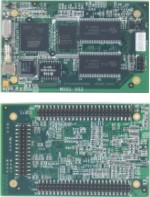
M-501
ARM-9 Web Server OEM CPU Board
78,00 EUR
including VAT 92.82 EUR
- ARM9 RISC Processor: Atmel AT91RM9200 ARM920T core running at 180MHz with integrated Memory Management Unit (MMU), delivering up to 200 MIPS performance.
- Linux-Ready Platform: Pre-installed Linux kernel 2.6.14 with U-Boot 1.1.2 bootloader and full file system support (JFFS2, EXT2/3, VFAT/FAT, NFS).
- Memory Architecture: 64MB SDRAM and 16MB NOR Flash (expandable to 32/64MB Flash options).
- Networking: Integrated 10/100Mbps Ethernet interface with DAVICOM DM9161 PHY and 1.5KV magnetic isolation.
- USB Connectivity: Two USB 2.0 full-speed (12Mbps) host ports for peripheral expansion (WiFi, flash drives, modems, serial adapters).
- Serial Communication: Four UARTs supporting RS-232/422/485 modes, up to 921.6Kbps, with hardware flow control and 9-bit multi-drop mode on COM1.
- Digital I/O: 32 programmable GPIOs (3.3V CMOS compatible) with interrupt capability.
- External Bus Interface: 8-bit data and address bus with four chip selects for external peripheral expansion.
- Storage Expansion: SD/MMC interface compliant with SD 1.0 specification, supporting up to 4GB SD cards.
- Low Power Design: Typical consumption under 2.5W at 3.3VDC input.
- Industrial Reliability: Fanless, flash-based architecture for 24/7 operation; operating temperature 0–70°C (M-501) or -20–80°C (M-501T).
- Development Support: Includes GNU C/C++ cross-compilation toolchain for Linux and Windows (Cygwin environment).
- Compact Form Factor: 80mm x 50mm SoM with 2.0mm pitch connectors for easy integration into OEM designs.
- Linux-Ready Platform: Pre-installed Linux kernel 2.6.14 with U-Boot 1.1.2 bootloader and full file system support (JFFS2, EXT2/3, VFAT/FAT, NFS).
- Memory Architecture: 64MB SDRAM and 16MB NOR Flash (expandable to 32/64MB Flash options).
- Networking: Integrated 10/100Mbps Ethernet interface with DAVICOM DM9161 PHY and 1.5KV magnetic isolation.
- USB Connectivity: Two USB 2.0 full-speed (12Mbps) host ports for peripheral expansion (WiFi, flash drives, modems, serial adapters).
- Serial Communication: Four UARTs supporting RS-232/422/485 modes, up to 921.6Kbps, with hardware flow control and 9-bit multi-drop mode on COM1.
- Digital I/O: 32 programmable GPIOs (3.3V CMOS compatible) with interrupt capability.
- External Bus Interface: 8-bit data and address bus with four chip selects for external peripheral expansion.
- Storage Expansion: SD/MMC interface compliant with SD 1.0 specification, supporting up to 4GB SD cards.
- Low Power Design: Typical consumption under 2.5W at 3.3VDC input.
- Industrial Reliability: Fanless, flash-based architecture for 24/7 operation; operating temperature 0–70°C (M-501) or -20–80°C (M-501T).
- Development Support: Includes GNU C/C++ cross-compilation toolchain for Linux and Windows (Cygwin environment).
- Compact Form Factor: 80mm x 50mm SoM with 2.0mm pitch connectors for easy integration into OEM designs.
1. Product Overview
Product Name: M-501
Model: M-501 / M-501T (wide temperature version)
Series: ARM-9 Web Server OEM CPU Board / Matrix-500 Embedded Platform
Article Number: M-501
Manufacturer: Artila Electronics Co., Ltd. (www.artila.com)
The Artila M-501 is a compact, Linux-ready ARM9-based System-on-Module (SoM) designed for OEM and embedded industrial applications. It serves as the core CPU board for Artila’s Matrix-500 series of industrial embedded computers. The M-501 integrates an Atmel AT91RM9200 ARM920T processor, 64MB SDRAM, and 16MB NOR Flash memory, providing a complete embedded computing platform for web server, data acquisition, and control applications. It is optimized for low power consumption, high reliability, and 24/7 operation in industrial environments.
2. Key Features
- ARM9 RISC Processor: Atmel AT91RM9200 ARM920T core running at 180MHz with integrated Memory Management Unit (MMU), delivering up to 200 MIPS performance.
- Linux-Ready Platform: Pre-installed Linux kernel 2.6.14 with U-Boot 1.1.2 bootloader and full file system support (JFFS2, EXT2/3, VFAT/FAT, NFS).
- Memory Architecture: 64MB SDRAM and 16MB NOR Flash (expandable to 32/64MB Flash options).
- Networking: Integrated 10/100Mbps Ethernet interface with DAVICOM DM9161 PHY and 1.5KV magnetic isolation.
- USB Connectivity: Two USB 2.0 full-speed (12Mbps) host ports for peripheral expansion (WiFi, flash drives, modems, serial adapters).
- Serial Communication: Four UARTs supporting RS-232/422/485 modes, up to 921.6Kbps, with hardware flow control and 9-bit multi-drop mode on COM1.
- Digital I/O: 32 programmable GPIOs (3.3V CMOS compatible) with interrupt capability.
- External Bus Interface: 8-bit data and address bus with four chip selects for external peripheral expansion.
- Storage Expansion: SD/MMC interface compliant with SD 1.0 specification, supporting up to 4GB SD cards.
- Low Power Design: Typical consumption under 2.5W at 3.3VDC input.
- Industrial Reliability: Fanless, flash-based architecture for 24/7 operation; operating temperature 0–70°C (M-501) or -20–80°C (M-501T).
- Development Support: Includes GNU C/C++ cross-compilation toolchain for Linux and Windows (Cygwin environment).
- Compact Form Factor: 80mm x 50mm SoM with 2.0mm pitch connectors for easy integration into OEM designs.
3. Technical Specifications
Processor & Memory
- CPU: Atmel AT91RM9200 ARM920T (ARM9 core)
- Clock Speed: 180MHz
- Performance: 200 MIPS
- Cache: 16KB instruction + 16KB data cache
- SDRAM: 64MB
- Flash Memory: 16MB NOR Flash (Intel StrataFlash or equivalent)
- EEPROM: Supports AT24C16 (via I²C)
- Real-Time Clock: Ricoh RS5C372 supported
Networking
- Ethernet: 1 x 10/100Mbps (RJ45)
- PHY: DAVICOM DM9161
- Isolation: 1.5KV magnetic isolation
Serial Interfaces (UARTs)
- Total Ports: 4
- COM1: RS-232/422/485 (software selectable)
- COM2: RS-232 with full modem control (DCD, DTR, DSR)
- COM3 & COM4: RS-232 with RTS/CTS flow control
- Baud Rate: Up to 921.6Kbps
- Data Bits: 5–9 bits
- Parity: None, Even, Odd, Mark, Space
- Stop Bits: 1, 1.5, 2
- Flow Control: RTS/CTS, XON/XOFF, None
- Signal Level: CMOS 3.3V compatible
USB Interfaces
- Host Ports: 2 x USB 2.0 full-speed (12Mbps)
- Supported Devices: Flash drives, WiFi adapters (Ralink RT73), Ethernet adapters (RT8150), RS-232 adapters (PL-2303), modems (CDC/ACM).
I/O and Expansion
- GPIO: 32 programmable digital I/Os (CMOS 3.3V)
- External Bus: 8-bit data (D0–D7), 8-bit address (A0–A7), 4 chip selects (CS3–CS6)
- SPI: MISO, MOSI, SPCK, CS1, CS2
- I²C: TWD, TWCK
- I²S: TSCK, TWS, TSD (TX); RSCK, RWS, RSD (RX)
- SD/MMC: MCCDA, MCCK, MCDA0–MCDA3 (SD 1.0 compliant)
- Watchdog Timer: Built-in, used by Linux kernel
Power & Environmental
- Input Voltage: 3.0–3.6VDC (nominal 3.3V)
- Power Consumption: <2.5W
- Operating Temperature:
- M-501: 0°C to 70°C
- M-501T: -20°C to 80°C
- Humidity: 5–95% RH non-condensing
- Dimensions: 80mm (W) x 50mm (H)
- Mounting: 4 x M2 holes
- Connectors: CN1 (28-pin), CN2 (50-pin), CN3 (50-pin), 2.0mm pitch
4. Functionality
The M-501 functions as a complete embedded Linux computing module for OEM integration. It boots from onboard NOR Flash using U-Boot, loads the Linux 2.6.14 kernel, and mounts a JFFS2 or EXT2/3 file system. The system provides a full TCP/IP stack, web server (lighttpd/boa), SSH, FTP, and Telnet services, enabling remote management and web-based control.
Use Cases & Applications:
- Industrial automation controllers
- Embedded web servers and gateways
- Remote data acquisition and logging
- Distributed control systems
- Networked instrumentation
- IoT edge computing nodes
Compatibility:
- Compatible with Artila Matrix-500/510/520 carrier boards
- Supports standard Linux networking and serial communication protocols
- Works with USB peripherals and SD storage devices
5. Components & Accessories
Included Items:
- M-501 System-on-Module
- Artila CD containing:
- GNU C/C++ toolchain for Linux and Windows (Cygwin)
- Installation guides and example programs
- Utility software (update, setuart, manager.jar)
Optional Accessories:
- CB-RJ45F9-150: RJ45 to DB9 Female Cable
- CB-RJ2CON-100: Serial Console Cable
- DK-35A: DIN Rail Mounting Kit
- PWR-12V-1A: 110–240VAC to 12VDC Power Adapter
- M-501 Starter Kit: Includes carrier board with power circuitry, 3x RS-232, 1x RS-232/422/485, Ethernet, USB, SD socket, GPIO connectors, RTC, EEPROM, and local bus connector
6. Installation & Setup
Hardware Integration:
The M-501 is designed for direct integration into OEM carrier boards via its 2.0mm pitch connectors. The module provides all necessary signals for power, Ethernet, serial, USB, GPIO, and external bus interfaces.
Power Requirements:
Supply regulated 3.3VDC (±10%) to the power pins. Typical consumption is 2W.
Mounting:
Four M2 mounting holes are provided for mechanical fixation.
Configuration:
- Default IP: 192.168.2.127
- Default Login:
- SSH: root / root
- Telnet: guest / guest
- Serial Console: Disabled by default; can be enabled via special cable (CB-RJ2CON-100) connected to Port 3 (ttyS3).
- Serial Console Settings: 115200 baud, 8N1, VT100 terminal.
Network Setup:
Static IP configuration via `/disk/etc/rc`:
`ifconfig eth0 192.168.2.127 netmask 255.255.255.0`
For DHCP: `dhcpcd eth0 &`
Wireless LAN Setup:
Supports USB WLAN adapters using Ralink RT2571/RT73 chipset.
Commands:
```
modprobe rt73
ifconfig wlan0 up
iwconfig wlan0 essid <SSID> key <KEY> mode managed
dhcpcd wlan0 &
```
7. Performance & Capabilities
- Processing Speed: 180MHz ARM9 core, 200 MIPS
- Memory Bandwidth: 64MB SDRAM, optimized for Linux multitasking
- Networking: 10/100Mbps Ethernet throughput with full TCP/IP stack
- Serial Communication: Up to 921.6Kbps per UART; COM1 supports RS-485 multi-drop mode
- USB Performance: Full-speed 12Mbps host operation
- Storage: 16MB NOR Flash (expandable), SD card up to 4GB
- Power Efficiency: <2.5W typical, suitable for fanless operation
- Reliability: Flash-based, no moving parts, designed for continuous operation
Limitations:
- No hardware floating-point unit (software emulation only)
- Limited onboard Flash storage (user applications stored in /disk partition)
- SD interface compliant with SD 1.0 specification only
8. Standards & Compliance
- Operating System: Linux kernel 2.6.14
- Bootloader: U-Boot 1.1.2
- File Systems: JFFS2, EXT2/3, VFAT/FAT, NFS
- Network Protocols: IPv4, ICMP, ARP, DHCP, NTP, TCP, UDP, FTP, Telnet, HTTP, PPP, PPPoE, CHAP, PAP, SMTP, SNMP v1/v3, SSL, SSH 1/2
- Regulatory Compliance: CE Class A, FCC Class A
- Electrical Standards: 3.3V CMOS logic levels, 1.5KV Ethernet isolation
- Environmental Standards: Industrial temperature range (M-501T)
- Software Tools: GNU GCC, GLIBC, GDB, BusyBox, Tinylogin, iptables, pppd, boa, sshd, snmpd
9. Additional Information
Warranty & Support:
Artila provides standard warranty coverage for manufacturing defects and offers technical support via documentation, online resources, and firmware updates.
Maintenance:
- Use the `update` utility to refresh loader, kernel, or root file system images.
- To restore factory defaults: `/update --FORMAT` (erases user disk).
- Backup user data to USB or SD before formatting.
Software Updates:
Firmware and kernel updates are available from Artila’s website. The `update` command supports image replacement and flash formatting.
Development Environment:
- Linux Toolchain: arm-linux-gcc cross compiler, GLIBC POSIX library.
- Windows Toolchain: Cygwin-based cross compiler (arm-linux-cygwin.zip).
- Example Programs: Provided on Artila CD under `/Matrix500/examples`.
- Compilation Example:
```
arm-linux-gcc -o hello hello.c
ftp 192.168.2.127
chmod +x hello
./hello
```
Revision History:
- Rev 1.0 (2006/10/17): Initial release
- Rev 1.1 (2007/09/10): Hardware modification (CN3 pin 38 remapped from PC6 to PB22 for improved I/O reliability)
Ordering Information:
- M-501: Standard temperature version (0–70°C)
- M-501T: Wide temperature version (-20–80°C)
- M-501 Starter Kit: Includes carrier board and accessories
Summary
The Artila M-501 ARM9 Web Server OEM CPU Board is a robust, Linux-ready embedded computing module optimized for industrial and OEM applications. With its ARM920T processor, integrated Ethernet, multiple serial interfaces, USB expansion, and SD storage, it provides a flexible foundation for networked control, data acquisition, and embedded web applications. Its pre-installed Linux OS, open-source toolchain, and low power design make it ideal for developers seeking a reliable, compact, and easily deployable embedded platform.
Product Name: M-501
Model: M-501 / M-501T (wide temperature version)
Series: ARM-9 Web Server OEM CPU Board / Matrix-500 Embedded Platform
Article Number: M-501
Manufacturer: Artila Electronics Co., Ltd. (www.artila.com)
The Artila M-501 is a compact, Linux-ready ARM9-based System-on-Module (SoM) designed for OEM and embedded industrial applications. It serves as the core CPU board for Artila’s Matrix-500 series of industrial embedded computers. The M-501 integrates an Atmel AT91RM9200 ARM920T processor, 64MB SDRAM, and 16MB NOR Flash memory, providing a complete embedded computing platform for web server, data acquisition, and control applications. It is optimized for low power consumption, high reliability, and 24/7 operation in industrial environments.
2. Key Features
- ARM9 RISC Processor: Atmel AT91RM9200 ARM920T core running at 180MHz with integrated Memory Management Unit (MMU), delivering up to 200 MIPS performance.
- Linux-Ready Platform: Pre-installed Linux kernel 2.6.14 with U-Boot 1.1.2 bootloader and full file system support (JFFS2, EXT2/3, VFAT/FAT, NFS).
- Memory Architecture: 64MB SDRAM and 16MB NOR Flash (expandable to 32/64MB Flash options).
- Networking: Integrated 10/100Mbps Ethernet interface with DAVICOM DM9161 PHY and 1.5KV magnetic isolation.
- USB Connectivity: Two USB 2.0 full-speed (12Mbps) host ports for peripheral expansion (WiFi, flash drives, modems, serial adapters).
- Serial Communication: Four UARTs supporting RS-232/422/485 modes, up to 921.6Kbps, with hardware flow control and 9-bit multi-drop mode on COM1.
- Digital I/O: 32 programmable GPIOs (3.3V CMOS compatible) with interrupt capability.
- External Bus Interface: 8-bit data and address bus with four chip selects for external peripheral expansion.
- Storage Expansion: SD/MMC interface compliant with SD 1.0 specification, supporting up to 4GB SD cards.
- Low Power Design: Typical consumption under 2.5W at 3.3VDC input.
- Industrial Reliability: Fanless, flash-based architecture for 24/7 operation; operating temperature 0–70°C (M-501) or -20–80°C (M-501T).
- Development Support: Includes GNU C/C++ cross-compilation toolchain for Linux and Windows (Cygwin environment).
- Compact Form Factor: 80mm x 50mm SoM with 2.0mm pitch connectors for easy integration into OEM designs.
3. Technical Specifications
Processor & Memory
- CPU: Atmel AT91RM9200 ARM920T (ARM9 core)
- Clock Speed: 180MHz
- Performance: 200 MIPS
- Cache: 16KB instruction + 16KB data cache
- SDRAM: 64MB
- Flash Memory: 16MB NOR Flash (Intel StrataFlash or equivalent)
- EEPROM: Supports AT24C16 (via I²C)
- Real-Time Clock: Ricoh RS5C372 supported
Networking
- Ethernet: 1 x 10/100Mbps (RJ45)
- PHY: DAVICOM DM9161
- Isolation: 1.5KV magnetic isolation
Serial Interfaces (UARTs)
- Total Ports: 4
- COM1: RS-232/422/485 (software selectable)
- COM2: RS-232 with full modem control (DCD, DTR, DSR)
- COM3 & COM4: RS-232 with RTS/CTS flow control
- Baud Rate: Up to 921.6Kbps
- Data Bits: 5–9 bits
- Parity: None, Even, Odd, Mark, Space
- Stop Bits: 1, 1.5, 2
- Flow Control: RTS/CTS, XON/XOFF, None
- Signal Level: CMOS 3.3V compatible
USB Interfaces
- Host Ports: 2 x USB 2.0 full-speed (12Mbps)
- Supported Devices: Flash drives, WiFi adapters (Ralink RT73), Ethernet adapters (RT8150), RS-232 adapters (PL-2303), modems (CDC/ACM).
I/O and Expansion
- GPIO: 32 programmable digital I/Os (CMOS 3.3V)
- External Bus: 8-bit data (D0–D7), 8-bit address (A0–A7), 4 chip selects (CS3–CS6)
- SPI: MISO, MOSI, SPCK, CS1, CS2
- I²C: TWD, TWCK
- I²S: TSCK, TWS, TSD (TX); RSCK, RWS, RSD (RX)
- SD/MMC: MCCDA, MCCK, MCDA0–MCDA3 (SD 1.0 compliant)
- Watchdog Timer: Built-in, used by Linux kernel
Power & Environmental
- Input Voltage: 3.0–3.6VDC (nominal 3.3V)
- Power Consumption: <2.5W
- Operating Temperature:
- M-501: 0°C to 70°C
- M-501T: -20°C to 80°C
- Humidity: 5–95% RH non-condensing
- Dimensions: 80mm (W) x 50mm (H)
- Mounting: 4 x M2 holes
- Connectors: CN1 (28-pin), CN2 (50-pin), CN3 (50-pin), 2.0mm pitch
4. Functionality
The M-501 functions as a complete embedded Linux computing module for OEM integration. It boots from onboard NOR Flash using U-Boot, loads the Linux 2.6.14 kernel, and mounts a JFFS2 or EXT2/3 file system. The system provides a full TCP/IP stack, web server (lighttpd/boa), SSH, FTP, and Telnet services, enabling remote management and web-based control.
Use Cases & Applications:
- Industrial automation controllers
- Embedded web servers and gateways
- Remote data acquisition and logging
- Distributed control systems
- Networked instrumentation
- IoT edge computing nodes
Compatibility:
- Compatible with Artila Matrix-500/510/520 carrier boards
- Supports standard Linux networking and serial communication protocols
- Works with USB peripherals and SD storage devices
5. Components & Accessories
Included Items:
- M-501 System-on-Module
- Artila CD containing:
- GNU C/C++ toolchain for Linux and Windows (Cygwin)
- Installation guides and example programs
- Utility software (update, setuart, manager.jar)
Optional Accessories:
- CB-RJ45F9-150: RJ45 to DB9 Female Cable
- CB-RJ2CON-100: Serial Console Cable
- DK-35A: DIN Rail Mounting Kit
- PWR-12V-1A: 110–240VAC to 12VDC Power Adapter
- M-501 Starter Kit: Includes carrier board with power circuitry, 3x RS-232, 1x RS-232/422/485, Ethernet, USB, SD socket, GPIO connectors, RTC, EEPROM, and local bus connector
6. Installation & Setup
Hardware Integration:
The M-501 is designed for direct integration into OEM carrier boards via its 2.0mm pitch connectors. The module provides all necessary signals for power, Ethernet, serial, USB, GPIO, and external bus interfaces.
Power Requirements:
Supply regulated 3.3VDC (±10%) to the power pins. Typical consumption is 2W.
Mounting:
Four M2 mounting holes are provided for mechanical fixation.
Configuration:
- Default IP: 192.168.2.127
- Default Login:
- SSH: root / root
- Telnet: guest / guest
- Serial Console: Disabled by default; can be enabled via special cable (CB-RJ2CON-100) connected to Port 3 (ttyS3).
- Serial Console Settings: 115200 baud, 8N1, VT100 terminal.
Network Setup:
Static IP configuration via `/disk/etc/rc`:
`ifconfig eth0 192.168.2.127 netmask 255.255.255.0`
For DHCP: `dhcpcd eth0 &`
Wireless LAN Setup:
Supports USB WLAN adapters using Ralink RT2571/RT73 chipset.
Commands:
```
modprobe rt73
ifconfig wlan0 up
iwconfig wlan0 essid <SSID> key <KEY> mode managed
dhcpcd wlan0 &
```
7. Performance & Capabilities
- Processing Speed: 180MHz ARM9 core, 200 MIPS
- Memory Bandwidth: 64MB SDRAM, optimized for Linux multitasking
- Networking: 10/100Mbps Ethernet throughput with full TCP/IP stack
- Serial Communication: Up to 921.6Kbps per UART; COM1 supports RS-485 multi-drop mode
- USB Performance: Full-speed 12Mbps host operation
- Storage: 16MB NOR Flash (expandable), SD card up to 4GB
- Power Efficiency: <2.5W typical, suitable for fanless operation
- Reliability: Flash-based, no moving parts, designed for continuous operation
Limitations:
- No hardware floating-point unit (software emulation only)
- Limited onboard Flash storage (user applications stored in /disk partition)
- SD interface compliant with SD 1.0 specification only
8. Standards & Compliance
- Operating System: Linux kernel 2.6.14
- Bootloader: U-Boot 1.1.2
- File Systems: JFFS2, EXT2/3, VFAT/FAT, NFS
- Network Protocols: IPv4, ICMP, ARP, DHCP, NTP, TCP, UDP, FTP, Telnet, HTTP, PPP, PPPoE, CHAP, PAP, SMTP, SNMP v1/v3, SSL, SSH 1/2
- Regulatory Compliance: CE Class A, FCC Class A
- Electrical Standards: 3.3V CMOS logic levels, 1.5KV Ethernet isolation
- Environmental Standards: Industrial temperature range (M-501T)
- Software Tools: GNU GCC, GLIBC, GDB, BusyBox, Tinylogin, iptables, pppd, boa, sshd, snmpd
9. Additional Information
Warranty & Support:
Artila provides standard warranty coverage for manufacturing defects and offers technical support via documentation, online resources, and firmware updates.
Maintenance:
- Use the `update` utility to refresh loader, kernel, or root file system images.
- To restore factory defaults: `/update --FORMAT` (erases user disk).
- Backup user data to USB or SD before formatting.
Software Updates:
Firmware and kernel updates are available from Artila’s website. The `update` command supports image replacement and flash formatting.
Development Environment:
- Linux Toolchain: arm-linux-gcc cross compiler, GLIBC POSIX library.
- Windows Toolchain: Cygwin-based cross compiler (arm-linux-cygwin.zip).
- Example Programs: Provided on Artila CD under `/Matrix500/examples`.
- Compilation Example:
```
arm-linux-gcc -o hello hello.c
ftp 192.168.2.127
chmod +x hello
./hello
```
Revision History:
- Rev 1.0 (2006/10/17): Initial release
- Rev 1.1 (2007/09/10): Hardware modification (CN3 pin 38 remapped from PC6 to PB22 for improved I/O reliability)
Ordering Information:
- M-501: Standard temperature version (0–70°C)
- M-501T: Wide temperature version (-20–80°C)
- M-501 Starter Kit: Includes carrier board and accessories
Summary
The Artila M-501 ARM9 Web Server OEM CPU Board is a robust, Linux-ready embedded computing module optimized for industrial and OEM applications. With its ARM920T processor, integrated Ethernet, multiple serial interfaces, USB expansion, and SD storage, it provides a flexible foundation for networked control, data acquisition, and embedded web applications. Its pre-installed Linux OS, open-source toolchain, and low power design make it ideal for developers seeking a reliable, compact, and easily deployable embedded platform.
-
 M-501_Datasheet.pdf
PDF Catalog
M-501_Datasheet.pdf
PDF Catalog
-
 M501_user_guide_V2.pdf
Manual
M501_user_guide_V2.pdf
Manual
-
 Matrix 500 Data Sheet.pdf
Manual
Matrix 500 Data Sheet.pdf
Manual
-
 Enable Serial Console3.pdf
Manual
Enable Serial Console3.pdf
Manual
-
 Serial Console Cable.pdf
Manual
Serial Console Cable.pdf
Manual


No accessories available.