 LOOKING FOR THE RIGHT
INDUSTRIAL SOLUTION?
Discover embedded, communication and automation solutions tailored to your application.
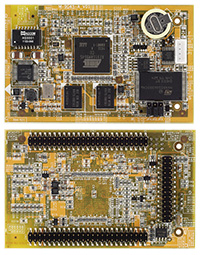
- Processor: Atmel AT91SAM9G45 ARM9 CPU, 400 MHz with Memory Management Unit (MMU).
- Operating System: Linux kernel 2.6.38 pre‑installed with U‑Boot bootloader.
- Memory: 128 MB DDR2 SDRAM, 256 MB NAND Flash, and 2 MB DataFlash® for system backup.
- Compact Form Factor: SoM dimensions 50 × 80 mm; carrier board designed for direct integration.
- Low Power Consumption: Typical power usage below 2.5 W.
- Display Support: 24‑bit TTL LCD interface with dimming control; supports TFT panels up to 1280 × 860 pixels.
- Touchscreen Interface: 4‑wire resistive touchscreen support.
- Networking: Integrated 10/100 Mbps Ethernet with on‑board PHY (DAVICOM DM9161) and 1.5 kV magnetic isolation.
- Multiple Serial Interfaces: Four UARTs supporting up to 921.6 kbps with full modem control signals.
- USB Connectivity: One USB 2.0 host port and one USB 2.0 device (client) port, both supporting 480 Mbps high‑speed mode.
- Peripheral Interfaces: I²C, I²S, SPI, SD/MMC, GPIO, AC97 audio, and watchdog timers.
- Real‑Time Clock: ST M41T81 RTC with on‑board 48 mAh lithium backup battery and external battery input.
- Software Ecosystem: Pre‑installed Linux utilities, web server, SSH, FTP, and package management via IPKG.
- Development Tools: GNU C/C++ cross‑compiler toolchain, GTK+, X11, GPE, and Qt4‑Embedded GUI support.
- Expansion and Debugging: RS‑232 console port, GPIO headers, and local bus connectors for peripheral expansion.
- Starter Kit Availability: Includes SoM, carrier board, power circuitry, and all essential I/O interfaces.
- Operating System: Linux kernel 2.6.38 pre‑installed with U‑Boot bootloader.
- Memory: 128 MB DDR2 SDRAM, 256 MB NAND Flash, and 2 MB DataFlash® for system backup.
- Compact Form Factor: SoM dimensions 50 × 80 mm; carrier board designed for direct integration.
- Low Power Consumption: Typical power usage below 2.5 W.
- Display Support: 24‑bit TTL LCD interface with dimming control; supports TFT panels up to 1280 × 860 pixels.
- Touchscreen Interface: 4‑wire resistive touchscreen support.
- Networking: Integrated 10/100 Mbps Ethernet with on‑board PHY (DAVICOM DM9161) and 1.5 kV magnetic isolation.
- Multiple Serial Interfaces: Four UARTs supporting up to 921.6 kbps with full modem control signals.
- USB Connectivity: One USB 2.0 host port and one USB 2.0 device (client) port, both supporting 480 Mbps high‑speed mode.
- Peripheral Interfaces: I²C, I²S, SPI, SD/MMC, GPIO, AC97 audio, and watchdog timers.
- Real‑Time Clock: ST M41T81 RTC with on‑board 48 mAh lithium backup battery and external battery input.
- Software Ecosystem: Pre‑installed Linux utilities, web server, SSH, FTP, and package management via IPKG.
- Development Tools: GNU C/C++ cross‑compiler toolchain, GTK+, X11, GPE, and Qt4‑Embedded GUI support.
- Expansion and Debugging: RS‑232 console port, GPIO headers, and local bus connectors for peripheral expansion.
- Starter Kit Availability: Includes SoM, carrier board, power circuitry, and all essential I/O interfaces.
Comprehensive Product Summary: M‑9G45A‑Carrier‑Board
### 1. Product Overview
Product Name: M‑9G45A‑Carrier‑Board
Article Number: M‑9G45A‑Carrier‑Board
Model: M‑9G45A
Series: M‑9G45A Evaluation and Development Platform
Manufacturer: Artila Electronics Co., Ltd.
Product Type: Evaluation Board for M‑9G45‑A System‑on‑Module (SoM)
Power Input Range: 5 – 40 V DC (Carrier Board) / 3 – 3.6 V DC (SoM)
Primary Purpose: Hardware evaluation and application development platform for the Artila M‑9G45‑A Linux‑ready ARM9 System‑on‑Module.
The M‑9G45A‑Carrier‑Board is a fully featured evaluation and development platform designed to support the M‑9G45‑A SoM. It provides all necessary interfaces, connectors, and peripheral support to evaluate the performance of the AT91SAM9G45‑based embedded Linux system. The board integrates power regulation, communication ports, display interfaces, and expansion connectors, enabling rapid prototyping and system integration for industrial, automation, and embedded control applications.
### 2. Key Features
- Processor: Atmel AT91SAM9G45 ARM9 CPU, 400 MHz with Memory Management Unit (MMU).
- Operating System: Linux kernel 2.6.38 pre‑installed with U‑Boot bootloader.
- Memory: 128 MB DDR2 SDRAM, 256 MB NAND Flash, and 2 MB DataFlash® for system backup.
- Compact Form Factor: SoM dimensions 50 × 80 mm; carrier board designed for direct integration.
- Low Power Consumption: Typical power usage below 2.5 W.
- Display Support: 24‑bit TTL LCD interface with dimming control; supports TFT panels up to 1280 × 860 pixels.
- Touchscreen Interface: 4‑wire resistive touchscreen support.
- Networking: Integrated 10/100 Mbps Ethernet with on‑board PHY (DAVICOM DM9161) and 1.5 kV magnetic isolation.
- Multiple Serial Interfaces: Four UARTs supporting up to 921.6 kbps with full modem control signals.
- USB Connectivity: One USB 2.0 host port and one USB 2.0 device (client) port, both supporting 480 Mbps high‑speed mode.
- Peripheral Interfaces: I²C, I²S, SPI, SD/MMC, GPIO, AC97 audio, and watchdog timers.
- Real‑Time Clock: ST M41T81 RTC with on‑board 48 mAh lithium backup battery and external battery input.
- Software Ecosystem: Pre‑installed Linux utilities, web server, SSH, FTP, and package management via IPKG.
- Development Tools: GNU C/C++ cross‑compiler toolchain, GTK+, X11, GPE, and Qt4‑Embedded GUI support.
- Expansion and Debugging: RS‑232 console port, GPIO headers, and local bus connectors for peripheral expansion.
- Starter Kit Availability: Includes SoM, carrier board, power circuitry, and all essential I/O interfaces.
### 3. Technical Specifications
Processor and Memory
- CPU: Atmel AT91SAM9G45, ARM926EJ‑S core, 400 MHz
- Memory: 128 MB DDR2 SDRAM
- Flash Storage: 256 MB NAND Flash
- Backup Storage: 2 MB DataFlash®
- Power Consumption: Typical 2 W at 3.3 V DC
Electrical Characteristics
- SoM Input Voltage: 3 – 3.6 V DC (nominal 3.3 V)
- Carrier Board Input Voltage: 9 – 30 V DC (supports 5 – 40 V DC range)
- Isolation: 1.5 kV magnetic isolation on Ethernet interface
Physical Dimensions
- SoM: 80 mm (W) × 50 mm (H)
- Mounting Holes: 2 × M2 (2.0 mm diameter)
- Connector Pitch: 2.0 mm (CN1: 28 pins, CN2: 50 pins, CN3: 50 pins; total 128 pins)
Materials and Build
- PCB: Multi‑layer FR‑4 industrial‑grade board
- Connectors: DF13, FFC, and box headers for robust mechanical connection
### 4. Functionality
The M‑9G45A‑Carrier‑Board functions as a complete evaluation platform for the M‑9G45‑A SoM. It provides regulated power, signal routing, and peripheral connectivity to enable developers to test and deploy embedded Linux applications.
Primary Use Cases:
- Industrial automation controllers
- Human‑machine interfaces (HMI)
- Networked data acquisition systems
- Embedded gateways and communication devices
- Educational and research platforms for ARM‑based Linux systems
Operation Overview:
The SoM mounts onto the carrier board via three high‑density connectors (CN1–CN3). The carrier board distributes power, exposes I/O interfaces, and provides connectors for Ethernet, USB, serial ports, LCD, and GPIO. The Linux OS boots from NAND Flash via U‑Boot, with file systems supported on NAND, SD, or network (NFS). Developers can access the system through the RS‑232 console or network interfaces for configuration and software deployment.
Compatibility:
- Compatible with standard TFT LCD panels (TTL or LVDS)
- Supports SD 2.0 memory cards up to 32 GB
- USB host supports flash drives, Wi‑Fi adapters, webcams, keyboards, mice, and modems
- USB device mode supports PC connectivity for data exchange or firmware updates
### 5. Components & Accessories
Included Components (Starter Kit):
- M‑9G45A SoM (AT91SAM9G45 + Linux 2.6.38)
- Carrier Board with integrated power circuitry
- 1 × RS‑485 port
- 3 × RS‑232 ports
- 1 × Ethernet port (10/100 Mbps)
- 4 × USB 2.0 host ports
- 1 × USB 2.0 client port
- 1 × microSD socket
- Real‑Time Clock (ST M41T81)
- EEPROM (AT24C16 compatible)
- Local bus connector for expansion
Optional Accessories:
- LCD panels (TTL or LVDS interface)
- 4‑wire resistive touchscreen
- External RTC battery (3 V CR2032)
- Power adapter (9 – 30 V DC)
- Audio input/output cables
- RS‑232/RS‑485 cables
- USB peripherals (Wi‑Fi, Bluetooth, 3G, etc.)
Connectors and Interfaces:
- CN6: 40‑pin DF13 LCD CMOS interface
- CN7: 40‑pin FFC LCD CMOS + Touchscreen interface
- CN11: 30‑pin DF13 LCD LVDS interface
- CN8/CN9: LCD backlight control (12 V / 5 V)
- CN14: 20‑pin GPIO header
- CN16/CN17/CN18: RS‑232 ports
- J5: RS‑485 terminal block
- J1: Ethernet RJ‑45 port
- CN13/CN15: USB host/client connectors
- J2: Power input terminal
- J3/J4: Audio output/input jacks
- JP1–JP4: Configuration jumpers for PWM, ON/OFF voltage, and audio output selection
### 6. Installation & Setup
Power Requirements:
- Supply voltage: 9 – 30 V DC (recommended 12 V DC)
- Power input via J2 terminal block
- Ensure correct backlight voltage selection (5 V or 12 V) via CN8/CN9 jumpers to prevent hardware damage.
Mounting Options:
- Two M2 mounting holes for secure installation in enclosures or test fixtures.
- Compact 80 × 50 mm SoM footprint allows integration into custom carrier boards.
Configuration and Setup:
- Default Ethernet IP: 192.168.2.127
- Serial Console: RS‑232, 115200 bps, 8N1, VT100 terminal
- LCD default resolution: 800 × 480 pixels
- Bootloader: U‑Boot (supports boot from NAND, SD, or network)
- Software configuration via SSH, Telnet, or Webmin web interface.
- Package management through IPKG for installing or upgrading software modules.
Development Environment:
- Cross‑compilation supported via GNU GCC toolchain.
- GUI development supported with GTK+, X11, GPE, and Qt4‑Embedded.
- Source code deployment via FTP, SCP, or USB storage.
### 7. Performance & Capabilities
Processing Performance:
- 400 MHz ARM9 core optimized for embedded Linux multitasking.
- Hardware MMU enables full Linux kernel operation with virtual memory.
Networking:
- 10/100 Mbps Ethernet with integrated PHY and transformer ensures reliable connectivity.
- Supports TCP/IP, SSH, FTP, HTTP, SNMP, and other standard network protocols.
Storage and File Systems:
- NAND Flash (256 MB) for OS and application storage.
- SD Card interface supports up to 32 GB removable storage.
- Supported file systems: UBI, JFFS2, EXT2/EXT3, VFAT/FAT, NFS, NTFS.
Serial Communication:
- Four UARTs with configurable baud rates up to 921.6 kbps.
- Supports parity (None, Even, Odd, Mark, Space), data bits (5–8), stop bits (1–2), and flow control (RTS/CTS, XON/XOFF).
USB Performance:
- USB 2.0 high‑speed (480 Mbps) host and device modes.
- Supports mass storage, network adapters, modems, and HID devices.
Display and Graphics:
- 24‑bit RGB TTL interface for high‑color TFT panels.
- LVDS output via CN11 for long‑distance or high‑resolution displays.
- Dimming and backlight control via PWM (JP1/JP2 configurable for 3.3 V or 5 V).
- Touchscreen interface supports 4‑wire resistive panels.
Audio:
- AC97 interface with selectable line‑out or earphone output (JP3/JP4).
- Audio input via J4 connector.
Reliability and Monitoring:
- Dual watchdog timers (CPU and user‑programmable).
- System Ready and LAN Activity LEDs for status indication.
- On‑board buzzer for system alerts.
Limitations:
- Single‑core ARM9 architecture limits heavy multitasking or high‑definition multimedia.
- Maximum display resolution 1280 × 860 pixels.
- USB limited to 2.0 standard (no USB 3.0 support).
### 8. Standards & Compliance
Electrical and Interface Standards:
- Ethernet: IEEE 802.3 10/100 Base‑T compliant
- USB: USB 2.0 High‑Speed compliant
- SD Card: SD Specification 2.0 compliant
- UART: RS‑232/RS‑485 standard signal levels
- GPIO: CMOS 3.3 V logic compatible
Software and OS Standards:
- Linux 2.6.38 kernel (POSIX compliant)
- GNU C/C++ toolchain (GCC, GLIBC)
- IPKG package management system
- Webmin for web‑based system administration
Regulatory and Safety:
- Designed for industrial temperature and voltage ranges
- 1.5 kV isolation on Ethernet for surge protection
- Conforms to RoHS environmental standards (lead‑free manufacturing)
### 9. Additional Information
Warranty and Support:
- Standard manufacturer warranty (typically 1 year, extendable depending on region).
- Technical support available via Artila’s online portal and documentation resources.
- Firmware updates and Linux kernel patches provided through Artila’s website.
Maintenance:
- Minimal maintenance required; ensure clean power supply and proper ventilation.
- Replace RTC backup battery (CR2032) periodically to maintain timekeeping.
- Regularly update software packages via IPKG or Webmin.
Software Updates and Customization:
- Linux kernel and root filesystem can be customized for specific applications.
- USB drivers and device support can be extended through kernel modules.
- Supports remote firmware updates via network or USB.
Documentation and Resources:
- Hardware Guide: M‑9G45A‑EV Hardware Manual
- Connector Reference: CSI‑4585‑400R (CN6), CSI‑4585‑300R (CN11), CSF‑2481‑401R (CN7)
- Online resources: [www.artila.com](http://www.artila.com)
Ordering Information:
- M‑9G45A: SoM with AT91SAM9G45, 128 MB DDR2, 256 MB NAND Flash, Linux 2.6.38.
- M‑9G45A Starter Kit: Includes SoM, carrier board, power circuitry, Ethernet, USB, RS‑232/RS‑485, RTC, EEPROM, and expansion connectors.
### Summary
The Artila M‑9G45A‑Carrier‑Board is a robust, Linux‑ready evaluation platform engineered for the M‑9G45‑A System‑on‑Module, built around the Atmel AT91SAM9G45 ARM9 processor. It combines industrial‑grade hardware design with a comprehensive Linux software stack, offering developers a complete environment for embedded system prototyping and deployment. With its extensive I/O options—Ethernet, USB, UART, SPI, I²C, GPIO, and display interfaces—it supports a wide range of applications from industrial control to networked embedded devices. The board’s low power consumption, compact footprint, and flexible configuration make it an ideal choice for OEMs and developers seeking a reliable ARM9‑based Linux platform.
### 1. Product Overview
Product Name: M‑9G45A‑Carrier‑Board
Article Number: M‑9G45A‑Carrier‑Board
Model: M‑9G45A
Series: M‑9G45A Evaluation and Development Platform
Manufacturer: Artila Electronics Co., Ltd.
Product Type: Evaluation Board for M‑9G45‑A System‑on‑Module (SoM)
Power Input Range: 5 – 40 V DC (Carrier Board) / 3 – 3.6 V DC (SoM)
Primary Purpose: Hardware evaluation and application development platform for the Artila M‑9G45‑A Linux‑ready ARM9 System‑on‑Module.
The M‑9G45A‑Carrier‑Board is a fully featured evaluation and development platform designed to support the M‑9G45‑A SoM. It provides all necessary interfaces, connectors, and peripheral support to evaluate the performance of the AT91SAM9G45‑based embedded Linux system. The board integrates power regulation, communication ports, display interfaces, and expansion connectors, enabling rapid prototyping and system integration for industrial, automation, and embedded control applications.
### 2. Key Features
- Processor: Atmel AT91SAM9G45 ARM9 CPU, 400 MHz with Memory Management Unit (MMU).
- Operating System: Linux kernel 2.6.38 pre‑installed with U‑Boot bootloader.
- Memory: 128 MB DDR2 SDRAM, 256 MB NAND Flash, and 2 MB DataFlash® for system backup.
- Compact Form Factor: SoM dimensions 50 × 80 mm; carrier board designed for direct integration.
- Low Power Consumption: Typical power usage below 2.5 W.
- Display Support: 24‑bit TTL LCD interface with dimming control; supports TFT panels up to 1280 × 860 pixels.
- Touchscreen Interface: 4‑wire resistive touchscreen support.
- Networking: Integrated 10/100 Mbps Ethernet with on‑board PHY (DAVICOM DM9161) and 1.5 kV magnetic isolation.
- Multiple Serial Interfaces: Four UARTs supporting up to 921.6 kbps with full modem control signals.
- USB Connectivity: One USB 2.0 host port and one USB 2.0 device (client) port, both supporting 480 Mbps high‑speed mode.
- Peripheral Interfaces: I²C, I²S, SPI, SD/MMC, GPIO, AC97 audio, and watchdog timers.
- Real‑Time Clock: ST M41T81 RTC with on‑board 48 mAh lithium backup battery and external battery input.
- Software Ecosystem: Pre‑installed Linux utilities, web server, SSH, FTP, and package management via IPKG.
- Development Tools: GNU C/C++ cross‑compiler toolchain, GTK+, X11, GPE, and Qt4‑Embedded GUI support.
- Expansion and Debugging: RS‑232 console port, GPIO headers, and local bus connectors for peripheral expansion.
- Starter Kit Availability: Includes SoM, carrier board, power circuitry, and all essential I/O interfaces.
### 3. Technical Specifications
Processor and Memory
- CPU: Atmel AT91SAM9G45, ARM926EJ‑S core, 400 MHz
- Memory: 128 MB DDR2 SDRAM
- Flash Storage: 256 MB NAND Flash
- Backup Storage: 2 MB DataFlash®
- Power Consumption: Typical 2 W at 3.3 V DC
Electrical Characteristics
- SoM Input Voltage: 3 – 3.6 V DC (nominal 3.3 V)
- Carrier Board Input Voltage: 9 – 30 V DC (supports 5 – 40 V DC range)
- Isolation: 1.5 kV magnetic isolation on Ethernet interface
Physical Dimensions
- SoM: 80 mm (W) × 50 mm (H)
- Mounting Holes: 2 × M2 (2.0 mm diameter)
- Connector Pitch: 2.0 mm (CN1: 28 pins, CN2: 50 pins, CN3: 50 pins; total 128 pins)
Materials and Build
- PCB: Multi‑layer FR‑4 industrial‑grade board
- Connectors: DF13, FFC, and box headers for robust mechanical connection
### 4. Functionality
The M‑9G45A‑Carrier‑Board functions as a complete evaluation platform for the M‑9G45‑A SoM. It provides regulated power, signal routing, and peripheral connectivity to enable developers to test and deploy embedded Linux applications.
Primary Use Cases:
- Industrial automation controllers
- Human‑machine interfaces (HMI)
- Networked data acquisition systems
- Embedded gateways and communication devices
- Educational and research platforms for ARM‑based Linux systems
Operation Overview:
The SoM mounts onto the carrier board via three high‑density connectors (CN1–CN3). The carrier board distributes power, exposes I/O interfaces, and provides connectors for Ethernet, USB, serial ports, LCD, and GPIO. The Linux OS boots from NAND Flash via U‑Boot, with file systems supported on NAND, SD, or network (NFS). Developers can access the system through the RS‑232 console or network interfaces for configuration and software deployment.
Compatibility:
- Compatible with standard TFT LCD panels (TTL or LVDS)
- Supports SD 2.0 memory cards up to 32 GB
- USB host supports flash drives, Wi‑Fi adapters, webcams, keyboards, mice, and modems
- USB device mode supports PC connectivity for data exchange or firmware updates
### 5. Components & Accessories
Included Components (Starter Kit):
- M‑9G45A SoM (AT91SAM9G45 + Linux 2.6.38)
- Carrier Board with integrated power circuitry
- 1 × RS‑485 port
- 3 × RS‑232 ports
- 1 × Ethernet port (10/100 Mbps)
- 4 × USB 2.0 host ports
- 1 × USB 2.0 client port
- 1 × microSD socket
- Real‑Time Clock (ST M41T81)
- EEPROM (AT24C16 compatible)
- Local bus connector for expansion
Optional Accessories:
- LCD panels (TTL or LVDS interface)
- 4‑wire resistive touchscreen
- External RTC battery (3 V CR2032)
- Power adapter (9 – 30 V DC)
- Audio input/output cables
- RS‑232/RS‑485 cables
- USB peripherals (Wi‑Fi, Bluetooth, 3G, etc.)
Connectors and Interfaces:
- CN6: 40‑pin DF13 LCD CMOS interface
- CN7: 40‑pin FFC LCD CMOS + Touchscreen interface
- CN11: 30‑pin DF13 LCD LVDS interface
- CN8/CN9: LCD backlight control (12 V / 5 V)
- CN14: 20‑pin GPIO header
- CN16/CN17/CN18: RS‑232 ports
- J5: RS‑485 terminal block
- J1: Ethernet RJ‑45 port
- CN13/CN15: USB host/client connectors
- J2: Power input terminal
- J3/J4: Audio output/input jacks
- JP1–JP4: Configuration jumpers for PWM, ON/OFF voltage, and audio output selection
### 6. Installation & Setup
Power Requirements:
- Supply voltage: 9 – 30 V DC (recommended 12 V DC)
- Power input via J2 terminal block
- Ensure correct backlight voltage selection (5 V or 12 V) via CN8/CN9 jumpers to prevent hardware damage.
Mounting Options:
- Two M2 mounting holes for secure installation in enclosures or test fixtures.
- Compact 80 × 50 mm SoM footprint allows integration into custom carrier boards.
Configuration and Setup:
- Default Ethernet IP: 192.168.2.127
- Serial Console: RS‑232, 115200 bps, 8N1, VT100 terminal
- LCD default resolution: 800 × 480 pixels
- Bootloader: U‑Boot (supports boot from NAND, SD, or network)
- Software configuration via SSH, Telnet, or Webmin web interface.
- Package management through IPKG for installing or upgrading software modules.
Development Environment:
- Cross‑compilation supported via GNU GCC toolchain.
- GUI development supported with GTK+, X11, GPE, and Qt4‑Embedded.
- Source code deployment via FTP, SCP, or USB storage.
### 7. Performance & Capabilities
Processing Performance:
- 400 MHz ARM9 core optimized for embedded Linux multitasking.
- Hardware MMU enables full Linux kernel operation with virtual memory.
Networking:
- 10/100 Mbps Ethernet with integrated PHY and transformer ensures reliable connectivity.
- Supports TCP/IP, SSH, FTP, HTTP, SNMP, and other standard network protocols.
Storage and File Systems:
- NAND Flash (256 MB) for OS and application storage.
- SD Card interface supports up to 32 GB removable storage.
- Supported file systems: UBI, JFFS2, EXT2/EXT3, VFAT/FAT, NFS, NTFS.
Serial Communication:
- Four UARTs with configurable baud rates up to 921.6 kbps.
- Supports parity (None, Even, Odd, Mark, Space), data bits (5–8), stop bits (1–2), and flow control (RTS/CTS, XON/XOFF).
USB Performance:
- USB 2.0 high‑speed (480 Mbps) host and device modes.
- Supports mass storage, network adapters, modems, and HID devices.
Display and Graphics:
- 24‑bit RGB TTL interface for high‑color TFT panels.
- LVDS output via CN11 for long‑distance or high‑resolution displays.
- Dimming and backlight control via PWM (JP1/JP2 configurable for 3.3 V or 5 V).
- Touchscreen interface supports 4‑wire resistive panels.
Audio:
- AC97 interface with selectable line‑out or earphone output (JP3/JP4).
- Audio input via J4 connector.
Reliability and Monitoring:
- Dual watchdog timers (CPU and user‑programmable).
- System Ready and LAN Activity LEDs for status indication.
- On‑board buzzer for system alerts.
Limitations:
- Single‑core ARM9 architecture limits heavy multitasking or high‑definition multimedia.
- Maximum display resolution 1280 × 860 pixels.
- USB limited to 2.0 standard (no USB 3.0 support).
### 8. Standards & Compliance
Electrical and Interface Standards:
- Ethernet: IEEE 802.3 10/100 Base‑T compliant
- USB: USB 2.0 High‑Speed compliant
- SD Card: SD Specification 2.0 compliant
- UART: RS‑232/RS‑485 standard signal levels
- GPIO: CMOS 3.3 V logic compatible
Software and OS Standards:
- Linux 2.6.38 kernel (POSIX compliant)
- GNU C/C++ toolchain (GCC, GLIBC)
- IPKG package management system
- Webmin for web‑based system administration
Regulatory and Safety:
- Designed for industrial temperature and voltage ranges
- 1.5 kV isolation on Ethernet for surge protection
- Conforms to RoHS environmental standards (lead‑free manufacturing)
### 9. Additional Information
Warranty and Support:
- Standard manufacturer warranty (typically 1 year, extendable depending on region).
- Technical support available via Artila’s online portal and documentation resources.
- Firmware updates and Linux kernel patches provided through Artila’s website.
Maintenance:
- Minimal maintenance required; ensure clean power supply and proper ventilation.
- Replace RTC backup battery (CR2032) periodically to maintain timekeeping.
- Regularly update software packages via IPKG or Webmin.
Software Updates and Customization:
- Linux kernel and root filesystem can be customized for specific applications.
- USB drivers and device support can be extended through kernel modules.
- Supports remote firmware updates via network or USB.
Documentation and Resources:
- Hardware Guide: M‑9G45A‑EV Hardware Manual
- Connector Reference: CSI‑4585‑400R (CN6), CSI‑4585‑300R (CN11), CSF‑2481‑401R (CN7)
- Online resources: [www.artila.com](http://www.artila.com)
Ordering Information:
- M‑9G45A: SoM with AT91SAM9G45, 128 MB DDR2, 256 MB NAND Flash, Linux 2.6.38.
- M‑9G45A Starter Kit: Includes SoM, carrier board, power circuitry, Ethernet, USB, RS‑232/RS‑485, RTC, EEPROM, and expansion connectors.
### Summary
The Artila M‑9G45A‑Carrier‑Board is a robust, Linux‑ready evaluation platform engineered for the M‑9G45‑A System‑on‑Module, built around the Atmel AT91SAM9G45 ARM9 processor. It combines industrial‑grade hardware design with a comprehensive Linux software stack, offering developers a complete environment for embedded system prototyping and deployment. With its extensive I/O options—Ethernet, USB, UART, SPI, I²C, GPIO, and display interfaces—it supports a wide range of applications from industrial control to networked embedded devices. The board’s low power consumption, compact footprint, and flexible configuration make it an ideal choice for OEMs and developers seeking a reliable ARM9‑based Linux platform.
-
 M-9G45A_Datasheet.pdf
PDF Catalog
M-9G45A_Datasheet.pdf
PDF Catalog
-
 M-9G45A Data Sheet.pdf
PDF Catalog
M-9G45A Data Sheet.pdf
PDF Catalog
-
 M-9G45A-EV Schematic.pdf
PDF Catalog
M-9G45A-EV Schematic.pdf
PDF Catalog
-
 Warranty Declaration.pdf
PDF Catalog
Warranty Declaration.pdf
PDF Catalog

No accessories available.