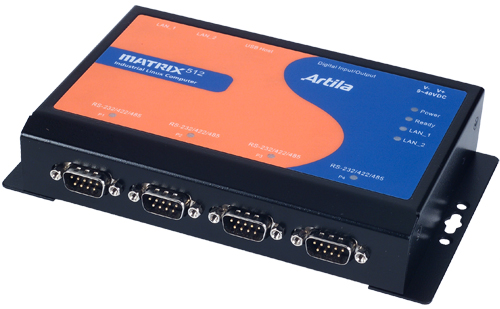
DK-35A
LOOKING FOR THE RIGHT
INDUSTRIAL SOLUTION?
Discover embedded, communication and automation solutions tailored to your application.
- Processor: Atmel AT91SAM9G45 ARM9 CPU, 400 MHz with Memory Management Unit (MMU)
- Memory: 128 MB DDR2 SDRAM, 256 MB NAND Flash
- Storage Expansion: MicroSD slot supporting up to 32 GB SDHC cards
- Networking: Two 10/100 Mbps Ethernet ports (LAN 1 and LAN 2)
- Wireless Connectivity:
- Optional 802.11 b/g/n WLAN via half‑size miniPCIe (Ralink RT5390U)
- Optional 2G/3G cellular via full‑size miniPCIe (Cinterion module) with SIM socket
- Serial Communication: Four RS‑232/422/485 software‑selectable ports
- USB Interfaces: Two USB 2.0 high‑speed (480 Mbps) host ports and one USB device port
- Digital I/O:
- Two isolated digital inputs (2500 Vrms isolation)
- One relay output (Form A or B, 30 VDC @ 1 A, jumper‑selectable)
- Operating System: Pre‑installed Linux 2.6.38 kernel and root file system
- Software Environment:
- GNU C/C++ toolchain for Linux and Windows (via Cygwin)
- BusyBox utilities and Artila‑specific management tools
- Web server (lighttpd), SSH, FTP, and Telnet services pre‑configured
- Power Input: 9 – 48 V DC, 500 mA @ 12 V DC typical
- Enclosure: Fanless, metal housing suitable for DIN‑rail or wall mounting
- Operating Temperature: 0 °C – 70 °C
- Dimensions: 175 mm × 103 mm × 43 mm
- Memory: 128 MB DDR2 SDRAM, 256 MB NAND Flash
- Storage Expansion: MicroSD slot supporting up to 32 GB SDHC cards
- Networking: Two 10/100 Mbps Ethernet ports (LAN 1 and LAN 2)
- Wireless Connectivity:
- Optional 802.11 b/g/n WLAN via half‑size miniPCIe (Ralink RT5390U)
- Optional 2G/3G cellular via full‑size miniPCIe (Cinterion module) with SIM socket
- Serial Communication: Four RS‑232/422/485 software‑selectable ports
- USB Interfaces: Two USB 2.0 high‑speed (480 Mbps) host ports and one USB device port
- Digital I/O:
- Two isolated digital inputs (2500 Vrms isolation)
- One relay output (Form A or B, 30 VDC @ 1 A, jumper‑selectable)
- Operating System: Pre‑installed Linux 2.6.38 kernel and root file system
- Software Environment:
- GNU C/C++ toolchain for Linux and Windows (via Cygwin)
- BusyBox utilities and Artila‑specific management tools
- Web server (lighttpd), SSH, FTP, and Telnet services pre‑configured
- Power Input: 9 – 48 V DC, 500 mA @ 12 V DC typical
- Enclosure: Fanless, metal housing suitable for DIN‑rail or wall mounting
- Operating Temperature: 0 °C – 70 °C
- Dimensions: 175 mm × 103 mm × 43 mm
Comprehensive Product Summary – Artila Matrix‑513 Industrial Embedded Computer
### 1. Product Overview
Product Name: Matrix‑513
Model: Matrix‑513
Series: Matrix Industrial Embedded Computer Series
Article Number: Matrix‑513
Manufacturer: Artila Electronics Co., Ltd.
The Artila Matrix‑513 is an ARM9‑based industrial embedded computer designed for automation, networking, and remote data acquisition applications. It integrates an Atmel AT91SAM9G45 400 MHz processor with a Linux 2.6.38 operating system, offering a compact, fanless, and robust platform for industrial control and communication tasks. The system supports multiple serial interfaces, dual Ethernet ports, USB connectivity, and optional wireless and 3G modules, making it a versatile solution for embedded networking and IoT edge computing.
### 2. Key Features
- Processor: Atmel AT91SAM9G45 ARM9 CPU, 400 MHz with Memory Management Unit (MMU)
- Memory: 128 MB DDR2 SDRAM, 256 MB NAND Flash
- Storage Expansion: MicroSD slot supporting up to 32 GB SDHC cards
- Networking: Two 10/100 Mbps Ethernet ports (LAN 1 and LAN 2)
- Wireless Connectivity:
- Optional 802.11 b/g/n WLAN via half‑size miniPCIe (Ralink RT5390U)
- Optional 2G/3G cellular via full‑size miniPCIe (Cinterion module) with SIM socket
- Serial Communication: Four RS‑232/422/485 software‑selectable ports
- USB Interfaces: Two USB 2.0 high‑speed (480 Mbps) host ports and one USB device port
- Digital I/O:
- Two isolated digital inputs (2500 Vrms isolation)
- One relay output (Form A or B, 30 VDC @ 1 A, jumper‑selectable)
- Operating System: Pre‑installed Linux 2.6.38 kernel and root file system
- Software Environment:
- GNU C/C++ toolchain for Linux and Windows (via Cygwin)
- BusyBox utilities and Artila‑specific management tools
- Web server (lighttpd), SSH, FTP, and Telnet services pre‑configured
- Power Input: 9 – 48 V DC, 500 mA @ 12 V DC typical
- Enclosure: Fanless, metal housing suitable for DIN‑rail or wall mounting
- Operating Temperature: 0 °C – 70 °C
- Dimensions: 175 mm × 103 mm × 43 mm
### 3. Technical Specifications
| Parameter | Specification |
|----------------|-------------------|
| CPU | Atmel AT91SAM9G45 ARM9 @ 400 MHz |
| Cache | 32 KB Data Cache + 32 KB Instruction Cache |
| RAM | 128 MB DDR2 SDRAM |
| Flash Memory | 256 MB NAND Flash |
| Storage Expansion | MicroSD slot (32 GB SDHC max.) |
| Ethernet Ports | 2 × 10/100 Mbps (RJ‑45) |
| Serial Ports | 4 × RS‑232/422/485 (DB9 Male, software‑selectable) |
| USB Ports | 2 × USB 2.0 Host (480 Mbps), 1 × USB Device |
| MiniPCIe Slots | 1 × Full‑size (USB bus only), 1 × Half‑size (USB bus only) |
| SIM Sockets | 1 × SIM socket (for 3G module) |
| Digital Inputs | 2 × Isolated DI (2500 Vrms isolation) |
| Relay Output | 1 × Form A/B relay (30 VDC @ 1 A) |
| Power Supply | 9 – 48 V DC input, 500 mA @ 12 V DC |
| Operating Temperature | 0 °C to 70 °C |
| Enclosure | Fanless metal case, DIN‑rail mountable |
| Dimensions | 175 mm (L) × 103 mm (W) × 43 mm (H) |
| Weight | Approx. 0.6 kg (typical) |
| OS Kernel | Linux 2.6.38 |
| File System | NAND Flash with Bootloader (uBoot), Kernel, Root FS, User Disk (/home) |
### 4. Functionality
The Matrix‑513 operates as a compact industrial controller and communication gateway. It boots from NAND Flash, loads the Linux kernel, and mounts the root file system automatically. Users can access the system via Ethernet (SSH, Telnet, FTP, or web interface) or through the serial console port.
Use Cases and Applications:
- Industrial automation and process control
- Remote data acquisition and telemetry
- IoT edge computing and protocol conversion
- Networked serial device management
- Embedded web server or data logger
Compatibility:
- Supports standard Linux utilities and drivers
- Compatible with Ralink RT5370 WLAN modules and Cinterion 3G modules
- Works with USB storage, USB serial adapters, and CDC‑compliant modems
- Supports GNU toolchains for both Linux and Windows (via Cygwin)
### 5. Components & Accessories
Included Items:
- Matrix‑513 Box Computer
- Wall mount bracket
Optional Accessories:
| Part No. | Description |
|---------------|----------------|
| CBL‑F10M9‑20 (91‑0P9M9‑001) | Console Cable (10‑pin header to DB9 male, 20 cm) |
| DK‑35A (36‑DK35A‑000) | DIN Rail Mounting Kit |
| Pigtail‑WiFi‑1001‑20 (91‑CST16‑001) | IPEX to RP‑SMA female coaxial cable (20 cm) |
| Pigtail‑3G‑1001‑20 (91‑CST17‑001) | IPEX to SMA female coaxial cable (20 cm) |
| Ant‑WiFi‑1001 (91‑CRF38‑001) | 5 dBi External Wi‑Fi Antenna |
| Ant‑3G‑1001 (91‑CRF37‑001) | 5 dBi External 2G/3G Antenna |
| M‑9001 (ZA‑CAR00‑004) | 802.11 b/g/n USB Half‑size miniPCIe Card (Ralink RT5390U) |
| M‑9011 (CM5000) | Full‑size miniPCIe 2G/3G Card with SIM Socket |
| PWR‑12V‑1A (31‑62100‑000) | 110–240 VAC to 12 VDC 1 A Power Adapter |
### 6. Installation & Setup
Power and Boot:
- Connect 9–48 V DC power input.
- Power LED indicates status (green = power OK).
- System boots Linux kernel and mounts file system automatically.
Network Configuration:
- Default LAN 1 IP: 192.168.2.127
- Default LAN 2 IP: 192.168.3.127
- Default login: root / guest (password same as username)
- Modify network settings via `/etc/network/interfaces`.
Serial Console Access:
- Internal 10‑pin header (CON1) for console access.
- Use Artila console cable (91‑0P9M9‑001).
- Terminal settings: 115200 bps, 8N1, VT100.
Mounting Options:
- Wall mount bracket included.
- Optional DIN‑rail mount kit (DK‑35A).
Wireless Setup:
- Install Wi‑Fi or 3G miniPCIe modules under top cover.
- Configure wireless driver in `/etc/modules` (e.g., add `rt5370sta`).
- Edit `/etc/Wireless/RT5370STA/RT5370STA.dat` for SSID and security settings.
Software Development:
- GNU toolchain available for Linux and Windows (Cygwin).
- Example compilation: `arm-linux-gcc -g example.c -o example`.
- Remote debugging supported via `gdbserver`.
### 7. Performance & Capabilities
- Processing Speed: 400 MHz ARM9 core with MMU
- Memory Bandwidth: DDR2 interface optimized for industrial applications
- Networking: Dual Ethernet interfaces support redundant or segmented networks
- Serial Throughput: Up to 921,600 bps per port (RS‑485 supported)
- USB Performance: 480 Mbps (USB 2.0 High Speed)
- Wireless Bandwidth: Up to 150 Mbps (802.11 n module)
- Power Efficiency: < 6 W typical consumption
- Reliability: Fanless design for continuous operation in industrial environments
- Limitations: No native video output; miniPCIe slots support USB signals only (no PCIe bus).
### 8. Standards & Compliance
- Operating System: Linux 2.6.38 kernel with GNU toolchain
- Communication Protocols: TCP/IP, SSH 1.0/2.0, FTP, Telnet, HTTP, PPP
- Electrical Isolation: 2500 Vrms for digital inputs
- Safety and EMC: Designed for industrial environments (CE and FCC Class A compliance typical)
- Software Package Management: ipkg (lightweight package manager)
- File System Integrity: Automatic recovery via DataFlash boot if NAND fails
- Environmental Compliance: RoHS compliant components
### 9. Additional Information
Warranty & Support:
Artila Electronics provides standard limited warranty coverage for hardware defects and offers technical support through its website and FTP portal. Firmware updates, kernel images, and software packages are available for download from Artila FTP.
Maintenance:
- Periodically update firmware using the `update` utility.
- Use `setuart` to configure serial ports.
- Use `gpioctl` for digital I/O control.
- System recovery available via USB disk with image files (M9G45A/m9g45a.alf, M9G45‑K, M9G45‑R).
Software Updates:
- Use `ipkg update` and `ipkg install` to add new modules or utilities.
- Webmin interface available on port 10000 for remote administration.
Developer Resources:
- Example programs and toolchains available on Artila FTP.
- Supports cross‑compilation under Linux or Windows (Cygwin).
- Debugging supported via `gdbserver` and DDD (Data Display Debugger).
System Recovery Procedure:
If the NAND file system fails, the Matrix‑513 automatically boots from DataFlash and provides a console menu for recovery. Users can update the loader, kernel, and file system from a USB disk or rebuild a custom file system image using the `mkimage` utility.
Utility Software Collection:
- BusyBox core utilities
- sysvinit and util‑linux mount/umount
- SSH and SFTP server
- lighttpd web server
- vsftpd FTP server
- iptables for routing and firewall
- ipkg package manager
- wireless tools and PPP utilities
- Artila custom utilities (update, setuart, gpioctl, version)
### Summary
The Artila Matrix‑513 is a compact, fanless, and Linux‑ready industrial embedded computer built around the Atmel AT91SAM9G45 ARM9 processor. It provides a robust platform for industrial automation, data acquisition, and IoT gateway applications. With dual Ethernet ports, multiple serial interfaces, USB connectivity, and expandable wireless options, it offers flexibility for a wide range of industrial and networked deployments. Its pre‑installed Linux environment, comprehensive toolchain support, and modular hardware design make it ideal for developers and system integrators seeking a reliable and customizable embedded platform.

### 1. Product Overview
Product Name: Matrix‑513
Model: Matrix‑513
Series: Matrix Industrial Embedded Computer Series
Article Number: Matrix‑513
Manufacturer: Artila Electronics Co., Ltd.
The Artila Matrix‑513 is an ARM9‑based industrial embedded computer designed for automation, networking, and remote data acquisition applications. It integrates an Atmel AT91SAM9G45 400 MHz processor with a Linux 2.6.38 operating system, offering a compact, fanless, and robust platform for industrial control and communication tasks. The system supports multiple serial interfaces, dual Ethernet ports, USB connectivity, and optional wireless and 3G modules, making it a versatile solution for embedded networking and IoT edge computing.
### 2. Key Features
- Processor: Atmel AT91SAM9G45 ARM9 CPU, 400 MHz with Memory Management Unit (MMU)
- Memory: 128 MB DDR2 SDRAM, 256 MB NAND Flash
- Storage Expansion: MicroSD slot supporting up to 32 GB SDHC cards
- Networking: Two 10/100 Mbps Ethernet ports (LAN 1 and LAN 2)
- Wireless Connectivity:
- Optional 802.11 b/g/n WLAN via half‑size miniPCIe (Ralink RT5390U)
- Optional 2G/3G cellular via full‑size miniPCIe (Cinterion module) with SIM socket
- Serial Communication: Four RS‑232/422/485 software‑selectable ports
- USB Interfaces: Two USB 2.0 high‑speed (480 Mbps) host ports and one USB device port
- Digital I/O:
- Two isolated digital inputs (2500 Vrms isolation)
- One relay output (Form A or B, 30 VDC @ 1 A, jumper‑selectable)
- Operating System: Pre‑installed Linux 2.6.38 kernel and root file system
- Software Environment:
- GNU C/C++ toolchain for Linux and Windows (via Cygwin)
- BusyBox utilities and Artila‑specific management tools
- Web server (lighttpd), SSH, FTP, and Telnet services pre‑configured
- Power Input: 9 – 48 V DC, 500 mA @ 12 V DC typical
- Enclosure: Fanless, metal housing suitable for DIN‑rail or wall mounting
- Operating Temperature: 0 °C – 70 °C
- Dimensions: 175 mm × 103 mm × 43 mm
### 3. Technical Specifications
| Parameter | Specification |
|----------------|-------------------|
| CPU | Atmel AT91SAM9G45 ARM9 @ 400 MHz |
| Cache | 32 KB Data Cache + 32 KB Instruction Cache |
| RAM | 128 MB DDR2 SDRAM |
| Flash Memory | 256 MB NAND Flash |
| Storage Expansion | MicroSD slot (32 GB SDHC max.) |
| Ethernet Ports | 2 × 10/100 Mbps (RJ‑45) |
| Serial Ports | 4 × RS‑232/422/485 (DB9 Male, software‑selectable) |
| USB Ports | 2 × USB 2.0 Host (480 Mbps), 1 × USB Device |
| MiniPCIe Slots | 1 × Full‑size (USB bus only), 1 × Half‑size (USB bus only) |
| SIM Sockets | 1 × SIM socket (for 3G module) |
| Digital Inputs | 2 × Isolated DI (2500 Vrms isolation) |
| Relay Output | 1 × Form A/B relay (30 VDC @ 1 A) |
| Power Supply | 9 – 48 V DC input, 500 mA @ 12 V DC |
| Operating Temperature | 0 °C to 70 °C |
| Enclosure | Fanless metal case, DIN‑rail mountable |
| Dimensions | 175 mm (L) × 103 mm (W) × 43 mm (H) |
| Weight | Approx. 0.6 kg (typical) |
| OS Kernel | Linux 2.6.38 |
| File System | NAND Flash with Bootloader (uBoot), Kernel, Root FS, User Disk (/home) |
### 4. Functionality
The Matrix‑513 operates as a compact industrial controller and communication gateway. It boots from NAND Flash, loads the Linux kernel, and mounts the root file system automatically. Users can access the system via Ethernet (SSH, Telnet, FTP, or web interface) or through the serial console port.
Use Cases and Applications:
- Industrial automation and process control
- Remote data acquisition and telemetry
- IoT edge computing and protocol conversion
- Networked serial device management
- Embedded web server or data logger
Compatibility:
- Supports standard Linux utilities and drivers
- Compatible with Ralink RT5370 WLAN modules and Cinterion 3G modules
- Works with USB storage, USB serial adapters, and CDC‑compliant modems
- Supports GNU toolchains for both Linux and Windows (via Cygwin)
### 5. Components & Accessories
Included Items:
- Matrix‑513 Box Computer
- Wall mount bracket
Optional Accessories:
| Part No. | Description |
|---------------|----------------|
| CBL‑F10M9‑20 (91‑0P9M9‑001) | Console Cable (10‑pin header to DB9 male, 20 cm) |
| DK‑35A (36‑DK35A‑000) | DIN Rail Mounting Kit |
| Pigtail‑WiFi‑1001‑20 (91‑CST16‑001) | IPEX to RP‑SMA female coaxial cable (20 cm) |
| Pigtail‑3G‑1001‑20 (91‑CST17‑001) | IPEX to SMA female coaxial cable (20 cm) |
| Ant‑WiFi‑1001 (91‑CRF38‑001) | 5 dBi External Wi‑Fi Antenna |
| Ant‑3G‑1001 (91‑CRF37‑001) | 5 dBi External 2G/3G Antenna |
| M‑9001 (ZA‑CAR00‑004) | 802.11 b/g/n USB Half‑size miniPCIe Card (Ralink RT5390U) |
| M‑9011 (CM5000) | Full‑size miniPCIe 2G/3G Card with SIM Socket |
| PWR‑12V‑1A (31‑62100‑000) | 110–240 VAC to 12 VDC 1 A Power Adapter |
### 6. Installation & Setup
Power and Boot:
- Connect 9–48 V DC power input.
- Power LED indicates status (green = power OK).
- System boots Linux kernel and mounts file system automatically.
Network Configuration:
- Default LAN 1 IP: 192.168.2.127
- Default LAN 2 IP: 192.168.3.127
- Default login: root / guest (password same as username)
- Modify network settings via `/etc/network/interfaces`.
Serial Console Access:
- Internal 10‑pin header (CON1) for console access.
- Use Artila console cable (91‑0P9M9‑001).
- Terminal settings: 115200 bps, 8N1, VT100.
Mounting Options:
- Wall mount bracket included.
- Optional DIN‑rail mount kit (DK‑35A).
Wireless Setup:
- Install Wi‑Fi or 3G miniPCIe modules under top cover.
- Configure wireless driver in `/etc/modules` (e.g., add `rt5370sta`).
- Edit `/etc/Wireless/RT5370STA/RT5370STA.dat` for SSID and security settings.
Software Development:
- GNU toolchain available for Linux and Windows (Cygwin).
- Example compilation: `arm-linux-gcc -g example.c -o example`.
- Remote debugging supported via `gdbserver`.
### 7. Performance & Capabilities
- Processing Speed: 400 MHz ARM9 core with MMU
- Memory Bandwidth: DDR2 interface optimized for industrial applications
- Networking: Dual Ethernet interfaces support redundant or segmented networks
- Serial Throughput: Up to 921,600 bps per port (RS‑485 supported)
- USB Performance: 480 Mbps (USB 2.0 High Speed)
- Wireless Bandwidth: Up to 150 Mbps (802.11 n module)
- Power Efficiency: < 6 W typical consumption
- Reliability: Fanless design for continuous operation in industrial environments
- Limitations: No native video output; miniPCIe slots support USB signals only (no PCIe bus).
### 8. Standards & Compliance
- Operating System: Linux 2.6.38 kernel with GNU toolchain
- Communication Protocols: TCP/IP, SSH 1.0/2.0, FTP, Telnet, HTTP, PPP
- Electrical Isolation: 2500 Vrms for digital inputs
- Safety and EMC: Designed for industrial environments (CE and FCC Class A compliance typical)
- Software Package Management: ipkg (lightweight package manager)
- File System Integrity: Automatic recovery via DataFlash boot if NAND fails
- Environmental Compliance: RoHS compliant components
### 9. Additional Information
Warranty & Support:
Artila Electronics provides standard limited warranty coverage for hardware defects and offers technical support through its website and FTP portal. Firmware updates, kernel images, and software packages are available for download from Artila FTP.
Maintenance:
- Periodically update firmware using the `update` utility.
- Use `setuart` to configure serial ports.
- Use `gpioctl` for digital I/O control.
- System recovery available via USB disk with image files (M9G45A/m9g45a.alf, M9G45‑K, M9G45‑R).
Software Updates:
- Use `ipkg update` and `ipkg install` to add new modules or utilities.
- Webmin interface available on port 10000 for remote administration.
Developer Resources:
- Example programs and toolchains available on Artila FTP.
- Supports cross‑compilation under Linux or Windows (Cygwin).
- Debugging supported via `gdbserver` and DDD (Data Display Debugger).
System Recovery Procedure:
If the NAND file system fails, the Matrix‑513 automatically boots from DataFlash and provides a console menu for recovery. Users can update the loader, kernel, and file system from a USB disk or rebuild a custom file system image using the `mkimage` utility.
Utility Software Collection:
- BusyBox core utilities
- sysvinit and util‑linux mount/umount
- SSH and SFTP server
- lighttpd web server
- vsftpd FTP server
- iptables for routing and firewall
- ipkg package manager
- wireless tools and PPP utilities
- Artila custom utilities (update, setuart, gpioctl, version)
### Summary
The Artila Matrix‑513 is a compact, fanless, and Linux‑ready industrial embedded computer built around the Atmel AT91SAM9G45 ARM9 processor. It provides a robust platform for industrial automation, data acquisition, and IoT gateway applications. With dual Ethernet ports, multiple serial interfaces, USB connectivity, and expandable wireless options, it offers flexibility for a wide range of industrial and networked deployments. Its pre‑installed Linux environment, comprehensive toolchain support, and modular hardware design make it ideal for developers and system integrators seeking a reliable and customizable embedded platform.
-
Matrix-513 Data Sheet.pdf
PDF Catalog
-
Warranty Declaration.pdf
PDF Catalog
-
Matrix-513_User_Guide.pdf
Manual
-
Serial Console Cable.pdf
Manual
-
gdbserver_HOW_TO.pdf
Manual
- DK-35A - DIN rail mounting kit (2pcs, 4 screws)
- CB-RJ45F9-150 - Data Cable DB9f Matrix-5xx series
- CB-RJ2Con-100 - Console Cable Matrix-5xx series