DK-35A
LOOKING FOR THE RIGHT
INDUSTRIAL SOLUTION?
Discover embedded, communication and automation solutions tailored to your application.
- Processor: ARM926EJ-S ARM Thumb processor with MMU, operating at 400 MHz.
- Memory: 64 MB SDRAM and 256 MB NAND Flash; includes 2 MB DataFlash for system backup.
- Operating System: Pre-installed Linux kernel 2.6.29; supports WinCE and Java accelerator.
- Networking: Two 10/100 Mbps Ethernet ports for redundant or segmented network configurations.
- CAN Bus: Two fully isolated CAN 2.0A/2.0B ports (2500 Vrms isolation) with optional 120 Ω termination.
- Serial Communication: Two 3-in-1 software-configurable RS-232/422/485 ports.
- USB Connectivity: Two USB 2.0 full-speed (12 Mbps) host ports and one USB device port.
- Digital I/O: 21 programmable GPIO channels accessible via DB25 connector.
- Storage Expansion: MicroSD card slot for additional storage or data logging.
- Power Input: Wide-range 9–40 V DC input with low power consumption (~2.3 W typical).
- Security: Supports SSL, SSH 1.0/2.0, and secure remote access.
- Software Tools: Includes BusyBox utilities, Artila-specific management tools, and ipkg package management.
- Compatibility: Upward compatible with Matrix-500 series; supports SocketCAN and CANopen libraries.
- Mounting Options: Wall mount bracket included; optional DIN-rail mounting kit (DK-35A).
- Development Support: GNU C/C++ toolchain for Linux and Windows (Cygwin), cross-compilation support, and example source code.
- Memory: 64 MB SDRAM and 256 MB NAND Flash; includes 2 MB DataFlash for system backup.
- Operating System: Pre-installed Linux kernel 2.6.29; supports WinCE and Java accelerator.
- Networking: Two 10/100 Mbps Ethernet ports for redundant or segmented network configurations.
- CAN Bus: Two fully isolated CAN 2.0A/2.0B ports (2500 Vrms isolation) with optional 120 Ω termination.
- Serial Communication: Two 3-in-1 software-configurable RS-232/422/485 ports.
- USB Connectivity: Two USB 2.0 full-speed (12 Mbps) host ports and one USB device port.
- Digital I/O: 21 programmable GPIO channels accessible via DB25 connector.
- Storage Expansion: MicroSD card slot for additional storage or data logging.
- Power Input: Wide-range 9–40 V DC input with low power consumption (~2.3 W typical).
- Security: Supports SSL, SSH 1.0/2.0, and secure remote access.
- Software Tools: Includes BusyBox utilities, Artila-specific management tools, and ipkg package management.
- Compatibility: Upward compatible with Matrix-500 series; supports SocketCAN and CANopen libraries.
- Mounting Options: Wall mount bracket included; optional DIN-rail mounting kit (DK-35A).
- Development Support: GNU C/C++ toolchain for Linux and Windows (Cygwin), cross-compilation support, and example source code.
1. Product Overview
Product Name: Matrix-522
Model: Matrix-522
Series: Matrix 500 Series Industrial Embedded Computers
Article Number: Matrix-522
Manufacturer: Artila Electronics Co., Ltd.
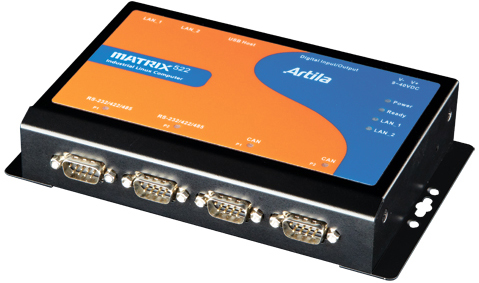
The Artila Matrix-522 is an ARM9-based industrial-grade embedded Linux computer designed for automation, control, and communication applications. It integrates a 400 MHz ARM926EJ-S processor, dual Ethernet interfaces, dual isolated CAN 2.0A/2.0B ports, dual USB 2.0 host ports, and 21 programmable digital I/O channels. The system runs a pre-installed Linux 2.6.29 operating system and supports a full GNU toolchain for both Linux and Windows development environments. It is a compact, fanless, flash-based industrial computer suitable for DIN-rail or wall mounting, optimized for reliability in harsh environments.
2. Key Features
- Processor: ARM926EJ-S ARM Thumb processor with MMU, operating at 400 MHz.
- Memory: 64 MB SDRAM and 256 MB NAND Flash; includes 2 MB DataFlash for system backup.
- Operating System: Pre-installed Linux kernel 2.6.29; supports WinCE and Java accelerator.
- Networking: Two 10/100 Mbps Ethernet ports for redundant or segmented network configurations.
- CAN Bus: Two fully isolated CAN 2.0A/2.0B ports (2500 Vrms isolation) with optional 120 Ω termination.
- Serial Communication: Two 3-in-1 software-configurable RS-232/422/485 ports.
- USB Connectivity: Two USB 2.0 full-speed (12 Mbps) host ports and one USB device port.
- Digital I/O: 21 programmable GPIO channels accessible via DB25 connector.
- Storage Expansion: MicroSD card slot for additional storage or data logging.
- Power Input: Wide-range 9–40 V DC input with low power consumption (~2.3 W typical).
- Security: Supports SSL, SSH 1.0/2.0, and secure remote access.
- Software Tools: Includes BusyBox utilities, Artila-specific management tools, and ipkg package management.
- Compatibility: Upward compatible with Matrix-500 series; supports SocketCAN and CANopen libraries.
- Mounting Options: Wall mount bracket included; optional DIN-rail mounting kit (DK-35A).
- Development Support: GNU C/C++ toolchain for Linux and Windows (Cygwin), cross-compilation support, and example source code.
3. Technical Specifications
- Processor: ARM9 (ARM926EJ-S) 400 MHz
- Memory:
- SDRAM: 64 MB
- NAND Flash: 256 MB
- DataFlash: 2 MB (system backup)
- Storage Expansion: MicroSD card interface
- Networking:
- 2 × 10/100 Mbps Ethernet (RJ45)
- Link/Activity LEDs per port
- Serial Interfaces:
- 2 × RS-232/422/485 (software selectable, DB9 male)
- Baud rate up to 921,600 bps
- Console port (internal 10-pin header, RS-232 level)
- CAN Bus:
- 2 × CAN 2.0A/2.0B ports (DB9 male)
- 2500 Vrms isolation
- 120 Ω termination (removable via jumpers J7/J8)
- USB:
- 2 × USB 2.0 host ports (12 Mbps)
- 1 × USB device port
- Digital I/O:
- 21 programmable GPIO lines (DB25 female)
- TTL-compatible signal levels
- +3.3 V and +5 V supply pins available
- Power Supply:
- Input: 9–40 V DC
- Typical consumption: 190 mA @ 12 V DC (~2.3 W)
- Environmental:
- Operating temperature: 0 °C – 70 °C
- Fanless, solid-state design
- Physical:
- Dimensions: 160 mm × 104 mm × 32 mm
- Weight: ~440 g
- Enclosure: Metal, industrial-grade
- Indicators:
- Power LED (green)
- Ready LED (system boot status)
- Link/Act LEDs (Ethernet activity)
- Serial/CAN dual-color LEDs (TX/RX indication)
4. Functionality
The Matrix-522 functions as a compact embedded web server and communication controller. It boots from NAND Flash, loads the Linux kernel, and mounts the root file system automatically. Users can access the system via Ethernet (SSH, Telnet, FTP, or HTTP) or through the serial console. The device supports multiple communication protocols and can serve as a gateway between Ethernet, serial, and CAN networks.
Use Cases and Applications:
- Industrial automation and control systems
- CAN-based machine communication and monitoring
- Data acquisition and remote telemetry
- Embedded web server for equipment management
- Protocol conversion (e.g., Modbus TCP to CAN)
- Edge computing and IoT gateway applications
Compatibility:
- Supports SocketCAN and CANopen for CAN network integration.
- Compatible with standard Linux utilities and open-source libraries.
- Works with Artila’s Java Manager and ipkg package management system.
- Supports cross-compilation using GNU toolchains for ARM (Linux or Windows/Cygwin).
5. Components & Accessories
Included Items:
- Matrix-522 industrial box computer
- Wall-mount bracket
Optional Accessories:
- CBL-F10M9-20 (91-0P9M9-001): Console cable (10-pin header to DB9 male, 20 cm)
- DK-35A (36-DK35A-000): DIN-rail mounting kit
Connectors:
- Ethernet: 2 × RJ45
- Serial Ports: 2 × DB9 male (RS-232/422/485)
- CAN Ports: 2 × DB9 male (isolated)
- Digital I/O: 1 × DB25 female
- USB: 2 × USB Type-A host, 1 × USB device
- Console Port: 10-pin internal header (RS-232)
- Reset Button: Front panel
- Power Input: Terminal block connector
6. Installation & Setup
Power Requirements:
Supply 9–40 V DC via terminal block. Ensure stable power before booting.
Mounting Options:
- Wall mount (default bracket included)
- DIN-rail mount (optional DK-35A kit)
Initial Configuration:
- Default LAN1 IP: 192.168.2.127
- Default LAN2 IP: 192.168.3.127
- Default login:
- Username: root / guest
- Password: root / guest (guest for Telnet only)
- Serial console: 115200 bps, 8 N 1, no flow control, VT100 terminal type
Network Setup:
Edit `/etc/network/interfaces` for static or DHCP configuration.
Wireless LAN supported via USB WLAN adapters (driver-dependent).
Serial Console Access:
Use the internal CON1 header with the optional console cable. Alternatively, redirect the console to any serial port using the `setconsole` command.
Software Configuration:
- Modify `/etc/inittab` for run-level control.
- Use `/etc/rc.local` to auto-start user applications.
- Web server configuration located in `/etc/lighttpd.conf`.
7. Performance & Capabilities
- Processing Speed: 400 MHz ARM9 core with 32 KB instruction and 32 KB data cache.
- Memory Performance: 64 MB SDRAM ensures stable multitasking for embedded applications.
- Storage Capacity: 256 MB NAND Flash with user partition (~12 MB available for applications).
- Networking: Dual Ethernet interfaces support routing, redundancy, or segmented networks.
- CAN Bus: Supports bit rates from 10 kbps to 1 Mbps; configuration via `/etc/can_config`.
- Serial Communication: Up to 921,600 bps; configurable for RS-232, RS-422, or RS-485.
- USB Performance: Full-speed (12 Mbps) host ports for peripherals such as flash drives, modems, or WLAN adapters.
- System Efficiency: Fanless, low-power design optimized for 24/7 operation.
- Limitations: No built-in SD slot on earlier Matrix-500 models; Matrix-522 includes MicroSD support.
8. Standards & Compliance
- CAN Bus: ISO 11898-1/2 compliant (CAN 2.0A/2.0B)
- Ethernet: IEEE 802.3 10/100 Base-TX
- USB: USB 2.0 full-speed compliant
- EMC & Safety: Designed for industrial environments (compliance with CE/FCC standards typical for Artila products)
- Software Standards:
- Linux kernel 2.6.29
- GNU C/C++ toolchain (gcc 4.3.3, glibc 2.9, binutils 2.18)
- SocketCAN and CANopen (CanFestival 3) support
- Security Protocols: SSH 1.0/2.0, SSL for encrypted communication
9. Additional Information
Warranty & Support:
Artila Electronics provides technical support and firmware updates via its official website and FTP server. Warranty terms typically cover manufacturing defects; users should contact Artila for RMA procedures.
Maintenance:
- Regularly back up configuration files and user data.
- Use the `update` utility to upgrade loader, kernel, or file system images.
- System recovery can be performed via USB disk using the built-in recovery console.
Software Updates & Package Management:
- ipkg Utility: Lightweight package manager for installing, upgrading, and removing software.
- Configuration file: `/etc/ipkg.conf`
- Supports installation via Internet or USB disk.
- Example repositories:
- `http://www.artila.com/download/ipkgs/9G20/utility/`
- `http://www.artila.com/download/ipkgs/9G20/modules/`
- Webmin Interface: Web-based system administration tool accessible via port 10000.
Development Environment:
- Linux Toolchain: `arm-linux-gnueabi-gcc`, `arm-linux-gnueabi-g++`, `arm-linux-gnueabi-strip`
- Windows (Cygwin) Toolchain: `arm-none-linux-gnueabi-gcc`, `arm-none-linux-gnueabi-g++`
- Example Programs: Available on Artila FTP under `/examples` (CAN, GPIO, network, etc.)
- Debugging: Supports `gdbserver` for remote debugging via TCP/IP.
System Recovery Options:
If the NAND Flash file system fails, the system automatically boots from DataFlash and provides a recovery console with options to:
- Update loader, kernel, and file system images from USB.
- Rebuild or duplicate file systems.
- Restore environment variables to factory defaults.
Utility Software Summary:
- busybox v1.14.2: Core Linux utilities
- sysvinit v2.86: System initialization
- lighttpd v1.7: Web server
- vsftpd v2.0.5: FTP server
- ssh v4.6p1: Secure shell and SFTP
- iptables v1.3.8: Network routing and firewall
- wireless_tools v29: WLAN configuration
- canutils v4.0.6: CAN bus utilities
- artila utility v1.1: Device-specific management tools
Artila Utility Commands:
- `update` – Upgrade loader, kernel, or environment files.
- `setuart` – Configure serial port mode and baud rate.
- `setconsole` – Redirect console to any serial port.
- `version` – Display OS version.
- `gpioctl` – Configure and control GPIO pins.
System Indicators:
- Power LED: Solid green when powered.
- Ready LED: Solid green after successful boot.
- Link/Act LEDs: Indicate Ethernet connectivity and traffic.
- Serial/CAN LEDs: Dual-color indicators for TX/RX activity.
Boot Loader Menu:
Accessed via serial console (115200 bps, VT100).
Options include formatting user disk, upgrading loader/kernel/filesystem, configuring Ethernet, toggling console, and resetting system.
Recovery and Debugging:
- Loader version 1.1.4 supports serial and TFTP upgrades.
- Ethernet configuration commands: `set ipaddr`, `set serverip`, `set netmask`, `set gateway`.
- Recovery via USB or serial console using Xmodem/Kermit protocols.
Summary
The Artila Matrix-522 is a robust, fanless, ARM9-based embedded Linux computer engineered for industrial automation, communication, and control applications. With dual Ethernet, dual isolated CAN interfaces, multiple serial ports, and extensive GPIO, it serves as a versatile platform for embedded networking and data acquisition. Its pre-installed Linux OS, comprehensive toolchain support, and modular software architecture make it ideal for developers and system integrators seeking a reliable, open, and programmable industrial controller. The Matrix-522 combines compact design, low power consumption, and high connectivity, ensuring dependable operation in demanding industrial environments.

Product Name: Matrix-522
Model: Matrix-522
Series: Matrix 500 Series Industrial Embedded Computers
Article Number: Matrix-522
Manufacturer: Artila Electronics Co., Ltd.
The Artila Matrix-522 is an ARM9-based industrial-grade embedded Linux computer designed for automation, control, and communication applications. It integrates a 400 MHz ARM926EJ-S processor, dual Ethernet interfaces, dual isolated CAN 2.0A/2.0B ports, dual USB 2.0 host ports, and 21 programmable digital I/O channels. The system runs a pre-installed Linux 2.6.29 operating system and supports a full GNU toolchain for both Linux and Windows development environments. It is a compact, fanless, flash-based industrial computer suitable for DIN-rail or wall mounting, optimized for reliability in harsh environments.
2. Key Features
- Processor: ARM926EJ-S ARM Thumb processor with MMU, operating at 400 MHz.
- Memory: 64 MB SDRAM and 256 MB NAND Flash; includes 2 MB DataFlash for system backup.
- Operating System: Pre-installed Linux kernel 2.6.29; supports WinCE and Java accelerator.
- Networking: Two 10/100 Mbps Ethernet ports for redundant or segmented network configurations.
- CAN Bus: Two fully isolated CAN 2.0A/2.0B ports (2500 Vrms isolation) with optional 120 Ω termination.
- Serial Communication: Two 3-in-1 software-configurable RS-232/422/485 ports.
- USB Connectivity: Two USB 2.0 full-speed (12 Mbps) host ports and one USB device port.
- Digital I/O: 21 programmable GPIO channels accessible via DB25 connector.
- Storage Expansion: MicroSD card slot for additional storage or data logging.
- Power Input: Wide-range 9–40 V DC input with low power consumption (~2.3 W typical).
- Security: Supports SSL, SSH 1.0/2.0, and secure remote access.
- Software Tools: Includes BusyBox utilities, Artila-specific management tools, and ipkg package management.
- Compatibility: Upward compatible with Matrix-500 series; supports SocketCAN and CANopen libraries.
- Mounting Options: Wall mount bracket included; optional DIN-rail mounting kit (DK-35A).
- Development Support: GNU C/C++ toolchain for Linux and Windows (Cygwin), cross-compilation support, and example source code.
3. Technical Specifications
- Processor: ARM9 (ARM926EJ-S) 400 MHz
- Memory:
- SDRAM: 64 MB
- NAND Flash: 256 MB
- DataFlash: 2 MB (system backup)
- Storage Expansion: MicroSD card interface
- Networking:
- 2 × 10/100 Mbps Ethernet (RJ45)
- Link/Activity LEDs per port
- Serial Interfaces:
- 2 × RS-232/422/485 (software selectable, DB9 male)
- Baud rate up to 921,600 bps
- Console port (internal 10-pin header, RS-232 level)
- CAN Bus:
- 2 × CAN 2.0A/2.0B ports (DB9 male)
- 2500 Vrms isolation
- 120 Ω termination (removable via jumpers J7/J8)
- USB:
- 2 × USB 2.0 host ports (12 Mbps)
- 1 × USB device port
- Digital I/O:
- 21 programmable GPIO lines (DB25 female)
- TTL-compatible signal levels
- +3.3 V and +5 V supply pins available
- Power Supply:
- Input: 9–40 V DC
- Typical consumption: 190 mA @ 12 V DC (~2.3 W)
- Environmental:
- Operating temperature: 0 °C – 70 °C
- Fanless, solid-state design
- Physical:
- Dimensions: 160 mm × 104 mm × 32 mm
- Weight: ~440 g
- Enclosure: Metal, industrial-grade
- Indicators:
- Power LED (green)
- Ready LED (system boot status)
- Link/Act LEDs (Ethernet activity)
- Serial/CAN dual-color LEDs (TX/RX indication)
4. Functionality
The Matrix-522 functions as a compact embedded web server and communication controller. It boots from NAND Flash, loads the Linux kernel, and mounts the root file system automatically. Users can access the system via Ethernet (SSH, Telnet, FTP, or HTTP) or through the serial console. The device supports multiple communication protocols and can serve as a gateway between Ethernet, serial, and CAN networks.
Use Cases and Applications:
- Industrial automation and control systems
- CAN-based machine communication and monitoring
- Data acquisition and remote telemetry
- Embedded web server for equipment management
- Protocol conversion (e.g., Modbus TCP to CAN)
- Edge computing and IoT gateway applications
Compatibility:
- Supports SocketCAN and CANopen for CAN network integration.
- Compatible with standard Linux utilities and open-source libraries.
- Works with Artila’s Java Manager and ipkg package management system.
- Supports cross-compilation using GNU toolchains for ARM (Linux or Windows/Cygwin).
5. Components & Accessories
Included Items:
- Matrix-522 industrial box computer
- Wall-mount bracket
Optional Accessories:
- CBL-F10M9-20 (91-0P9M9-001): Console cable (10-pin header to DB9 male, 20 cm)
- DK-35A (36-DK35A-000): DIN-rail mounting kit
Connectors:
- Ethernet: 2 × RJ45
- Serial Ports: 2 × DB9 male (RS-232/422/485)
- CAN Ports: 2 × DB9 male (isolated)
- Digital I/O: 1 × DB25 female
- USB: 2 × USB Type-A host, 1 × USB device
- Console Port: 10-pin internal header (RS-232)
- Reset Button: Front panel
- Power Input: Terminal block connector
6. Installation & Setup
Power Requirements:
Supply 9–40 V DC via terminal block. Ensure stable power before booting.
Mounting Options:
- Wall mount (default bracket included)
- DIN-rail mount (optional DK-35A kit)
Initial Configuration:
- Default LAN1 IP: 192.168.2.127
- Default LAN2 IP: 192.168.3.127
- Default login:
- Username: root / guest
- Password: root / guest (guest for Telnet only)
- Serial console: 115200 bps, 8 N 1, no flow control, VT100 terminal type
Network Setup:
Edit `/etc/network/interfaces` for static or DHCP configuration.
Wireless LAN supported via USB WLAN adapters (driver-dependent).
Serial Console Access:
Use the internal CON1 header with the optional console cable. Alternatively, redirect the console to any serial port using the `setconsole` command.
Software Configuration:
- Modify `/etc/inittab` for run-level control.
- Use `/etc/rc.local` to auto-start user applications.
- Web server configuration located in `/etc/lighttpd.conf`.
7. Performance & Capabilities
- Processing Speed: 400 MHz ARM9 core with 32 KB instruction and 32 KB data cache.
- Memory Performance: 64 MB SDRAM ensures stable multitasking for embedded applications.
- Storage Capacity: 256 MB NAND Flash with user partition (~12 MB available for applications).
- Networking: Dual Ethernet interfaces support routing, redundancy, or segmented networks.
- CAN Bus: Supports bit rates from 10 kbps to 1 Mbps; configuration via `/etc/can_config`.
- Serial Communication: Up to 921,600 bps; configurable for RS-232, RS-422, or RS-485.
- USB Performance: Full-speed (12 Mbps) host ports for peripherals such as flash drives, modems, or WLAN adapters.
- System Efficiency: Fanless, low-power design optimized for 24/7 operation.
- Limitations: No built-in SD slot on earlier Matrix-500 models; Matrix-522 includes MicroSD support.
8. Standards & Compliance
- CAN Bus: ISO 11898-1/2 compliant (CAN 2.0A/2.0B)
- Ethernet: IEEE 802.3 10/100 Base-TX
- USB: USB 2.0 full-speed compliant
- EMC & Safety: Designed for industrial environments (compliance with CE/FCC standards typical for Artila products)
- Software Standards:
- Linux kernel 2.6.29
- GNU C/C++ toolchain (gcc 4.3.3, glibc 2.9, binutils 2.18)
- SocketCAN and CANopen (CanFestival 3) support
- Security Protocols: SSH 1.0/2.0, SSL for encrypted communication
9. Additional Information
Warranty & Support:
Artila Electronics provides technical support and firmware updates via its official website and FTP server. Warranty terms typically cover manufacturing defects; users should contact Artila for RMA procedures.
Maintenance:
- Regularly back up configuration files and user data.
- Use the `update` utility to upgrade loader, kernel, or file system images.
- System recovery can be performed via USB disk using the built-in recovery console.
Software Updates & Package Management:
- ipkg Utility: Lightweight package manager for installing, upgrading, and removing software.
- Configuration file: `/etc/ipkg.conf`
- Supports installation via Internet or USB disk.
- Example repositories:
- `http://www.artila.com/download/ipkgs/9G20/utility/`
- `http://www.artila.com/download/ipkgs/9G20/modules/`
- Webmin Interface: Web-based system administration tool accessible via port 10000.
Development Environment:
- Linux Toolchain: `arm-linux-gnueabi-gcc`, `arm-linux-gnueabi-g++`, `arm-linux-gnueabi-strip`
- Windows (Cygwin) Toolchain: `arm-none-linux-gnueabi-gcc`, `arm-none-linux-gnueabi-g++`
- Example Programs: Available on Artila FTP under `/examples` (CAN, GPIO, network, etc.)
- Debugging: Supports `gdbserver` for remote debugging via TCP/IP.
System Recovery Options:
If the NAND Flash file system fails, the system automatically boots from DataFlash and provides a recovery console with options to:
- Update loader, kernel, and file system images from USB.
- Rebuild or duplicate file systems.
- Restore environment variables to factory defaults.
Utility Software Summary:
- busybox v1.14.2: Core Linux utilities
- sysvinit v2.86: System initialization
- lighttpd v1.7: Web server
- vsftpd v2.0.5: FTP server
- ssh v4.6p1: Secure shell and SFTP
- iptables v1.3.8: Network routing and firewall
- wireless_tools v29: WLAN configuration
- canutils v4.0.6: CAN bus utilities
- artila utility v1.1: Device-specific management tools
Artila Utility Commands:
- `update` – Upgrade loader, kernel, or environment files.
- `setuart` – Configure serial port mode and baud rate.
- `setconsole` – Redirect console to any serial port.
- `version` – Display OS version.
- `gpioctl` – Configure and control GPIO pins.
System Indicators:
- Power LED: Solid green when powered.
- Ready LED: Solid green after successful boot.
- Link/Act LEDs: Indicate Ethernet connectivity and traffic.
- Serial/CAN LEDs: Dual-color indicators for TX/RX activity.
Boot Loader Menu:
Accessed via serial console (115200 bps, VT100).
Options include formatting user disk, upgrading loader/kernel/filesystem, configuring Ethernet, toggling console, and resetting system.
Recovery and Debugging:
- Loader version 1.1.4 supports serial and TFTP upgrades.
- Ethernet configuration commands: `set ipaddr`, `set serverip`, `set netmask`, `set gateway`.
- Recovery via USB or serial console using Xmodem/Kermit protocols.
Summary
The Artila Matrix-522 is a robust, fanless, ARM9-based embedded Linux computer engineered for industrial automation, communication, and control applications. With dual Ethernet, dual isolated CAN interfaces, multiple serial ports, and extensive GPIO, it serves as a versatile platform for embedded networking and data acquisition. Its pre-installed Linux OS, comprehensive toolchain support, and modular software architecture make it ideal for developers and system integrators seeking a reliable, open, and programmable industrial controller. The Matrix-522 combines compact design, low power consumption, and high connectivity, ensuring dependable operation in demanding industrial environments.
-
Matrix-522 Data Sheet.pdf
PDF Catalog
-
Warranty Declaration.pdf
PDF Catalog
-
Matrix-522_User_Guide.pdf
Manual
-
Enable Serial Console3.pdf
Manual
-
LoaderHowTo.pdf
Manual
-
gdbserver_HOW_TO.pdf
Manual
- DK-35A - DIN rail mounting kit (2pcs, 4 screws)
- CB-RJ45F9-150 - Data Cable DB9f Matrix-5xx series
- CB-RJ2Con-100 - Console Cable Matrix-5xx series