 LOOKING FOR THE RIGHT
INDUSTRIAL SOLUTION?
Discover embedded, communication and automation solutions tailored to your application.
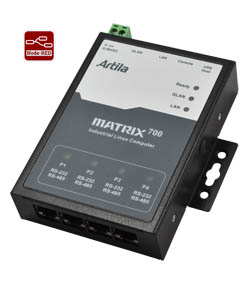
Matrix-700
Cortex A5 Embedded Computer 2* LAN 4*RS232/485 2*USB
240,00 EUR
including VAT 285.60 EUR
- Processor: ATMEL ATSAMA5D35 ARM Cortex-A5 CPU, 536 MHz with MMU.
- Memory: 512 MB LPDDR2 SDRAM, 8 GB eMMC Flash, and 8 MB DataFlash for system backup.
- Operating System: Linux kernel 4.9.x (Yocto-based), EXT4 file system, BareBox bootloader.
- Networking: Dual Ethernet ports — one Gigabit (RJ45) and one 10/100 Mbps (RJ45).
- Serial Communication: Four software-selectable RS-232/RS-485 ports with automatic flow control.
- USB Interfaces: Two USB 2.0 high-speed host ports (480 Mbps) and one micro-USB console/client port.
- Storage Expansion: One microSD slot (SD 2.0 compliant, SDHC up to 64 GB).
- Power Input: 9–48 V DC via terminal block or 5 V DC via micro-USB.
- Power Consumption: < 3 W typical (200 mA @ 12 V DC).
- Operating Temperature: 0 °C – 70 °C (32 °F – 158 °F).
- Form Factor: Compact box computer, fanless design, DIN-rail mountable.
- Certifications: CE Class A, FCC Class A.
- Software Environment: Debian-compatible Linux with apt-get package management, gcc 6.2.0 + glibc 2.24 toolchain, and preinstalled development utilities.
- Preinstalled Services: SSH, Nginx web server, PHP/Perl/Python/NodeJS, SQLite3, Webmin, iptables, BusyBox, vim/nano/sed.
- Reliability Features: Hardware watchdog, real-time clock with supercapacitor backup, buzzer, system-ready LED indicators.
- Low Power Design: Ultra-low power consumption suitable for always-on embedded systems.
- Memory: 512 MB LPDDR2 SDRAM, 8 GB eMMC Flash, and 8 MB DataFlash for system backup.
- Operating System: Linux kernel 4.9.x (Yocto-based), EXT4 file system, BareBox bootloader.
- Networking: Dual Ethernet ports — one Gigabit (RJ45) and one 10/100 Mbps (RJ45).
- Serial Communication: Four software-selectable RS-232/RS-485 ports with automatic flow control.
- USB Interfaces: Two USB 2.0 high-speed host ports (480 Mbps) and one micro-USB console/client port.
- Storage Expansion: One microSD slot (SD 2.0 compliant, SDHC up to 64 GB).
- Power Input: 9–48 V DC via terminal block or 5 V DC via micro-USB.
- Power Consumption: < 3 W typical (200 mA @ 12 V DC).
- Operating Temperature: 0 °C – 70 °C (32 °F – 158 °F).
- Form Factor: Compact box computer, fanless design, DIN-rail mountable.
- Certifications: CE Class A, FCC Class A.
- Software Environment: Debian-compatible Linux with apt-get package management, gcc 6.2.0 + glibc 2.24 toolchain, and preinstalled development utilities.
- Preinstalled Services: SSH, Nginx web server, PHP/Perl/Python/NodeJS, SQLite3, Webmin, iptables, BusyBox, vim/nano/sed.
- Reliability Features: Hardware watchdog, real-time clock with supercapacitor backup, buzzer, system-ready LED indicators.
- Low Power Design: Ultra-low power consumption suitable for always-on embedded systems.
1. Product Overview
Product Name: Matrix-700
Model: Matrix-700
Series: Matrix-7xx Industrial IoT Gateway Series
Article Number: Matrix-700
Manufacturer: Artila Electronics Co., Ltd.
Product Type: Linux-ready Cortex-A5 Industrial Embedded Box Computer
The Artila Matrix-700 is a compact, fanless, low-power industrial embedded computer designed for continuous 24/7 operation in unmanned or remote environments. It is based on the ATMEL ATSAMA5D35 ARM Cortex-A5 processor running at 536 MHz and integrates 512 MB LPDDR2 SDRAM and 8 GB eMMC Flash storage. The system runs a Debian-compatible Linux distribution with kernel 4.9.x (earlier versions 3.18.x and 4.4.x) and an EXT4 file system. It is engineered for industrial automation, IoT gateways, data acquisition, and embedded control applications requiring reliability, low power consumption, and flexible connectivity.
2. Key Features
- Processor: ATMEL ATSAMA5D35 ARM Cortex-A5 CPU, 536 MHz with MMU.
- Memory: 512 MB LPDDR2 SDRAM, 8 GB eMMC Flash, and 8 MB DataFlash for system backup.
- Operating System: Linux kernel 4.9.x (Yocto-based), EXT4 file system, BareBox bootloader.
- Networking: Dual Ethernet ports — one Gigabit (RJ45) and one 10/100 Mbps (RJ45).
- Serial Communication: Four software-selectable RS-232/RS-485 ports with automatic flow control.
- USB Interfaces: Two USB 2.0 high-speed host ports (480 Mbps) and one micro-USB console/client port.
- Storage Expansion: One microSD slot (SD 2.0 compliant, SDHC up to 64 GB).
- Power Input: 9–48 V DC via terminal block or 5 V DC via micro-USB.
- Power Consumption: < 3 W typical (200 mA @ 12 V DC).
- Operating Temperature: 0 °C – 70 °C (32 °F – 158 °F).
- Form Factor: Compact box computer, fanless design, DIN-rail mountable.
- Certifications: CE Class A, FCC Class A.
- Software Environment: Debian-compatible Linux with apt-get package management, gcc 6.2.0 + glibc 2.24 toolchain, and preinstalled development utilities.
- Preinstalled Services: SSH, Nginx web server, PHP/Perl/Python/NodeJS, SQLite3, Webmin, iptables, BusyBox, vim/nano/sed.
- Reliability Features: Hardware watchdog, real-time clock with supercapacitor backup, buzzer, system-ready LED indicators.
- Low Power Design: Ultra-low power consumption suitable for always-on embedded systems.
3. Technical Specifications
| Category | Specification |
|---------------|------------------|
| CPU | ATMEL ATSAMA5D35 ARM Cortex-A5, 536 MHz |
| Memory | 512 MB LPDDR2 SDRAM |
| Flash Storage | 8 GB eMMC Flash, 8 MB DataFlash (system backup) |
| Network Interfaces | 1 × Gigabit Ethernet (RJ45), 1 × 10/100 Mbps Ethernet (RJ45) |
| Serial Ports | 4 × RS-232/RS-485 (software selectable) |
| Serial Signals | RS-232: TX, RX, RTS, CTS; RS-485: Data+, Data– |
| Baud Rate | Up to 921.6 kbps |
| Parity / Data / Stop Bits | Parity: None/Even/Odd/Mark/Space; Data bits: 5–8; Stop bits: 1/1.5/2 |
| Flow Control | RTS/CTS, XON/XOFF, or None |
| USB Ports | 2 × USB 2.0 Host (480 Mbps), 1 × micro-USB Console/Client |
| SD Slot | 1 × microSD (SD 2.0, SDHC up to 64 GB) |
| Power Input | 9–48 V DC via terminal block or 5 V DC via micro-USB |
| Power Consumption | Typical 200 mA @ 12 V DC (< 3 W) |
| Dimensions (W × H × D) | 78 × 108 × 24 mm |
| Operating Temperature | 0 °C – 70 °C |
| RTC | Real-time clock with supercapacitor backup |
| Watchdog | Hardware watchdog timer |
| Buzzer | Integrated system buzzer |
| Indicators | System Ready LED, LAN/Gigabit LAN LEDs, Serial Port LEDs |
| Regulatory Compliance | CE Class A, FCC Class A |
| Weight | Approx. 200 g (typical for enclosure and components) |
4. Functionality
The Matrix-700 functions as a compact embedded Linux computer optimized for industrial and IoT applications. It boots from its onboard eMMC or an external microSD card using the BareBox bootloader. The preinstalled Linux OS provides a Debian-compatible environment supporting apt-get package management and standard GNU development tools.
Use Cases and Applications:
- Industrial automation and control systems.
- IoT edge gateways for data collection and protocol conversion.
- Remote monitoring and telemetry.
- Serial-to-Ethernet communication bridges.
- Embedded web servers and data loggers.
- Machine-to-machine (M2M) communication nodes.
Compatibility:
- Compatible with standard Linux software stacks and open-source tools.
- Supports C/C++/Python/NodeJS development.
- Works with USB peripherals, Ethernet networks, and serial devices.
- Integrates with Webmin for browser-based system management.
5. Components & Accessories
Included Items:
- Matrix-700 embedded box computer unit.
- Preinstalled Linux OS and file system.
- User documentation and online resources.
Optional Accessories:
- CB-RJ45F9-150 (91-R45F9-150): Serial cable (RJ45 to DB9 Female, 150 cm).
- DK-35A (36-DK35A-000): DIN-rail mounting kit for industrial installation.
- PWR-12V-1A (31-62100-000): 110–240 V AC to 12 V DC 1 A power adapter.
Connectors:
- Dual RJ45 Ethernet ports.
- Four RJ45 serial ports (RS-232/485).
- Two USB 2.0 Type-A host ports.
- One micro-USB console/client port.
- Terminal block for DC power input.
- microSD slot for storage expansion.
6. Installation & Setup
Powering the Device:
- Supply 9–48 V DC via terminal block or 5 V DC via micro-USB.
- Upon power-up, the system buzzer beeps once, LEDs indicate boot sequence, and the Ready LED turns solid green when the system is operational.
Mounting Options:
- Desktop or wall mounting.
- Optional DIN-rail mounting using DK-35A kit.
Initial Configuration:
- Access the console via micro-USB (CDC/ACM serial device).
- Default serial parameters: 115200 bps, 8 N 1, VT100.
- Default login: user = root, password = root.
- Network defaults:
- eth0 (Gigabit): DHCP (dynamic IP).
- eth1 (10/100 Mbps): static IP 192.168.2.127.
- Modify network settings in `/etc/network/interfaces`.
- SSH access enabled by default.
Software Setup:
- Supports apt-get for package installation and updates.
- Webmin accessible via HTTPS at `https://192.168.2.127:10000` (admin/admin).
- Nginx web server preconfigured with root directory `/var/www/localhost/html`.
7. Performance & Capabilities
- Processing: 536 MHz ARM Cortex-A5 with MMU, optimized for low power and embedded workloads.
- Memory Performance: 512 MB LPDDR2 ensures stable multitasking for lightweight server and gateway applications.
- Storage: 8 GB eMMC provides fast boot and reliable data retention; microSD expansion supports up to 64 GB.
- Networking: Dual Ethernet interfaces allow separation of LAN/WAN or redundant network configurations.
- Serial Communication: Four high-speed serial ports (up to 921.6 kbps) with flexible RS-232/485 configuration.
- USB Throughput: Two USB 2.0 host ports supporting 480 Mbps for peripherals such as flash drives, Wi-Fi dongles, or serial adapters.
- Power Efficiency: Consumes less than 3 W, ideal for battery or solar-powered systems.
- Reliability: Hardware watchdog and RTC ensure continuous operation and time synchronization.
- Limitations: Not designed for high-performance computing or graphics; optimized for headless embedded control and communication tasks.
8. Standards & Compliance
- Electrical Safety & EMC: CE Class A, FCC Class A compliant.
- Environmental: Operating temperature 0–70 °C, suitable for industrial indoor environments.
- Software Standards:
- Linux kernel 4.9.x (Yocto-based).
- EXT4 file system.
- GNU toolchain (gcc 6.2.0 + glibc 2.24).
- Debian package management (apt-get).
- Networking Protocols Supported: IPv4, ICMP, ARP, DHCP, NTP, TCP, UDP, FTP, HTTP, PPP, PPPoE, SMTP, SNMP v1/v3, SSL, SSH 1/2.
- Device Drivers: Standard Linux drivers for Ethernet, serial, GPIO, RTC, USB, and SD/MMC.
- Compliance with Open Source Standards: Fully compatible with Yocto Project and Debian repositories.
9. Additional Information
Warranty & Support:
Artila Electronics provides standard warranty coverage and technical support for the Matrix-700. Documentation, firmware updates, and SDKs are available from [www.artila.com](http://www.artila.com).
Maintenance & Updates:
- System updates via apt-get or Artila’s repository.
- Backup and restore utilities available for eMMC and SD/USB devices.
- Factory restore procedure supported via bootable microSD or USB drive.
- Webmin interface for system monitoring and configuration.
- Watchdog and RTC ensure system reliability during unattended operation.
Software Development Environment:
- Cross-compilation toolchain for Cortex-A5 (Yocto-based).
- Native gcc/g++ toolchains preinstalled for on-device compilation.
- Supports Python 2.7 and optional Python 3.x via apt-get.
- Compatible with Eclipse IDE and Yocto Project ADT plug-ins for remote development.
- Supports C/C++, Python, Perl, PHP, and NodeJS programming.
Backup & Restore Utilities:
- `backup /dev/sda1` and `restore /dev/sda1` commands for full system image management.
- Factory restore via `restore factory` command or bootable SD image.
- LED indicators show progress during backup/restore operations.
Web & Network Services:
- Preinstalled Nginx web server with PHP/Perl/Python support.
- SSH and FTP servers for remote access.
- SNMP and iptables for network management and security.
- Webmin for browser-based administration.
Expansion & Customization:
- USB Wi-Fi dongle support (RTL8192/RT5390 chipsets).
- GPIO access via sysfs for user-defined I/O control.
- Supports additional kernel modules via `/etc/modules`.
- Compatible with Eclipse Yocto plug-ins for embedded development.
Reliability & Industrial Design:
- Fanless aluminum enclosure for silent operation.
- Designed for 24/7/365 uptime in industrial automation and IoT environments.
- Supercapacitor-backed RTC maintains time during power loss.
- Hardware watchdog automatically recovers from system hangs.
Summary:
The Artila Matrix-700 is a robust, Linux-ready industrial embedded computer built around the ARM Cortex-A5 architecture. It combines low power consumption, flexible I/O, and open-source software compatibility in a compact form factor. With dual Ethernet, multiple serial ports, USB interfaces, and comprehensive Linux support, it serves as an ideal platform for industrial IoT gateways, automation controllers, and embedded data acquisition systems. Its Debian-compatible environment, preinstalled development tools, and Webmin interface simplify deployment and maintenance, while its hardware reliability features ensure continuous operation in demanding industrial settings.
Product Name: Matrix-700
Model: Matrix-700
Series: Matrix-7xx Industrial IoT Gateway Series
Article Number: Matrix-700
Manufacturer: Artila Electronics Co., Ltd.
Product Type: Linux-ready Cortex-A5 Industrial Embedded Box Computer
The Artila Matrix-700 is a compact, fanless, low-power industrial embedded computer designed for continuous 24/7 operation in unmanned or remote environments. It is based on the ATMEL ATSAMA5D35 ARM Cortex-A5 processor running at 536 MHz and integrates 512 MB LPDDR2 SDRAM and 8 GB eMMC Flash storage. The system runs a Debian-compatible Linux distribution with kernel 4.9.x (earlier versions 3.18.x and 4.4.x) and an EXT4 file system. It is engineered for industrial automation, IoT gateways, data acquisition, and embedded control applications requiring reliability, low power consumption, and flexible connectivity.
2. Key Features
- Processor: ATMEL ATSAMA5D35 ARM Cortex-A5 CPU, 536 MHz with MMU.
- Memory: 512 MB LPDDR2 SDRAM, 8 GB eMMC Flash, and 8 MB DataFlash for system backup.
- Operating System: Linux kernel 4.9.x (Yocto-based), EXT4 file system, BareBox bootloader.
- Networking: Dual Ethernet ports — one Gigabit (RJ45) and one 10/100 Mbps (RJ45).
- Serial Communication: Four software-selectable RS-232/RS-485 ports with automatic flow control.
- USB Interfaces: Two USB 2.0 high-speed host ports (480 Mbps) and one micro-USB console/client port.
- Storage Expansion: One microSD slot (SD 2.0 compliant, SDHC up to 64 GB).
- Power Input: 9–48 V DC via terminal block or 5 V DC via micro-USB.
- Power Consumption: < 3 W typical (200 mA @ 12 V DC).
- Operating Temperature: 0 °C – 70 °C (32 °F – 158 °F).
- Form Factor: Compact box computer, fanless design, DIN-rail mountable.
- Certifications: CE Class A, FCC Class A.
- Software Environment: Debian-compatible Linux with apt-get package management, gcc 6.2.0 + glibc 2.24 toolchain, and preinstalled development utilities.
- Preinstalled Services: SSH, Nginx web server, PHP/Perl/Python/NodeJS, SQLite3, Webmin, iptables, BusyBox, vim/nano/sed.
- Reliability Features: Hardware watchdog, real-time clock with supercapacitor backup, buzzer, system-ready LED indicators.
- Low Power Design: Ultra-low power consumption suitable for always-on embedded systems.
3. Technical Specifications
| Category | Specification |
|---------------|------------------|
| CPU | ATMEL ATSAMA5D35 ARM Cortex-A5, 536 MHz |
| Memory | 512 MB LPDDR2 SDRAM |
| Flash Storage | 8 GB eMMC Flash, 8 MB DataFlash (system backup) |
| Network Interfaces | 1 × Gigabit Ethernet (RJ45), 1 × 10/100 Mbps Ethernet (RJ45) |
| Serial Ports | 4 × RS-232/RS-485 (software selectable) |
| Serial Signals | RS-232: TX, RX, RTS, CTS; RS-485: Data+, Data– |
| Baud Rate | Up to 921.6 kbps |
| Parity / Data / Stop Bits | Parity: None/Even/Odd/Mark/Space; Data bits: 5–8; Stop bits: 1/1.5/2 |
| Flow Control | RTS/CTS, XON/XOFF, or None |
| USB Ports | 2 × USB 2.0 Host (480 Mbps), 1 × micro-USB Console/Client |
| SD Slot | 1 × microSD (SD 2.0, SDHC up to 64 GB) |
| Power Input | 9–48 V DC via terminal block or 5 V DC via micro-USB |
| Power Consumption | Typical 200 mA @ 12 V DC (< 3 W) |
| Dimensions (W × H × D) | 78 × 108 × 24 mm |
| Operating Temperature | 0 °C – 70 °C |
| RTC | Real-time clock with supercapacitor backup |
| Watchdog | Hardware watchdog timer |
| Buzzer | Integrated system buzzer |
| Indicators | System Ready LED, LAN/Gigabit LAN LEDs, Serial Port LEDs |
| Regulatory Compliance | CE Class A, FCC Class A |
| Weight | Approx. 200 g (typical for enclosure and components) |
4. Functionality
The Matrix-700 functions as a compact embedded Linux computer optimized for industrial and IoT applications. It boots from its onboard eMMC or an external microSD card using the BareBox bootloader. The preinstalled Linux OS provides a Debian-compatible environment supporting apt-get package management and standard GNU development tools.
Use Cases and Applications:
- Industrial automation and control systems.
- IoT edge gateways for data collection and protocol conversion.
- Remote monitoring and telemetry.
- Serial-to-Ethernet communication bridges.
- Embedded web servers and data loggers.
- Machine-to-machine (M2M) communication nodes.
Compatibility:
- Compatible with standard Linux software stacks and open-source tools.
- Supports C/C++/Python/NodeJS development.
- Works with USB peripherals, Ethernet networks, and serial devices.
- Integrates with Webmin for browser-based system management.
5. Components & Accessories
Included Items:
- Matrix-700 embedded box computer unit.
- Preinstalled Linux OS and file system.
- User documentation and online resources.
Optional Accessories:
- CB-RJ45F9-150 (91-R45F9-150): Serial cable (RJ45 to DB9 Female, 150 cm).
- DK-35A (36-DK35A-000): DIN-rail mounting kit for industrial installation.
- PWR-12V-1A (31-62100-000): 110–240 V AC to 12 V DC 1 A power adapter.
Connectors:
- Dual RJ45 Ethernet ports.
- Four RJ45 serial ports (RS-232/485).
- Two USB 2.0 Type-A host ports.
- One micro-USB console/client port.
- Terminal block for DC power input.
- microSD slot for storage expansion.
6. Installation & Setup
Powering the Device:
- Supply 9–48 V DC via terminal block or 5 V DC via micro-USB.
- Upon power-up, the system buzzer beeps once, LEDs indicate boot sequence, and the Ready LED turns solid green when the system is operational.
Mounting Options:
- Desktop or wall mounting.
- Optional DIN-rail mounting using DK-35A kit.
Initial Configuration:
- Access the console via micro-USB (CDC/ACM serial device).
- Default serial parameters: 115200 bps, 8 N 1, VT100.
- Default login: user = root, password = root.
- Network defaults:
- eth0 (Gigabit): DHCP (dynamic IP).
- eth1 (10/100 Mbps): static IP 192.168.2.127.
- Modify network settings in `/etc/network/interfaces`.
- SSH access enabled by default.
Software Setup:
- Supports apt-get for package installation and updates.
- Webmin accessible via HTTPS at `https://192.168.2.127:10000` (admin/admin).
- Nginx web server preconfigured with root directory `/var/www/localhost/html`.
7. Performance & Capabilities
- Processing: 536 MHz ARM Cortex-A5 with MMU, optimized for low power and embedded workloads.
- Memory Performance: 512 MB LPDDR2 ensures stable multitasking for lightweight server and gateway applications.
- Storage: 8 GB eMMC provides fast boot and reliable data retention; microSD expansion supports up to 64 GB.
- Networking: Dual Ethernet interfaces allow separation of LAN/WAN or redundant network configurations.
- Serial Communication: Four high-speed serial ports (up to 921.6 kbps) with flexible RS-232/485 configuration.
- USB Throughput: Two USB 2.0 host ports supporting 480 Mbps for peripherals such as flash drives, Wi-Fi dongles, or serial adapters.
- Power Efficiency: Consumes less than 3 W, ideal for battery or solar-powered systems.
- Reliability: Hardware watchdog and RTC ensure continuous operation and time synchronization.
- Limitations: Not designed for high-performance computing or graphics; optimized for headless embedded control and communication tasks.
8. Standards & Compliance
- Electrical Safety & EMC: CE Class A, FCC Class A compliant.
- Environmental: Operating temperature 0–70 °C, suitable for industrial indoor environments.
- Software Standards:
- Linux kernel 4.9.x (Yocto-based).
- EXT4 file system.
- GNU toolchain (gcc 6.2.0 + glibc 2.24).
- Debian package management (apt-get).
- Networking Protocols Supported: IPv4, ICMP, ARP, DHCP, NTP, TCP, UDP, FTP, HTTP, PPP, PPPoE, SMTP, SNMP v1/v3, SSL, SSH 1/2.
- Device Drivers: Standard Linux drivers for Ethernet, serial, GPIO, RTC, USB, and SD/MMC.
- Compliance with Open Source Standards: Fully compatible with Yocto Project and Debian repositories.
9. Additional Information
Warranty & Support:
Artila Electronics provides standard warranty coverage and technical support for the Matrix-700. Documentation, firmware updates, and SDKs are available from [www.artila.com](http://www.artila.com).
Maintenance & Updates:
- System updates via apt-get or Artila’s repository.
- Backup and restore utilities available for eMMC and SD/USB devices.
- Factory restore procedure supported via bootable microSD or USB drive.
- Webmin interface for system monitoring and configuration.
- Watchdog and RTC ensure system reliability during unattended operation.
Software Development Environment:
- Cross-compilation toolchain for Cortex-A5 (Yocto-based).
- Native gcc/g++ toolchains preinstalled for on-device compilation.
- Supports Python 2.7 and optional Python 3.x via apt-get.
- Compatible with Eclipse IDE and Yocto Project ADT plug-ins for remote development.
- Supports C/C++, Python, Perl, PHP, and NodeJS programming.
Backup & Restore Utilities:
- `backup /dev/sda1` and `restore /dev/sda1` commands for full system image management.
- Factory restore via `restore factory` command or bootable SD image.
- LED indicators show progress during backup/restore operations.
Web & Network Services:
- Preinstalled Nginx web server with PHP/Perl/Python support.
- SSH and FTP servers for remote access.
- SNMP and iptables for network management and security.
- Webmin for browser-based administration.
Expansion & Customization:
- USB Wi-Fi dongle support (RTL8192/RT5390 chipsets).
- GPIO access via sysfs for user-defined I/O control.
- Supports additional kernel modules via `/etc/modules`.
- Compatible with Eclipse Yocto plug-ins for embedded development.
Reliability & Industrial Design:
- Fanless aluminum enclosure for silent operation.
- Designed for 24/7/365 uptime in industrial automation and IoT environments.
- Supercapacitor-backed RTC maintains time during power loss.
- Hardware watchdog automatically recovers from system hangs.
Summary:
The Artila Matrix-700 is a robust, Linux-ready industrial embedded computer built around the ARM Cortex-A5 architecture. It combines low power consumption, flexible I/O, and open-source software compatibility in a compact form factor. With dual Ethernet, multiple serial ports, USB interfaces, and comprehensive Linux support, it serves as an ideal platform for industrial IoT gateways, automation controllers, and embedded data acquisition systems. Its Debian-compatible environment, preinstalled development tools, and Webmin interface simplify deployment and maintenance, while its hardware reliability features ensure continuous operation in demanding industrial settings.
-
 Matrix-700_Datasheet.pdf
PDF Catalog
Matrix-700_Datasheet.pdf
PDF Catalog
-
 Matrix-700_User_Guide.pdf
Manual
Matrix-700_User_Guide.pdf
Manual

No accessories available.