CB-F10M9-20
LOOKING FOR THE RIGHT
INDUSTRIAL SOLUTION?
Discover embedded, communication and automation solutions tailored to your application.
- Processor: ARM926EJ-S ARM Thumb Processor (Atmel AT91SAM9G20) operating at 400 MHz with integrated MMU.
- Memory: 64 MB SDRAM and 128 MB NAND Flash (expandable via SD card).
- Storage: Onboard NAND Flash stores bootloader, Linux kernel, root filesystem, and user data.
- Networking: Two independent 10/100 Mbps Ethernet ports (LAN1 and LAN2) with Link/Activity LEDs.
- Serial Communication:
- 4 serial ports total:
- Ports 1–2: Software-selectable RS-232 or isolated RS-485.
- Ports 3–4: RS-232 with hardware flow control.
- Port 2 supports full modem control (DSR, DCD, DTR).
- USB Connectivity:
- Two USB 2.0 full-speed (12 Mbps) host ports.
- One USB device port.
- Expansion: MicroSD card slot for additional storage.
- Operating System: Pre-installed Linux kernel 2.6.x with BusyBox utilities and Artila’s software suite.
- Power Input: 9 – 40 V DC with surge and polarity protection.
- Mounting: DIN-rail mountable design for industrial environments.
- Security: Supports SSL and SSH (v1.0/2.0) for secure remote access.
- Web Server: Integrated Apache2 or Lighttpd web server for remote management and web-based applications.
- Software Development:
- GNU toolchain for Linux and Windows (gcc 4.3.3, glibc 2.8/2.9, binutils 2.18/2.19).
- Supports cross-compilation and remote deployment.
- Utility Software: Includes Artila utilities (update, setuart, setconsole, gpioctl, version) and package management via `ipkg`.
- Recovery System: Built-in DataFlash recovery mode for system restoration and firmware updates.
- Memory: 64 MB SDRAM and 128 MB NAND Flash (expandable via SD card).
- Storage: Onboard NAND Flash stores bootloader, Linux kernel, root filesystem, and user data.
- Networking: Two independent 10/100 Mbps Ethernet ports (LAN1 and LAN2) with Link/Activity LEDs.
- Serial Communication:
- 4 serial ports total:
- Ports 1–2: Software-selectable RS-232 or isolated RS-485.
- Ports 3–4: RS-232 with hardware flow control.
- Port 2 supports full modem control (DSR, DCD, DTR).
- USB Connectivity:
- Two USB 2.0 full-speed (12 Mbps) host ports.
- One USB device port.
- Expansion: MicroSD card slot for additional storage.
- Operating System: Pre-installed Linux kernel 2.6.x with BusyBox utilities and Artila’s software suite.
- Power Input: 9 – 40 V DC with surge and polarity protection.
- Mounting: DIN-rail mountable design for industrial environments.
- Security: Supports SSL and SSH (v1.0/2.0) for secure remote access.
- Web Server: Integrated Apache2 or Lighttpd web server for remote management and web-based applications.
- Software Development:
- GNU toolchain for Linux and Windows (gcc 4.3.3, glibc 2.8/2.9, binutils 2.18/2.19).
- Supports cross-compilation and remote deployment.
- Utility Software: Includes Artila utilities (update, setuart, setconsole, gpioctl, version) and package management via `ipkg`.
- Recovery System: Built-in DataFlash recovery mode for system restoration and firmware updates.
Comprehensive Product Summary – PAC-4000 ARM-9 Automation Controller
### 1. Product Overview
Product Name: PAC-4000
Model: PAC-4000
Series: ARM-9 Industrial Automation Controller
Article Number: PAC-4000
Manufacturer: Artila Electronics Co., Ltd.
Version: 1.0
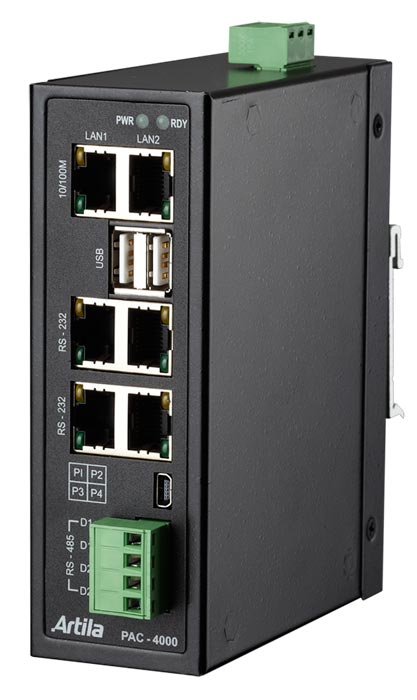
The Artila PAC-4000 is a compact, fanless, ARM9-based programmable automation controller designed for industrial and embedded applications. It integrates a 400 MHz ARM926EJ-S processor, dual Ethernet ports, multiple serial interfaces, and USB connectivity, all within a DIN-rail mountable enclosure. The controller runs a pre-installed Linux 2.6 operating system and supports a full GNU C/C++ development environment, making it ideal for automation, data acquisition, and networked control systems.
### 2. Key Features
- Processor: ARM926EJ-S ARM Thumb Processor (Atmel AT91SAM9G20) operating at 400 MHz with integrated MMU.
- Memory: 64 MB SDRAM and 128 MB NAND Flash (expandable via SD card).
- Storage: Onboard NAND Flash stores bootloader, Linux kernel, root filesystem, and user data.
- Networking: Two independent 10/100 Mbps Ethernet ports (LAN1 and LAN2) with Link/Activity LEDs.
- Serial Communication:
- 4 serial ports total:
- Ports 1–2: Software-selectable RS-232 or isolated RS-485.
- Ports 3–4: RS-232 with hardware flow control.
- Port 2 supports full modem control (DSR, DCD, DTR).
- USB Connectivity:
- Two USB 2.0 full-speed (12 Mbps) host ports.
- One USB device port.
- Expansion: MicroSD card slot for additional storage.
- Operating System: Pre-installed Linux kernel 2.6.x with BusyBox utilities and Artila’s software suite.
- Power Input: 9 – 40 V DC with surge and polarity protection.
- Mounting: DIN-rail mountable design for industrial environments.
- Security: Supports SSL and SSH (v1.0/2.0) for secure remote access.
- Web Server: Integrated Apache2 or Lighttpd web server for remote management and web-based applications.
- Software Development:
- GNU toolchain for Linux and Windows (gcc 4.3.3, glibc 2.8/2.9, binutils 2.18/2.19).
- Supports cross-compilation and remote deployment.
- Utility Software: Includes Artila utilities (update, setuart, setconsole, gpioctl, version) and package management via `ipkg`.
- Recovery System: Built-in DataFlash recovery mode for system restoration and firmware updates.
### 3. Technical Specifications
| Parameter | Specification |
|----------------|-------------------|
| Processor | ARM926EJ-S (Atmel AT91SAM9G20), 400 MHz |
| Memory | 64 MB SDRAM |
| Flash Storage | 128 MB NAND Flash |
| External Storage | MicroSD card slot |
| Ethernet Ports | 2 × 10/100 Base-T (RJ45) |
| USB Ports | 2 × USB 2.0 Host (12 Mbps), 1 × USB Device |
| Serial Ports | 4 total (2 × RS-232/RS-485 isolated, 2 × RS-232) |
| Power Input | 9 – 40 V DC, 300 mA @ 12 V DC |
| Power Protection | Surge protection, auto-polarity, shielding ground |
| Operating Temperature | 0 °C – 70 °C |
| Dimensions | 130 mm × 45 mm × 102.5 mm |
| Mounting | DIN-rail |
| Weight | Approx. 0.5 kg (typical) |
| Operating System | Linux 2.6.x |
| Toolchain | GNU C/C++ (Linux/Windows) |
| Network Protocols | TCP/IP, SSH, SSL, FTP, Telnet, HTTP |
| Indicators | Power LED, Ready LED, Link/Act LEDs, Serial TX/RX LEDs |
| Compliance | CE, RoHS (industrial-grade components) |
### 4. Functionality
The PAC-4000 functions as a compact embedded automation controller capable of running standalone or networked applications. It boots from onboard NAND Flash, loads the Linux kernel, and mounts the root filesystem automatically. Users can access the system via Ethernet (SSH, Telnet, FTP, or web interface) or through the serial console.
Use Cases and Applications:
- Industrial process control and monitoring.
- Data acquisition and logging.
- Remote device management and SCADA integration.
- Embedded web server for equipment configuration.
- Protocol conversion (RS-232/RS-485 to Ethernet).
- Edge computing and IoT gateway applications.
Compatibility:
- Compatible with USB storage devices, USB-to-serial adapters, and USB WLAN adapters (e.g., Ralink RT2571).
- Supports standard Linux utilities and third-party software via `ipkg`.
- Works with Windows or Linux hosts for cross-compilation and deployment.
### 5. Components & Accessories
Included Items:
1. PAC-4000 Programmable Automation Controller.
2. DIN-rail mounting bracket.
3. Artila CD (includes documentation, utilities, and GNU toolchain).
Optional Accessories:
- CB-RJ45F9-150: RJ45 to DB9 Female Cable (for serial connection).
- CB-BHDB9-020: M-502 console cable (for internal console access).
- PWR-12V-1A: 12 V DC power adapter.
Connectors:
- 3-pin plug-in screw terminal for power input.
- RJ45 connectors for Ethernet ports.
- DB9 connectors for serial ports.
- USB Type-A connectors for host ports.
- MicroSD slot for removable storage.
### 6. Installation & Setup
Power Requirements:
- Input voltage: 9 – 40 V DC.
- Typical consumption: 300 mA @ 12 V DC.
- Connect via 3-pin terminal block with shielding ground for EMI protection.
Mounting:
- DIN-rail bracket included for quick installation in control cabinets.
- Ensure adequate ventilation for fanless operation.
Initial Configuration:
- Default IP addresses:
- LAN1: 192.168.2.127
- LAN2: 192.168.3.127
- Default login credentials:
- Username: root / guest
- Password: root / guest (guest for Telnet only)
- Serial console settings:
- Baud rate: 115200 bps
- Data bits: 8
- Parity: None
- Stop bits: 1
- Terminal type: VT100
Network Setup:
- Edit `/etc/network/interfaces` to configure static or dynamic IP.
- Supports USB WLAN adapters (enable `rt73usb` module).
- Wireless configuration via `wireless_essid` and `wireless_key` parameters.
Software Setup:
- Use `ipkg` for package management (install, update, remove software).
- Cross-compile applications using the provided GNU toolchain.
- Transfer executables via FTP and set execution permissions.
### 7. Performance & Capabilities
Processing Performance:
- 400 MHz ARM9 CPU with 32 KB instruction and 32 KB data cache ensures efficient multitasking for embedded control.
Networking:
- Dual Ethernet interfaces allow network redundancy or separation of control and data networks.
- Integrated SSH and SSL provide secure remote access.
Serial Communication:
- Four serial ports with flexible configuration support a wide range of industrial devices.
- Isolated RS-485 ports ensure reliable communication in noisy environments.
Storage and File System:
- NAND Flash stores OS and user data; MicroSD and USB drives provide expansion.
- File system includes `/home` for user applications and `/usr/www` for web content.
System Boot and Recovery:
- Bootloader (uBoot) initializes the system and loads the Linux kernel.
- Automatic fallback to DataFlash recovery mode if NAND Flash fails.
- Recovery menu allows firmware update, filesystem creation, and environment restoration.
Efficiency and Reliability:
- Fanless design for silent, maintenance-free operation.
- Wide input voltage range and surge protection for industrial reliability.
- Operating temperature range 0 °C – 70 °C suitable for control cabinets and field installations.
Limitations:
- Limited onboard memory (64 MB SDRAM) restricts very large applications.
- USB ports operate at full-speed (12 Mbps), not high-speed (480 Mbps).
### 8. Standards & Compliance
- Operating System: Linux kernel 2.6.x (open-source, POSIX-compliant).
- Software Tools: GNU toolchain (gcc, glibc, binutils).
- Network Protocols: TCP/IP, SSH, SSL, FTP, HTTP, Telnet.
- Industrial Standards: RS-232, RS-485, Ethernet 10/100Base-T.
- Regulatory Compliance:
- CE (Electromagnetic Compatibility).
- RoHS (Restriction of Hazardous Substances).
- File System Standards: ext2/ext3 compatible.
- Security Standards: SSH v1/v2, SSL encryption for secure communication.
### 9. Additional Information
Warranty & Support:
- Standard manufacturer warranty (typically 1 year, extendable).
- Technical support available via Artila’s website and documentation CD.
- Firmware updates and software packages downloadable from Artila FTP server.
Maintenance:
- Fanless design minimizes mechanical wear.
- Regularly back up user data and configuration files.
- Use `update` utility for firmware and kernel updates.
- Use `gpioctl` and `setuart` utilities for hardware configuration.
Software Updates:
- Managed via `ipkg` package manager.
- Configuration file: `/etc/ipkg.conf`.
- Supports installation from Artila FTP or local USB storage.
- Example repositories:
- `ftp://ftp:ftp@ftp.artila.com/AT9G20/Artila-CD/Linux/Utility`
- `ftp://ftp:ftp@ftp.artila.com/AT9G20/Artila-CD/Linux/modules`
Web-Based Management:
- Webmin interface (port 10000) for system administration.
- Modules include system, server, network, hardware, and file management.
Recovery and Diagnostics:
- Loader menu accessible via serial console for run-level selection.
- System recovery options include:
1. Update Image (loader, kernel, filesystem).
2. Make Filesystem (custom image creation).
3. Recover Environment (restore defaults).
4. Show Info (system version).
5. Reboot.
- Force DataFlash boot by pressing “!” during startup.
Utility Software Collection:
- BusyBox v1.14.2 (core Linux utilities).
- Sysvinit v2.86 (system initialization).
- Lighttpd v1.7 (web server).
- SSH v4.6p1 (secure shell and SFTP).
- iptables v1.3.8 (network routing).
- ipkg v0.99.163 (package management).
- vsftpd v2.0.5 (FTP server).
- bash v3.2 (GNU shell).
- wireless_tools v29 (wireless configuration).
- ppp v2.4.3 (dial-up networking).
- Artila Utility v1.1 (custom management tools).
Development Environment:
- Example programs and Makefiles included on Artila CD.
- Supports auto-start applications via `/etc/rc.local`.
- Cross-compilation supported on major Linux distributions (Fedora, Ubuntu, Debian, CentOS, etc.) and Windows (via CodeSourcery toolchain).
### Summary
The Artila PAC-4000 is a robust, Linux-based industrial automation controller built around the ARM9 architecture. It combines flexible communication interfaces (Ethernet, RS-232/485, USB), reliable solid-state storage, and open-source software support in a compact, fanless form factor. Designed for industrial automation, remote monitoring, and embedded control, the PAC-4000 offers developers a stable, customizable platform with full Linux capabilities, secure networking, and comprehensive recovery tools. Its modular design, wide power range, and DIN-rail mounting make it ideal for deployment in demanding industrial environments where reliability, flexibility, and long-term support are critical.

### 1. Product Overview
Product Name: PAC-4000
Model: PAC-4000
Series: ARM-9 Industrial Automation Controller
Article Number: PAC-4000
Manufacturer: Artila Electronics Co., Ltd.
Version: 1.0
The Artila PAC-4000 is a compact, fanless, ARM9-based programmable automation controller designed for industrial and embedded applications. It integrates a 400 MHz ARM926EJ-S processor, dual Ethernet ports, multiple serial interfaces, and USB connectivity, all within a DIN-rail mountable enclosure. The controller runs a pre-installed Linux 2.6 operating system and supports a full GNU C/C++ development environment, making it ideal for automation, data acquisition, and networked control systems.
### 2. Key Features
- Processor: ARM926EJ-S ARM Thumb Processor (Atmel AT91SAM9G20) operating at 400 MHz with integrated MMU.
- Memory: 64 MB SDRAM and 128 MB NAND Flash (expandable via SD card).
- Storage: Onboard NAND Flash stores bootloader, Linux kernel, root filesystem, and user data.
- Networking: Two independent 10/100 Mbps Ethernet ports (LAN1 and LAN2) with Link/Activity LEDs.
- Serial Communication:
- 4 serial ports total:
- Ports 1–2: Software-selectable RS-232 or isolated RS-485.
- Ports 3–4: RS-232 with hardware flow control.
- Port 2 supports full modem control (DSR, DCD, DTR).
- USB Connectivity:
- Two USB 2.0 full-speed (12 Mbps) host ports.
- One USB device port.
- Expansion: MicroSD card slot for additional storage.
- Operating System: Pre-installed Linux kernel 2.6.x with BusyBox utilities and Artila’s software suite.
- Power Input: 9 – 40 V DC with surge and polarity protection.
- Mounting: DIN-rail mountable design for industrial environments.
- Security: Supports SSL and SSH (v1.0/2.0) for secure remote access.
- Web Server: Integrated Apache2 or Lighttpd web server for remote management and web-based applications.
- Software Development:
- GNU toolchain for Linux and Windows (gcc 4.3.3, glibc 2.8/2.9, binutils 2.18/2.19).
- Supports cross-compilation and remote deployment.
- Utility Software: Includes Artila utilities (update, setuart, setconsole, gpioctl, version) and package management via `ipkg`.
- Recovery System: Built-in DataFlash recovery mode for system restoration and firmware updates.
### 3. Technical Specifications
| Parameter | Specification |
|----------------|-------------------|
| Processor | ARM926EJ-S (Atmel AT91SAM9G20), 400 MHz |
| Memory | 64 MB SDRAM |
| Flash Storage | 128 MB NAND Flash |
| External Storage | MicroSD card slot |
| Ethernet Ports | 2 × 10/100 Base-T (RJ45) |
| USB Ports | 2 × USB 2.0 Host (12 Mbps), 1 × USB Device |
| Serial Ports | 4 total (2 × RS-232/RS-485 isolated, 2 × RS-232) |
| Power Input | 9 – 40 V DC, 300 mA @ 12 V DC |
| Power Protection | Surge protection, auto-polarity, shielding ground |
| Operating Temperature | 0 °C – 70 °C |
| Dimensions | 130 mm × 45 mm × 102.5 mm |
| Mounting | DIN-rail |
| Weight | Approx. 0.5 kg (typical) |
| Operating System | Linux 2.6.x |
| Toolchain | GNU C/C++ (Linux/Windows) |
| Network Protocols | TCP/IP, SSH, SSL, FTP, Telnet, HTTP |
| Indicators | Power LED, Ready LED, Link/Act LEDs, Serial TX/RX LEDs |
| Compliance | CE, RoHS (industrial-grade components) |
### 4. Functionality
The PAC-4000 functions as a compact embedded automation controller capable of running standalone or networked applications. It boots from onboard NAND Flash, loads the Linux kernel, and mounts the root filesystem automatically. Users can access the system via Ethernet (SSH, Telnet, FTP, or web interface) or through the serial console.
Use Cases and Applications:
- Industrial process control and monitoring.
- Data acquisition and logging.
- Remote device management and SCADA integration.
- Embedded web server for equipment configuration.
- Protocol conversion (RS-232/RS-485 to Ethernet).
- Edge computing and IoT gateway applications.
Compatibility:
- Compatible with USB storage devices, USB-to-serial adapters, and USB WLAN adapters (e.g., Ralink RT2571).
- Supports standard Linux utilities and third-party software via `ipkg`.
- Works with Windows or Linux hosts for cross-compilation and deployment.
### 5. Components & Accessories
Included Items:
1. PAC-4000 Programmable Automation Controller.
2. DIN-rail mounting bracket.
3. Artila CD (includes documentation, utilities, and GNU toolchain).
Optional Accessories:
- CB-RJ45F9-150: RJ45 to DB9 Female Cable (for serial connection).
- CB-BHDB9-020: M-502 console cable (for internal console access).
- PWR-12V-1A: 12 V DC power adapter.
Connectors:
- 3-pin plug-in screw terminal for power input.
- RJ45 connectors for Ethernet ports.
- DB9 connectors for serial ports.
- USB Type-A connectors for host ports.
- MicroSD slot for removable storage.
### 6. Installation & Setup
Power Requirements:
- Input voltage: 9 – 40 V DC.
- Typical consumption: 300 mA @ 12 V DC.
- Connect via 3-pin terminal block with shielding ground for EMI protection.
Mounting:
- DIN-rail bracket included for quick installation in control cabinets.
- Ensure adequate ventilation for fanless operation.
Initial Configuration:
- Default IP addresses:
- LAN1: 192.168.2.127
- LAN2: 192.168.3.127
- Default login credentials:
- Username: root / guest
- Password: root / guest (guest for Telnet only)
- Serial console settings:
- Baud rate: 115200 bps
- Data bits: 8
- Parity: None
- Stop bits: 1
- Terminal type: VT100
Network Setup:
- Edit `/etc/network/interfaces` to configure static or dynamic IP.
- Supports USB WLAN adapters (enable `rt73usb` module).
- Wireless configuration via `wireless_essid` and `wireless_key` parameters.
Software Setup:
- Use `ipkg` for package management (install, update, remove software).
- Cross-compile applications using the provided GNU toolchain.
- Transfer executables via FTP and set execution permissions.
### 7. Performance & Capabilities
Processing Performance:
- 400 MHz ARM9 CPU with 32 KB instruction and 32 KB data cache ensures efficient multitasking for embedded control.
Networking:
- Dual Ethernet interfaces allow network redundancy or separation of control and data networks.
- Integrated SSH and SSL provide secure remote access.
Serial Communication:
- Four serial ports with flexible configuration support a wide range of industrial devices.
- Isolated RS-485 ports ensure reliable communication in noisy environments.
Storage and File System:
- NAND Flash stores OS and user data; MicroSD and USB drives provide expansion.
- File system includes `/home` for user applications and `/usr/www` for web content.
System Boot and Recovery:
- Bootloader (uBoot) initializes the system and loads the Linux kernel.
- Automatic fallback to DataFlash recovery mode if NAND Flash fails.
- Recovery menu allows firmware update, filesystem creation, and environment restoration.
Efficiency and Reliability:
- Fanless design for silent, maintenance-free operation.
- Wide input voltage range and surge protection for industrial reliability.
- Operating temperature range 0 °C – 70 °C suitable for control cabinets and field installations.
Limitations:
- Limited onboard memory (64 MB SDRAM) restricts very large applications.
- USB ports operate at full-speed (12 Mbps), not high-speed (480 Mbps).
### 8. Standards & Compliance
- Operating System: Linux kernel 2.6.x (open-source, POSIX-compliant).
- Software Tools: GNU toolchain (gcc, glibc, binutils).
- Network Protocols: TCP/IP, SSH, SSL, FTP, HTTP, Telnet.
- Industrial Standards: RS-232, RS-485, Ethernet 10/100Base-T.
- Regulatory Compliance:
- CE (Electromagnetic Compatibility).
- RoHS (Restriction of Hazardous Substances).
- File System Standards: ext2/ext3 compatible.
- Security Standards: SSH v1/v2, SSL encryption for secure communication.
### 9. Additional Information
Warranty & Support:
- Standard manufacturer warranty (typically 1 year, extendable).
- Technical support available via Artila’s website and documentation CD.
- Firmware updates and software packages downloadable from Artila FTP server.
Maintenance:
- Fanless design minimizes mechanical wear.
- Regularly back up user data and configuration files.
- Use `update` utility for firmware and kernel updates.
- Use `gpioctl` and `setuart` utilities for hardware configuration.
Software Updates:
- Managed via `ipkg` package manager.
- Configuration file: `/etc/ipkg.conf`.
- Supports installation from Artila FTP or local USB storage.
- Example repositories:
- `ftp://ftp:ftp@ftp.artila.com/AT9G20/Artila-CD/Linux/Utility`
- `ftp://ftp:ftp@ftp.artila.com/AT9G20/Artila-CD/Linux/modules`
Web-Based Management:
- Webmin interface (port 10000) for system administration.
- Modules include system, server, network, hardware, and file management.
Recovery and Diagnostics:
- Loader menu accessible via serial console for run-level selection.
- System recovery options include:
1. Update Image (loader, kernel, filesystem).
2. Make Filesystem (custom image creation).
3. Recover Environment (restore defaults).
4. Show Info (system version).
5. Reboot.
- Force DataFlash boot by pressing “!” during startup.
Utility Software Collection:
- BusyBox v1.14.2 (core Linux utilities).
- Sysvinit v2.86 (system initialization).
- Lighttpd v1.7 (web server).
- SSH v4.6p1 (secure shell and SFTP).
- iptables v1.3.8 (network routing).
- ipkg v0.99.163 (package management).
- vsftpd v2.0.5 (FTP server).
- bash v3.2 (GNU shell).
- wireless_tools v29 (wireless configuration).
- ppp v2.4.3 (dial-up networking).
- Artila Utility v1.1 (custom management tools).
Development Environment:
- Example programs and Makefiles included on Artila CD.
- Supports auto-start applications via `/etc/rc.local`.
- Cross-compilation supported on major Linux distributions (Fedora, Ubuntu, Debian, CentOS, etc.) and Windows (via CodeSourcery toolchain).
### Summary
The Artila PAC-4000 is a robust, Linux-based industrial automation controller built around the ARM9 architecture. It combines flexible communication interfaces (Ethernet, RS-232/485, USB), reliable solid-state storage, and open-source software support in a compact, fanless form factor. Designed for industrial automation, remote monitoring, and embedded control, the PAC-4000 offers developers a stable, customizable platform with full Linux capabilities, secure networking, and comprehensive recovery tools. Its modular design, wide power range, and DIN-rail mounting make it ideal for deployment in demanding industrial environments where reliability, flexibility, and long-term support are critical.

-
PAC-4000 Data Sheet.pdf
PDF Catalog
-
Warranty Declaration.pdf
PDF Catalog
-
PAC-4000 User Guide.pdf
Manual
- CB-F10M9-20 - DB9m adapter cable iPAC-50XX
- CB-PHDF9-050 - Console Cable (Wafer box to DB9 Female), 50cm