CB-F10M9-20
LOOKING FOR THE RIGHT
INDUSTRIAL SOLUTION?
Discover embedded, communication and automation solutions tailored to your application.
- Processor: ARM926EJ‑S ARM Thumb Processor, 400 MHz with Memory Management Unit (MMU)
- Memory: 64 MB SDRAM and 128 MB NAND Flash (expandable via SD card)
- Operating System: Pre‑installed Linux Kernel 2.6.x with full GNU C/C++ toolchain support
- Networking: Dual 10/100 Mbps Ethernet ports (LAN 1 and LAN 2)
- USB Connectivity: Two USB 2.0 full‑speed (12 Mbps) host ports and one USB device port
- Serial Communication: Four serial ports (2 × RS‑232/RS‑485 software‑selectable, 2 × RS‑232 with hardware flow control)
- Digital I/O:
- 8 × isolated digital inputs (2500 Vrms isolation, bipolar, 5–24 V logic high)
- 8 × isolated Darlington digital outputs (2500 Vrms isolation, 5–50 V source, 500 mA max per channel)
- Storage Expansion: Micro SD/MMC card interface
- Power Input: 9 – 40 V DC with surge and polarity protection
- Mounting: DIN‑rail ready with included bracket
- Security & Networking: Supports SSL, SSH 1.0/2.0, FTP, Telnet, and web server (Apache2 or Lighttpd)
- Software Utilities: BusyBox, ipkg package manager, Artila utilities (setuart, setconsole, gpioctl, update, version)
- Toolchain Support: Cross‑compilation toolchains for Linux and Windows (GNU gcc 4.3.3, glibc 2.8/2.9, binutils 2.18/2.19)
- Maintenance & Recovery: Built‑in DataFlash recovery system, bootloader (uBoot), and system recovery console
- Memory: 64 MB SDRAM and 128 MB NAND Flash (expandable via SD card)
- Operating System: Pre‑installed Linux Kernel 2.6.x with full GNU C/C++ toolchain support
- Networking: Dual 10/100 Mbps Ethernet ports (LAN 1 and LAN 2)
- USB Connectivity: Two USB 2.0 full‑speed (12 Mbps) host ports and one USB device port
- Serial Communication: Four serial ports (2 × RS‑232/RS‑485 software‑selectable, 2 × RS‑232 with hardware flow control)
- Digital I/O:
- 8 × isolated digital inputs (2500 Vrms isolation, bipolar, 5–24 V logic high)
- 8 × isolated Darlington digital outputs (2500 Vrms isolation, 5–50 V source, 500 mA max per channel)
- Storage Expansion: Micro SD/MMC card interface
- Power Input: 9 – 40 V DC with surge and polarity protection
- Mounting: DIN‑rail ready with included bracket
- Security & Networking: Supports SSL, SSH 1.0/2.0, FTP, Telnet, and web server (Apache2 or Lighttpd)
- Software Utilities: BusyBox, ipkg package manager, Artila utilities (setuart, setconsole, gpioctl, update, version)
- Toolchain Support: Cross‑compilation toolchains for Linux and Windows (GNU gcc 4.3.3, glibc 2.8/2.9, binutils 2.18/2.19)
- Maintenance & Recovery: Built‑in DataFlash recovery system, bootloader (uBoot), and system recovery console
Comprehensive Product Summary – PAC‑4010 ARM‑9 Automation Controller
### 1. Product Overview
Product Name: PAC‑4010
Model: PAC‑4010
Series: ARM‑9 Industrial Automation Controller
Article Number: PAC‑4010
Manufacturer: Artila Electronics Co., Ltd.
Version: 1.0
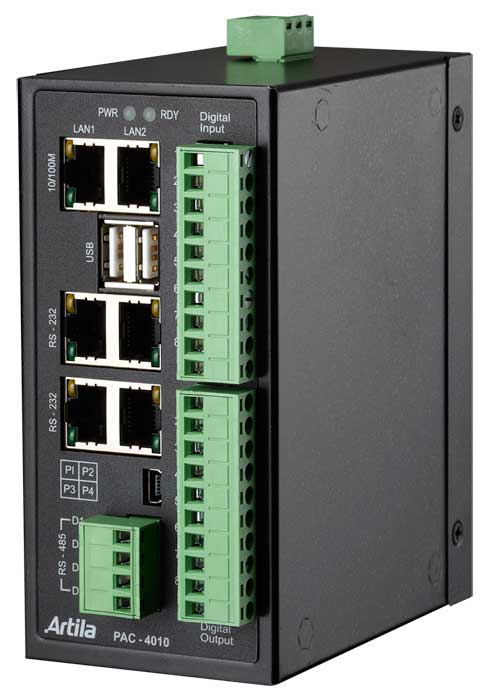
The Artila PAC‑4010 is a compact, fanless, ARM9‑based programmable automation controller designed for industrial automation, data acquisition, and embedded control applications. It integrates a 400 MHz ARM926EJ‑S processor, dual Ethernet ports, multiple serial interfaces, isolated digital I/O channels, and a pre‑installed Linux 2.6 operating system. The controller is engineered for DIN‑rail mounting and operates reliably in harsh industrial environments with a wide DC input range and extended temperature tolerance.
### 2. Key Features
- Processor: ARM926EJ‑S ARM Thumb Processor, 400 MHz with Memory Management Unit (MMU)
- Memory: 64 MB SDRAM and 128 MB NAND Flash (expandable via SD card)
- Operating System: Pre‑installed Linux Kernel 2.6.x with full GNU C/C++ toolchain support
- Networking: Dual 10/100 Mbps Ethernet ports (LAN 1 and LAN 2)
- USB Connectivity: Two USB 2.0 full‑speed (12 Mbps) host ports and one USB device port
- Serial Communication: Four serial ports (2 × RS‑232/RS‑485 software‑selectable, 2 × RS‑232 with hardware flow control)
- Digital I/O:
- 8 × isolated digital inputs (2500 Vrms isolation, bipolar, 5–24 V logic high)
- 8 × isolated Darlington digital outputs (2500 Vrms isolation, 5–50 V source, 500 mA max per channel)
- Storage Expansion: Micro SD/MMC card interface
- Power Input: 9 – 40 V DC with surge and polarity protection
- Mounting: DIN‑rail ready with included bracket
- Security & Networking: Supports SSL, SSH 1.0/2.0, FTP, Telnet, and web server (Apache2 or Lighttpd)
- Software Utilities: BusyBox, ipkg package manager, Artila utilities (setuart, setconsole, gpioctl, update, version)
- Toolchain Support: Cross‑compilation toolchains for Linux and Windows (GNU gcc 4.3.3, glibc 2.8/2.9, binutils 2.18/2.19)
- Maintenance & Recovery: Built‑in DataFlash recovery system, bootloader (uBoot), and system recovery console
### 3. Technical Specifications
| Parameter | Specification |
|----------------|-------------------|
| Processor | ARM926EJ‑S (ARM9 core), 400 MHz |
| Memory | 64 MB SDRAM, 128 MB NAND Flash |
| Storage Expansion | 1 × Micro SD/MMC slot |
| Ethernet Ports | 2 × 10/100 Base‑T (RJ‑45) |
| USB Ports | 2 × USB 2.0 Host (12 Mbps), 1 × USB Device |
| Serial Ports | 4 total: 2 × RS‑232/RS‑485 (isolated), 2 × RS‑232 (with flow control) |
| Digital Inputs | 8 × isolated (2500 Vrms), 5–24 V logic high, 0–1.5 V logic low, 1.2 kΩ input resistance, 20 µs response |
| Digital Outputs | 8 × isolated Darlington outputs (2500 Vrms), 5–50 V DC source, 500 mA max/channel |
| Power Supply | 9 – 40 V DC input, 300 mA @ 12 V DC |
| Power Protection | Surge protection, auto‑polarity, shielding ground |
| Operating Temperature | 0 °C – 70 °C |
| Dimensions (W × H × D) | 130 mm × 65 mm × 102.5 mm |
| Mounting | DIN‑rail bracket (included) |
| Enclosure | Fanless, industrial‑grade PCB assembly |
| Weight | Approx. 0.5 kg (typical) |
| LED Indicators | Power, Ready, Link/Act (Ethernet), Serial TX/RX |
| Isolation Voltage | 2500 Vrms (DI/DO channels) |
### 4. Functionality
The PAC‑4010 functions as a compact embedded automation controller capable of handling industrial control, data logging, and communication gateway tasks. It runs a standard Linux 2.6 kernel, enabling users to deploy custom applications, web interfaces, and network services.
Operation Overview:
- Upon power‑up, the bootloader initializes the Linux kernel, mounts the root filesystem, and starts essential services (SSH, FTP, Telnet, Syslog, Apache web server).
- Users can access the system via Ethernet (default IP 192.168.2.127 / 192.168.3.127), serial console, or SSH.
- The controller supports remote configuration, firmware updates, and software installation through the ipkg package manager.
- Digital I/O channels allow direct interfacing with sensors, relays, and actuators, while serial and Ethernet ports enable communication with PLCs, HMIs, and SCADA systems.
Typical Applications:
- Industrial process automation and control
- Remote data acquisition and monitoring
- Embedded web‑based control systems
- Communication gateways and protocol converters
- Machine‑to‑machine (M2M) and IoT edge computing nodes
Compatibility:
- Compatible with Linux and Windows development environments
- Supports USB WLAN adapters (Ralink RT2571) via rt73usb driver
- Works with standard terminal software (HyperTerminal, PuTTY) for console access
### 5. Components & Accessories
Included in Package:
1. PAC‑4010 Programmable Automation Controller
2. DIN‑rail mounting bracket
3. Artila CD (includes documentation, utilities, and GNU toolchain)
Optional Accessories:
- CB‑RJ45F9‑150: RJ‑45 to DB‑9 Female cable (for serial connection)
- CB‑BHDB9‑020: M‑502 console cable (for internal console access)
- PWR‑12V‑1A: 12 V DC / 1 A power adapter
Connectors:
- Power input: 3‑pin screw terminal (V+, V–, Shield Ground)
- Digital I/O: Terminal block connectors for DI0–DI7 and DO0–DO7
- Serial ports: RJ‑45 connectors (COM1–COM4)
- Ethernet: Dual RJ‑45 ports (LAN 1, LAN 2)
- USB: Standard Type‑A host ports and mini‑USB device port
### 6. Installation & Setup
Power Requirements:
- Input voltage: 9 – 40 V DC
- Connect V+ and V– to the power terminal; connect Shield Ground to chassis ground for EMI protection.
Mounting:
- Attach the included DIN‑rail bracket to the rear of the unit.
- Snap the controller onto a standard 35 mm DIN rail.
Initial Configuration:
1. Connect power and Ethernet cables.
2. Observe Power LED (solid green) and Ready LED (solid green after boot).
3. Access via Ethernet (default IP 192.168.2.127) or serial console (115200 bps, 8N1).
4. Login credentials:
- root/root (SSH, FTP)
- guest/guest (Telnet only)
5. Modify network settings in `/etc/network/interfaces`.
6. Optional: Configure wireless LAN using `wireless_essid` and `wireless_key` parameters.
Reset Function:
- Press the hardware Reset button only if the system becomes unresponsive.
Software Setup:
- Use `ipkg update` and `ipkg install` to manage software packages.
- Use `setuart` to configure serial port modes (RS‑232/RS‑485).
- Use `setconsole` to redirect console access to any serial port.
### 7. Performance & Capabilities
Processing & Memory:
- 400 MHz ARM9 CPU provides sufficient performance for multitasking control and communication applications.
- 64 MB SDRAM supports concurrent network services and user applications.
- 128 MB NAND Flash stores OS, file system, and user data; expandable via SD card.
Networking:
- Dual Ethernet interfaces allow network segmentation or redundant communication paths.
- Supports TCP/IP, SSH, FTP, Telnet, HTTP, and NTP protocols.
I/O Performance:
- Digital input response time: 20 µs
- Digital output drive capacity: 500 mA per channel (5–50 V DC)
- Isolation: 2500 Vrms ensures reliable operation in noisy environments.
Power Efficiency:
- Typical consumption: 300 mA @ 12 V DC (≈ 3.6 W)
- Fanless design minimizes maintenance and enhances reliability.
Limitations:
- Operating temperature limited to 0 – 70 °C (not suitable for extreme outdoor environments without enclosure).
- NAND Flash capacity may constrain large data logging applications (use SD card for expansion).
### 8. Standards & Compliance
- Electrical Isolation: 2500 Vrms (DI/DO)
- EMI Protection: Shielded ground terminal for noise suppression
- Operating System: Linux 2.6.x (open‑source, POSIX‑compliant)
- Software Standards: GNU C/C++ toolchain, BusyBox utilities, SysVinit system initialization
- Network Security: SSH v1/v2, SSL, SFTP, and user authentication
- Regulatory Compliance: Designed for industrial automation environments; conforms to CE and FCC Class A (typical for Artila industrial products)
- File System Integrity: uBoot bootloader with DataFlash recovery mechanism ensures system reliability
### 9. Additional Information
Warranty & Support:
- Standard manufacturer warranty (typically 1 year, extendable via distributor).
- Technical support available through Artila’s website and documentation CD.
- Firmware updates and software packages downloadable from Artila FTP servers.
Maintenance:
- Fanless architecture eliminates mechanical wear.
- Surge and polarity protection reduce risk of electrical damage.
- System recovery tools (DataFlash boot, USB image update) simplify maintenance.
Software Updates & Package Management:
- ipkg lightweight package manager for installing, upgrading, and removing software.
- Configurable repositories via `/etc/ipkg.conf` (supports FTP and USB sources).
- Example repositories:
- `ftp://ftp.artila.com/AT9G20/Artila-CD/Linux/Utility`
- `ftp://ftp.artila.com/AT9G20/Artila-CD/Linux/modules`
- Supports installation of webmin for web‑based system administration (port 10000).
System Recovery Options:
- Automatic DataFlash Boot: Triggered if NAND filesystem fails.
- Recovery Console Menu:
1. Update Image (loader, kernel, filesystem via USB)
2. Make Filesystem (create custom image)
3. Recover Environment (restore defaults)
4. Show Info (system version)
5. Reboot
Development Environment:
- Linux Toolchain: arm‑linux‑gnueabi‑gcc/g++/strip (gcc 4.3.3, glibc 2.9, binutils 2.18)
- Windows Toolchain: arm‑none‑linux‑gnueabi‑gcc/g++/strip (gcc 4.3.3, glibc 2.8, binutils 2.19)
- Supported OS for Development: Fedora 7+, Ubuntu 7.04+, OpenSUSE 10.2+, Debian 5.0+, CentOS 5+
Utility Software Collection:
- BusyBox v1.14.2: Core Linux utilities
- SysVinit v2.86: System initialization
- Lighttpd v1.7: Web server
- vsftpd v2.0.5: FTP server
- iptables v1.3.8: Firewall and routing
- ipkg v0.99.163: Package management
- wireless_tools v29: WLAN configuration
- PPP v2.4.3: Dial‑up networking
- Artila Utilities v1.1: update, setuart, setconsole, gpioctl, version
Example Development Workflow:
1. Compile user program using provided GNU toolchain.
2. Transfer executable via FTP to `/home/guest`.
3. Set execution permission (`chmod +x file.o`).
4. Run program (`./file.o`).
5. To auto‑start on boot, add command to `/etc/rc.local`.
System Indicators:
- Power LED: Solid green = power applied
- Ready LED: Solid green = system boot complete
- Ethernet LEDs: Green = link, Yellow = activity
- Serial LEDs: Yellow = RXD high, Green = TXD high
Default Network Configuration:
- LAN 1 IP: 192.168.2.127
- LAN 2 IP: 192.168.3.127
- Default services: amgrd, ssh, syslog/klogd, telnet, ftp, web server
Troubleshooting Highlights:
- Forgot Password: Boot to run level 1 via serial console, use `passwd` to reset.
- Forgot IP Address: Use Artila Java Manager or `ifconfig` via console.
- System Fails to Boot: Automatic DataFlash recovery or manual USB image update.
### Summary
The Artila PAC‑4010 is a robust, Linux‑based ARM9 automation controller optimized for industrial control and embedded networking applications. Its combination of dual Ethernet ports, multiple serial interfaces, isolated digital I/O, and open‑source Linux environment provides exceptional flexibility for system integrators and developers. The controller’s fanless, DIN‑rail‑mountable design ensures long‑term reliability in industrial environments, while its comprehensive software ecosystem—including GNU toolchains, ipkg package management, and Artila utilities—simplifies development, deployment, and maintenance.
With its wide power input range (9–40 V DC), 2500 Vrms isolation, and integrated recovery mechanisms, the PAC‑4010 delivers industrial‑grade performance and resilience for automation, data acquisition, and IoT gateway applications.

### 1. Product Overview
Product Name: PAC‑4010
Model: PAC‑4010
Series: ARM‑9 Industrial Automation Controller
Article Number: PAC‑4010
Manufacturer: Artila Electronics Co., Ltd.
Version: 1.0
The Artila PAC‑4010 is a compact, fanless, ARM9‑based programmable automation controller designed for industrial automation, data acquisition, and embedded control applications. It integrates a 400 MHz ARM926EJ‑S processor, dual Ethernet ports, multiple serial interfaces, isolated digital I/O channels, and a pre‑installed Linux 2.6 operating system. The controller is engineered for DIN‑rail mounting and operates reliably in harsh industrial environments with a wide DC input range and extended temperature tolerance.
### 2. Key Features
- Processor: ARM926EJ‑S ARM Thumb Processor, 400 MHz with Memory Management Unit (MMU)
- Memory: 64 MB SDRAM and 128 MB NAND Flash (expandable via SD card)
- Operating System: Pre‑installed Linux Kernel 2.6.x with full GNU C/C++ toolchain support
- Networking: Dual 10/100 Mbps Ethernet ports (LAN 1 and LAN 2)
- USB Connectivity: Two USB 2.0 full‑speed (12 Mbps) host ports and one USB device port
- Serial Communication: Four serial ports (2 × RS‑232/RS‑485 software‑selectable, 2 × RS‑232 with hardware flow control)
- Digital I/O:
- 8 × isolated digital inputs (2500 Vrms isolation, bipolar, 5–24 V logic high)
- 8 × isolated Darlington digital outputs (2500 Vrms isolation, 5–50 V source, 500 mA max per channel)
- Storage Expansion: Micro SD/MMC card interface
- Power Input: 9 – 40 V DC with surge and polarity protection
- Mounting: DIN‑rail ready with included bracket
- Security & Networking: Supports SSL, SSH 1.0/2.0, FTP, Telnet, and web server (Apache2 or Lighttpd)
- Software Utilities: BusyBox, ipkg package manager, Artila utilities (setuart, setconsole, gpioctl, update, version)
- Toolchain Support: Cross‑compilation toolchains for Linux and Windows (GNU gcc 4.3.3, glibc 2.8/2.9, binutils 2.18/2.19)
- Maintenance & Recovery: Built‑in DataFlash recovery system, bootloader (uBoot), and system recovery console
### 3. Technical Specifications
| Parameter | Specification |
|----------------|-------------------|
| Processor | ARM926EJ‑S (ARM9 core), 400 MHz |
| Memory | 64 MB SDRAM, 128 MB NAND Flash |
| Storage Expansion | 1 × Micro SD/MMC slot |
| Ethernet Ports | 2 × 10/100 Base‑T (RJ‑45) |
| USB Ports | 2 × USB 2.0 Host (12 Mbps), 1 × USB Device |
| Serial Ports | 4 total: 2 × RS‑232/RS‑485 (isolated), 2 × RS‑232 (with flow control) |
| Digital Inputs | 8 × isolated (2500 Vrms), 5–24 V logic high, 0–1.5 V logic low, 1.2 kΩ input resistance, 20 µs response |
| Digital Outputs | 8 × isolated Darlington outputs (2500 Vrms), 5–50 V DC source, 500 mA max/channel |
| Power Supply | 9 – 40 V DC input, 300 mA @ 12 V DC |
| Power Protection | Surge protection, auto‑polarity, shielding ground |
| Operating Temperature | 0 °C – 70 °C |
| Dimensions (W × H × D) | 130 mm × 65 mm × 102.5 mm |
| Mounting | DIN‑rail bracket (included) |
| Enclosure | Fanless, industrial‑grade PCB assembly |
| Weight | Approx. 0.5 kg (typical) |
| LED Indicators | Power, Ready, Link/Act (Ethernet), Serial TX/RX |
| Isolation Voltage | 2500 Vrms (DI/DO channels) |
### 4. Functionality
The PAC‑4010 functions as a compact embedded automation controller capable of handling industrial control, data logging, and communication gateway tasks. It runs a standard Linux 2.6 kernel, enabling users to deploy custom applications, web interfaces, and network services.
Operation Overview:
- Upon power‑up, the bootloader initializes the Linux kernel, mounts the root filesystem, and starts essential services (SSH, FTP, Telnet, Syslog, Apache web server).
- Users can access the system via Ethernet (default IP 192.168.2.127 / 192.168.3.127), serial console, or SSH.
- The controller supports remote configuration, firmware updates, and software installation through the ipkg package manager.
- Digital I/O channels allow direct interfacing with sensors, relays, and actuators, while serial and Ethernet ports enable communication with PLCs, HMIs, and SCADA systems.
Typical Applications:
- Industrial process automation and control
- Remote data acquisition and monitoring
- Embedded web‑based control systems
- Communication gateways and protocol converters
- Machine‑to‑machine (M2M) and IoT edge computing nodes
Compatibility:
- Compatible with Linux and Windows development environments
- Supports USB WLAN adapters (Ralink RT2571) via rt73usb driver
- Works with standard terminal software (HyperTerminal, PuTTY) for console access
### 5. Components & Accessories
Included in Package:
1. PAC‑4010 Programmable Automation Controller
2. DIN‑rail mounting bracket
3. Artila CD (includes documentation, utilities, and GNU toolchain)
Optional Accessories:
- CB‑RJ45F9‑150: RJ‑45 to DB‑9 Female cable (for serial connection)
- CB‑BHDB9‑020: M‑502 console cable (for internal console access)
- PWR‑12V‑1A: 12 V DC / 1 A power adapter
Connectors:
- Power input: 3‑pin screw terminal (V+, V–, Shield Ground)
- Digital I/O: Terminal block connectors for DI0–DI7 and DO0–DO7
- Serial ports: RJ‑45 connectors (COM1–COM4)
- Ethernet: Dual RJ‑45 ports (LAN 1, LAN 2)
- USB: Standard Type‑A host ports and mini‑USB device port
### 6. Installation & Setup
Power Requirements:
- Input voltage: 9 – 40 V DC
- Connect V+ and V– to the power terminal; connect Shield Ground to chassis ground for EMI protection.
Mounting:
- Attach the included DIN‑rail bracket to the rear of the unit.
- Snap the controller onto a standard 35 mm DIN rail.
Initial Configuration:
1. Connect power and Ethernet cables.
2. Observe Power LED (solid green) and Ready LED (solid green after boot).
3. Access via Ethernet (default IP 192.168.2.127) or serial console (115200 bps, 8N1).
4. Login credentials:
- root/root (SSH, FTP)
- guest/guest (Telnet only)
5. Modify network settings in `/etc/network/interfaces`.
6. Optional: Configure wireless LAN using `wireless_essid` and `wireless_key` parameters.
Reset Function:
- Press the hardware Reset button only if the system becomes unresponsive.
Software Setup:
- Use `ipkg update` and `ipkg install` to manage software packages.
- Use `setuart` to configure serial port modes (RS‑232/RS‑485).
- Use `setconsole` to redirect console access to any serial port.
### 7. Performance & Capabilities
Processing & Memory:
- 400 MHz ARM9 CPU provides sufficient performance for multitasking control and communication applications.
- 64 MB SDRAM supports concurrent network services and user applications.
- 128 MB NAND Flash stores OS, file system, and user data; expandable via SD card.
Networking:
- Dual Ethernet interfaces allow network segmentation or redundant communication paths.
- Supports TCP/IP, SSH, FTP, Telnet, HTTP, and NTP protocols.
I/O Performance:
- Digital input response time: 20 µs
- Digital output drive capacity: 500 mA per channel (5–50 V DC)
- Isolation: 2500 Vrms ensures reliable operation in noisy environments.
Power Efficiency:
- Typical consumption: 300 mA @ 12 V DC (≈ 3.6 W)
- Fanless design minimizes maintenance and enhances reliability.
Limitations:
- Operating temperature limited to 0 – 70 °C (not suitable for extreme outdoor environments without enclosure).
- NAND Flash capacity may constrain large data logging applications (use SD card for expansion).
### 8. Standards & Compliance
- Electrical Isolation: 2500 Vrms (DI/DO)
- EMI Protection: Shielded ground terminal for noise suppression
- Operating System: Linux 2.6.x (open‑source, POSIX‑compliant)
- Software Standards: GNU C/C++ toolchain, BusyBox utilities, SysVinit system initialization
- Network Security: SSH v1/v2, SSL, SFTP, and user authentication
- Regulatory Compliance: Designed for industrial automation environments; conforms to CE and FCC Class A (typical for Artila industrial products)
- File System Integrity: uBoot bootloader with DataFlash recovery mechanism ensures system reliability
### 9. Additional Information
Warranty & Support:
- Standard manufacturer warranty (typically 1 year, extendable via distributor).
- Technical support available through Artila’s website and documentation CD.
- Firmware updates and software packages downloadable from Artila FTP servers.
Maintenance:
- Fanless architecture eliminates mechanical wear.
- Surge and polarity protection reduce risk of electrical damage.
- System recovery tools (DataFlash boot, USB image update) simplify maintenance.
Software Updates & Package Management:
- ipkg lightweight package manager for installing, upgrading, and removing software.
- Configurable repositories via `/etc/ipkg.conf` (supports FTP and USB sources).
- Example repositories:
- `ftp://ftp.artila.com/AT9G20/Artila-CD/Linux/Utility`
- `ftp://ftp.artila.com/AT9G20/Artila-CD/Linux/modules`
- Supports installation of webmin for web‑based system administration (port 10000).
System Recovery Options:
- Automatic DataFlash Boot: Triggered if NAND filesystem fails.
- Recovery Console Menu:
1. Update Image (loader, kernel, filesystem via USB)
2. Make Filesystem (create custom image)
3. Recover Environment (restore defaults)
4. Show Info (system version)
5. Reboot
Development Environment:
- Linux Toolchain: arm‑linux‑gnueabi‑gcc/g++/strip (gcc 4.3.3, glibc 2.9, binutils 2.18)
- Windows Toolchain: arm‑none‑linux‑gnueabi‑gcc/g++/strip (gcc 4.3.3, glibc 2.8, binutils 2.19)
- Supported OS for Development: Fedora 7+, Ubuntu 7.04+, OpenSUSE 10.2+, Debian 5.0+, CentOS 5+
Utility Software Collection:
- BusyBox v1.14.2: Core Linux utilities
- SysVinit v2.86: System initialization
- Lighttpd v1.7: Web server
- vsftpd v2.0.5: FTP server
- iptables v1.3.8: Firewall and routing
- ipkg v0.99.163: Package management
- wireless_tools v29: WLAN configuration
- PPP v2.4.3: Dial‑up networking
- Artila Utilities v1.1: update, setuart, setconsole, gpioctl, version
Example Development Workflow:
1. Compile user program using provided GNU toolchain.
2. Transfer executable via FTP to `/home/guest`.
3. Set execution permission (`chmod +x file.o`).
4. Run program (`./file.o`).
5. To auto‑start on boot, add command to `/etc/rc.local`.
System Indicators:
- Power LED: Solid green = power applied
- Ready LED: Solid green = system boot complete
- Ethernet LEDs: Green = link, Yellow = activity
- Serial LEDs: Yellow = RXD high, Green = TXD high
Default Network Configuration:
- LAN 1 IP: 192.168.2.127
- LAN 2 IP: 192.168.3.127
- Default services: amgrd, ssh, syslog/klogd, telnet, ftp, web server
Troubleshooting Highlights:
- Forgot Password: Boot to run level 1 via serial console, use `passwd` to reset.
- Forgot IP Address: Use Artila Java Manager or `ifconfig` via console.
- System Fails to Boot: Automatic DataFlash recovery or manual USB image update.
### Summary
The Artila PAC‑4010 is a robust, Linux‑based ARM9 automation controller optimized for industrial control and embedded networking applications. Its combination of dual Ethernet ports, multiple serial interfaces, isolated digital I/O, and open‑source Linux environment provides exceptional flexibility for system integrators and developers. The controller’s fanless, DIN‑rail‑mountable design ensures long‑term reliability in industrial environments, while its comprehensive software ecosystem—including GNU toolchains, ipkg package management, and Artila utilities—simplifies development, deployment, and maintenance.
With its wide power input range (9–40 V DC), 2500 Vrms isolation, and integrated recovery mechanisms, the PAC‑4010 delivers industrial‑grade performance and resilience for automation, data acquisition, and IoT gateway applications.

-
PAC-4010 Data Sheet.pdf
PDF Catalog
-
Warranty Declaration.pdf
PDF Catalog
-
PAC-4010 User Guide.pdf
Manual
- CB-F10M9-20 - DB9m adapter cable iPAC-50XX
- CB-PHDF9-050 - Console Cable (Wafer box to DB9 Female), 50cm