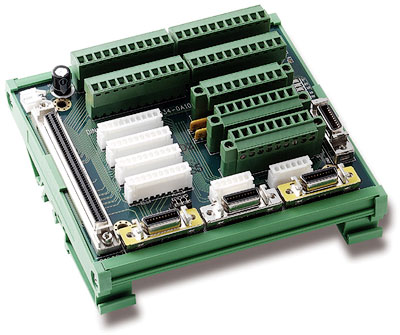
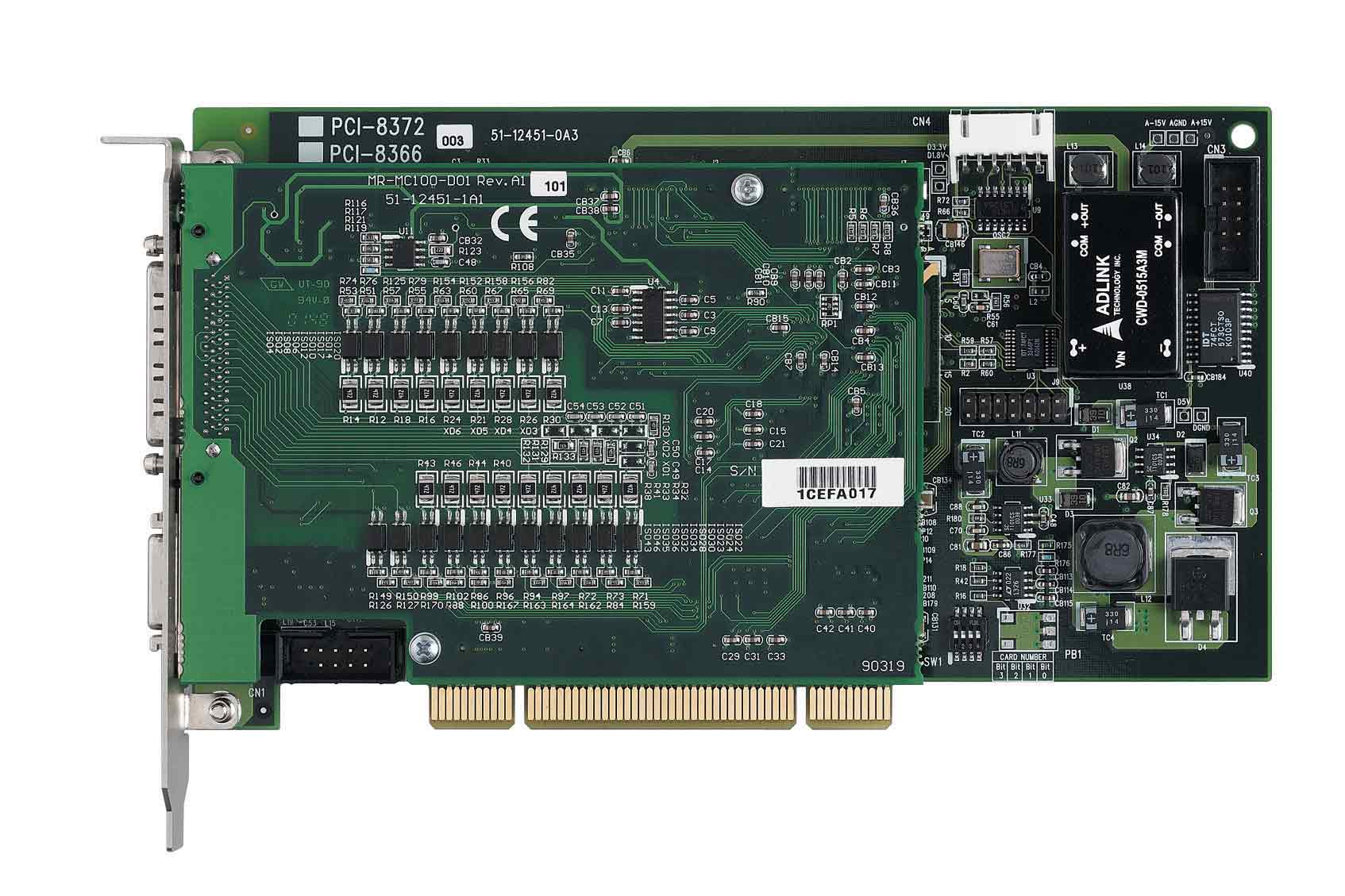
DIN-100S-01
LOOKING FOR THE RIGHT
INDUSTRIAL SOLUTION?
Discover embedded, communication and automation solutions tailored to your application.
- Two‑Axis Motion Control: Supports two independent motion axes with pulse and direction outputs for stepper or servo motor drivers.
- High‑Speed Pulse Output: Up to 2.4 Mpps per axis for high‑resolution, high‑speed motion.
- Interpolation: 2‑D linear and circular interpolation for coordinated multi‑axis motion.
- Hardware Motion Engine: NPM PCL‑5023 ASIC handles acceleration, deceleration, interpolation, and S‑curve profiles in hardware.
- Encoder Feedback: 28‑bit up/down counter per axis for incremental encoder input (EA, EB, EZ).
- Flexible Pulse Modes: OUT/DIR or CW/CCW pulse output; 1×, 2×, 4× AB‑phase or CW/CCW encoder input.
- On‑the‑Fly Control: Velocity change during motion supported; position change supported on PCI‑8102 variant.
- Home and Limit Functions: Programmable home search, positive/negative limit, and slow‑down inputs.
- Manual Pulser Interface: Accepts handwheel encoder input for manual positioning.
- Simultaneous Start/Stop: Hardware synchronization across multiple axes or multiple boards.
- Digital I/O: 16 isolated digital inputs and 16 isolated digital outputs for general‑purpose control.
- Position Compare & Trigger: Hardware comparator with dual trigger outputs (CMP1/CMP2) for vision or inspection synchronization.
- Interrupt Control: 32 programmable interrupt factors for flexible event handling.
- Software Support: MotionCreator and MotionCreator Pro utilities; C/C++, VB, Delphi, LabVIEW libraries for Windows 98/NT/2000/XP/7 and Linux (Red Hat/Fedora).
- Multi‑Board Operation: Up to 12 cards (24 axes) supported in one system.
- Compact PCI Form Factor: Half‑size PCI card with plug‑and‑play configuration.
- High‑Speed Pulse Output: Up to 2.4 Mpps per axis for high‑resolution, high‑speed motion.
- Interpolation: 2‑D linear and circular interpolation for coordinated multi‑axis motion.
- Hardware Motion Engine: NPM PCL‑5023 ASIC handles acceleration, deceleration, interpolation, and S‑curve profiles in hardware.
- Encoder Feedback: 28‑bit up/down counter per axis for incremental encoder input (EA, EB, EZ).
- Flexible Pulse Modes: OUT/DIR or CW/CCW pulse output; 1×, 2×, 4× AB‑phase or CW/CCW encoder input.
- On‑the‑Fly Control: Velocity change during motion supported; position change supported on PCI‑8102 variant.
- Home and Limit Functions: Programmable home search, positive/negative limit, and slow‑down inputs.
- Manual Pulser Interface: Accepts handwheel encoder input for manual positioning.
- Simultaneous Start/Stop: Hardware synchronization across multiple axes or multiple boards.
- Digital I/O: 16 isolated digital inputs and 16 isolated digital outputs for general‑purpose control.
- Position Compare & Trigger: Hardware comparator with dual trigger outputs (CMP1/CMP2) for vision or inspection synchronization.
- Interrupt Control: 32 programmable interrupt factors for flexible event handling.
- Software Support: MotionCreator and MotionCreator Pro utilities; C/C++, VB, Delphi, LabVIEW libraries for Windows 98/NT/2000/XP/7 and Linux (Red Hat/Fedora).
- Multi‑Board Operation: Up to 12 cards (24 axes) supported in one system.
- Compact PCI Form Factor: Half‑size PCI card with plug‑and‑play configuration.
Comprehensive Product Summary – ADLINK PCI‑8132 Two‑Axis Motion Control Card
### 1. Product Overview
Product Name: PCI‑8132
Model: PCI‑8132
Series: NuDAQ PCI Motion Control Series
Article Number: PCI‑8132
Manufacturer: ADLINK Technology Inc., Taipei, Taiwan
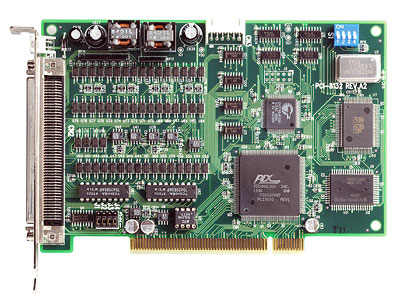
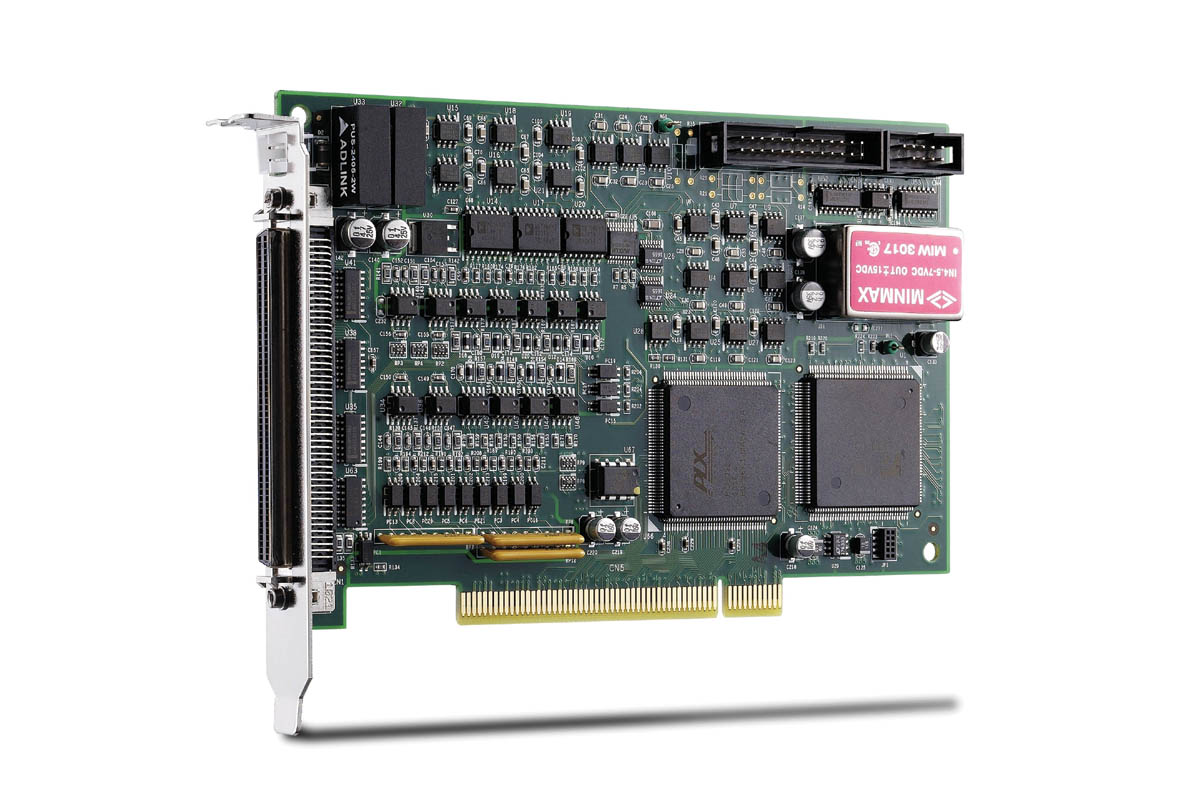
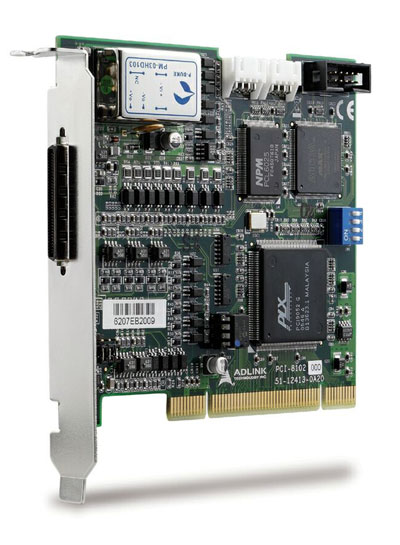
The ADLINK PCI‑8132 is a high‑performance, two‑axis motion control card designed for precise control of stepper and servo motors through a standard 32‑bit PCI bus interface. It provides pulse‑train command outputs, encoder feedback inputs, and a comprehensive set of digital I/O and motion control functions. The card integrates Nippon Pulse Motor (NPM) PCL‑5023 ASICs to deliver hardware‑based motion profiles, interpolation, and position comparison, minimizing CPU load and ensuring deterministic motion control performance.
### 2. Key Features
- Two‑Axis Motion Control: Supports two independent motion axes with pulse and direction outputs for stepper or servo motor drivers.
- High‑Speed Pulse Output: Up to 2.4 Mpps per axis for high‑resolution, high‑speed motion.
- Interpolation: 2‑D linear and circular interpolation for coordinated multi‑axis motion.
- Hardware Motion Engine: NPM PCL‑5023 ASIC handles acceleration, deceleration, interpolation, and S‑curve profiles in hardware.
- Encoder Feedback: 28‑bit up/down counter per axis for incremental encoder input (EA, EB, EZ).
- Flexible Pulse Modes: OUT/DIR or CW/CCW pulse output; 1×, 2×, 4× AB‑phase or CW/CCW encoder input.
- On‑the‑Fly Control: Velocity change during motion supported; position change supported on PCI‑8102 variant.
- Home and Limit Functions: Programmable home search, positive/negative limit, and slow‑down inputs.
- Manual Pulser Interface: Accepts handwheel encoder input for manual positioning.
- Simultaneous Start/Stop: Hardware synchronization across multiple axes or multiple boards.
- Digital I/O: 16 isolated digital inputs and 16 isolated digital outputs for general‑purpose control.
- Position Compare & Trigger: Hardware comparator with dual trigger outputs (CMP1/CMP2) for vision or inspection synchronization.
- Interrupt Control: 32 programmable interrupt factors for flexible event handling.
- Software Support: MotionCreator and MotionCreator Pro utilities; C/C++, VB, Delphi, LabVIEW libraries for Windows 98/NT/2000/XP/7 and Linux (Red Hat/Fedora).
- Multi‑Board Operation: Up to 12 cards (24 axes) supported in one system.
- Compact PCI Form Factor: Half‑size PCI card with plug‑and‑play configuration.
### 3. Technical Specifications
Form Factor: 32‑bit PCI bus, plug‑and‑play
Control Axes: 2 independent axes
Pulse Output Frequency: Up to 2.4 Mpps
Counter Resolution: 28‑bit up/down counter per axis (0 – 268,435,455 pulses)
Encoder Input Frequency: 2.4 MHz @ 4× AB phase
Interpolation: 2‑D linear and circular; 3‑D/4‑D not supported
Velocity Profiles: Trapezoidal and S‑curve acceleration/deceleration
Position Compare Range: ±8,388,607 (24‑bit)
I/O Isolation Voltage: 2500 Vrms
Power Requirements:
– PCI slot +5 V DC ±5 %, 900 mA max
– External +24 V DC ±5 %, 500 mA max
– External +5 V output 500 mA max
Operating Temperature: 0 – 50 °C
Storage Temperature: –20 – 80 °C
Humidity: 5 – 85 % RH (non‑condensing)
Dimensions: 164 mm (L) × 98.4 mm (H)
Connectors: 100‑pin SCSI‑II (CN2), 2‑pin CN1 (+24 V input), 6‑pin CN3 (start/stop)
### 4. Functionality
Operating Principle:
The PCI‑8132 generates high‑frequency pulse trains (OUT/DIR or CW/CCW) to command motor drivers. Encoder feedback (EA/EB/EZ) is counted by on‑board 28‑bit counters for position verification and closed‑loop correction. Motion profiles—linear, trapezoidal, or S‑curve—are executed by the PCL‑5023 ASIC, freeing the host CPU.
Use Cases & Applications:
- Semiconductor and electronics assembly automation
- CNC and precision machining
- Pick‑and‑place and packaging systems
- Inspection and vision‑triggered motion
- Laboratory automation and robotics
Compatibility:
Supports stepper, AC servo, DC servo, and linear motors with pulse‑train input drivers. Works with Windows 2K/XP/7 (32/64‑bit) and Linux (Red Hat/Fedora). Programming supported in VC/C++, VB, Delphi, LabVIEW, VB.Net.
### 5. Components & Accessories
Included Items:
- PCI‑8132 motion control card
- ADLINK software CD (drivers, MotionCreator utilities, libraries)
- User’s manual
- CN1 +24 V power input cable
Optional Accessories:
- DIN‑100S – 100‑pin SCSI‑II terminal board with screw terminals
- ACL‑102100 – 100‑pin SCSI‑II cable
- DIN‑812M, DIN‑68M‑J2A0, DIN‑68M‑J3A0, DIN‑68Y‑SGII0, DIN‑68P‑A40, DIN‑68S0 terminal boards
Connectors:
- CN1: External +24 V input (EX+24 V, EXGND)
- CN2: Main 100‑pin SCSI‑II connector for motion I/O (OUT/DIR, EA/EB/EZ, PEL/MEL, ORG, INP, ALM, SVON, ERC, RDY, DI/DO, CMP1/2, PA/PB)
- CN3: 6‑pin header for simultaneous Start/Stop (STA/STP) signals
### 6. Installation & Setup
Requirements:
- Available 32‑bit PCI slot
- External +24 V DC power supply (500 mA min)
- Windows or Linux OS with ADLINK drivers
Mounting:
Insert the card into a PCI slot, secure with bracket screw, and connect CN1 to a regulated +24 V supply.
Configuration:
- Plug‑and‑play PCI resource assignment by BIOS
- Jumper J1–J4: select pulse output type (line driver or open collector)
- DIP switch S1: set limit switch type (N.O./N.C.) and CMP output polarity
- CN3: connect STA/STP for multi‑card synchronization
Software Setup:
Install ADLINK drivers and MotionCreator utility. Configure axes, I/O logic, and motion parameters via GUI or API.
### 7. Performance & Capabilities
Speed & Resolution:
- Pulse output up to 2.4 Mpps per axis
- Encoder input up to 2.4 MHz (4× AB phase)
- 28‑bit position range (±134,217,727 counts)
Motion Profiles:
- Constant velocity, trapezoidal, and S‑curve acceleration
- Linear and circular interpolation between two axes
- On‑the‑fly velocity change supported
- Home return with three selectable modes (ORG only, ORG + EZ, ORG + EZ with deceleration)
I/O Performance:
- 16 isolated digital inputs (5–24 V)
- 16 isolated digital outputs (50 V max, 500 mA per channel max)
- 2500 Vrms optical isolation
- Manual pulser input (AB phase ×1/×2/×4 or CW/CCW)
Trigger & Compare:
- Dual position compare outputs (CMP1/CMP2) with 100 µs pulse width
- Comparator table up to 1024 points for on‑the‑fly triggering
- Max trigger frequency ≈ 10 kHz
Limitations:
- Two axes per card only (no 3‑D/4‑D interpolation)
- External +24 V supply required for I/O isolation
### 8. Standards & Compliance
- Bus Interface: 32‑bit PCI 2.1 compliant
- Isolation: Optical 2500 Vrms between I/O and logic
- Safety & EMC: Designed for industrial environments (CE mark applicable per ADLINK standards)
- Environmental: RoHS compliant materials
- Software: Windows and Linux drivers certified for industrial use
### 9. Additional Information
Warranty: 1‑year limited hardware warranty against defects in materials and workmanship.
Support & Service:
ADLINK Technology Inc.
9F, No. 166, Jian Yi Road, Chungho City, Taipei 235, Taiwan R.O.C.
Tel: +886‑2‑8226‑5877 Fax: +886‑2‑8226‑5717
Web: [www.adlinktech.com](http://www.adlinktech.com)
Email: service@adlink.com.tw | nudaq@adlink.com.tw
Maintenance:
- Keep card and connectors free of dust and moisture.
- Verify external power supply (+24 V DC) stability.
- Use shielded cables for encoder and pulse signals to minimize noise.
Software Updates:
Driver and MotionCreator updates available from ADLINK website.
Programming Interfaces:
- C/C++ Library: Over 100 functions for motion and I/O control (e.g., _8132_v_move, _8132_a_move, _8132_home_move, _8132_DI/DO_)
- Visual Basic and Delphi APIs: Simplified function calls for Windows applications
- LabVIEW VIs: Graphical motion control integration
- Linux API: C library for Red Hat/Fedora kernels
Typical Integration Example:
- CN2 connected to servo driver pulse inputs (PULS+/–, SIGN+/–)
- Encoder feedback (EA/EB/EZ) wired to CN2 pins 13–18 and 31–36
- Limit switches (PEL/MEL) and origin (ORG) wired to CN2 pins 37–47
- CN1 supplies +24 V for I/O isolation
- CN3 links multiple cards for synchronized start/stop
Example Performance:
- 2‑axis linear interpolation accuracy within ±1 pulse at 2.4 Mpps
- Circular interpolation smoothness optimized via hardware division control
- Position compare trigger latency < 10 µs
Reliability:
Industrial‑grade components rated for continuous operation 0–50 °C.
Mean time between failures (MTBF) > 100,000 hours typical.
### Summary
The ADLINK PCI‑8132 is a robust, industrial‑grade, two‑axis motion control card engineered for precise, high‑speed control of stepper and servo systems. Its hardware‑based motion engine, 2.4 Mpps pulse output, and 28‑bit encoder feedback enable accurate positioning and smooth motion profiles. With comprehensive I/O isolation, programmable interrupts, and multi‑board synchronization, the PCI‑8132 is ideal for automation applications requiring deterministic motion control and tight integration with industrial PC systems. ADLINK’s MotionCreator software and extensive API libraries simplify development across Windows and Linux platforms, making the PCI‑8132 a versatile solution for machine builders and system integrators seeking reliable two‑axis motion control on the PCI bus.

### 1. Product Overview
Product Name: PCI‑8132
Model: PCI‑8132
Series: NuDAQ PCI Motion Control Series
Article Number: PCI‑8132
Manufacturer: ADLINK Technology Inc., Taipei, Taiwan
The ADLINK PCI‑8132 is a high‑performance, two‑axis motion control card designed for precise control of stepper and servo motors through a standard 32‑bit PCI bus interface. It provides pulse‑train command outputs, encoder feedback inputs, and a comprehensive set of digital I/O and motion control functions. The card integrates Nippon Pulse Motor (NPM) PCL‑5023 ASICs to deliver hardware‑based motion profiles, interpolation, and position comparison, minimizing CPU load and ensuring deterministic motion control performance.
### 2. Key Features
- Two‑Axis Motion Control: Supports two independent motion axes with pulse and direction outputs for stepper or servo motor drivers.
- High‑Speed Pulse Output: Up to 2.4 Mpps per axis for high‑resolution, high‑speed motion.
- Interpolation: 2‑D linear and circular interpolation for coordinated multi‑axis motion.
- Hardware Motion Engine: NPM PCL‑5023 ASIC handles acceleration, deceleration, interpolation, and S‑curve profiles in hardware.
- Encoder Feedback: 28‑bit up/down counter per axis for incremental encoder input (EA, EB, EZ).
- Flexible Pulse Modes: OUT/DIR or CW/CCW pulse output; 1×, 2×, 4× AB‑phase or CW/CCW encoder input.
- On‑the‑Fly Control: Velocity change during motion supported; position change supported on PCI‑8102 variant.
- Home and Limit Functions: Programmable home search, positive/negative limit, and slow‑down inputs.
- Manual Pulser Interface: Accepts handwheel encoder input for manual positioning.
- Simultaneous Start/Stop: Hardware synchronization across multiple axes or multiple boards.
- Digital I/O: 16 isolated digital inputs and 16 isolated digital outputs for general‑purpose control.
- Position Compare & Trigger: Hardware comparator with dual trigger outputs (CMP1/CMP2) for vision or inspection synchronization.
- Interrupt Control: 32 programmable interrupt factors for flexible event handling.
- Software Support: MotionCreator and MotionCreator Pro utilities; C/C++, VB, Delphi, LabVIEW libraries for Windows 98/NT/2000/XP/7 and Linux (Red Hat/Fedora).
- Multi‑Board Operation: Up to 12 cards (24 axes) supported in one system.
- Compact PCI Form Factor: Half‑size PCI card with plug‑and‑play configuration.
### 3. Technical Specifications
Form Factor: 32‑bit PCI bus, plug‑and‑play
Control Axes: 2 independent axes
Pulse Output Frequency: Up to 2.4 Mpps
Counter Resolution: 28‑bit up/down counter per axis (0 – 268,435,455 pulses)
Encoder Input Frequency: 2.4 MHz @ 4× AB phase
Interpolation: 2‑D linear and circular; 3‑D/4‑D not supported
Velocity Profiles: Trapezoidal and S‑curve acceleration/deceleration
Position Compare Range: ±8,388,607 (24‑bit)
I/O Isolation Voltage: 2500 Vrms
Power Requirements:
– PCI slot +5 V DC ±5 %, 900 mA max
– External +24 V DC ±5 %, 500 mA max
– External +5 V output 500 mA max
Operating Temperature: 0 – 50 °C
Storage Temperature: –20 – 80 °C
Humidity: 5 – 85 % RH (non‑condensing)
Dimensions: 164 mm (L) × 98.4 mm (H)
Connectors: 100‑pin SCSI‑II (CN2), 2‑pin CN1 (+24 V input), 6‑pin CN3 (start/stop)
### 4. Functionality
Operating Principle:
The PCI‑8132 generates high‑frequency pulse trains (OUT/DIR or CW/CCW) to command motor drivers. Encoder feedback (EA/EB/EZ) is counted by on‑board 28‑bit counters for position verification and closed‑loop correction. Motion profiles—linear, trapezoidal, or S‑curve—are executed by the PCL‑5023 ASIC, freeing the host CPU.
Use Cases & Applications:
- Semiconductor and electronics assembly automation
- CNC and precision machining
- Pick‑and‑place and packaging systems
- Inspection and vision‑triggered motion
- Laboratory automation and robotics
Compatibility:
Supports stepper, AC servo, DC servo, and linear motors with pulse‑train input drivers. Works with Windows 2K/XP/7 (32/64‑bit) and Linux (Red Hat/Fedora). Programming supported in VC/C++, VB, Delphi, LabVIEW, VB.Net.
### 5. Components & Accessories
Included Items:
- PCI‑8132 motion control card
- ADLINK software CD (drivers, MotionCreator utilities, libraries)
- User’s manual
- CN1 +24 V power input cable
Optional Accessories:
- DIN‑100S – 100‑pin SCSI‑II terminal board with screw terminals
- ACL‑102100 – 100‑pin SCSI‑II cable
- DIN‑812M, DIN‑68M‑J2A0, DIN‑68M‑J3A0, DIN‑68Y‑SGII0, DIN‑68P‑A40, DIN‑68S0 terminal boards
Connectors:
- CN1: External +24 V input (EX+24 V, EXGND)
- CN2: Main 100‑pin SCSI‑II connector for motion I/O (OUT/DIR, EA/EB/EZ, PEL/MEL, ORG, INP, ALM, SVON, ERC, RDY, DI/DO, CMP1/2, PA/PB)
- CN3: 6‑pin header for simultaneous Start/Stop (STA/STP) signals
### 6. Installation & Setup
Requirements:
- Available 32‑bit PCI slot
- External +24 V DC power supply (500 mA min)
- Windows or Linux OS with ADLINK drivers
Mounting:
Insert the card into a PCI slot, secure with bracket screw, and connect CN1 to a regulated +24 V supply.
Configuration:
- Plug‑and‑play PCI resource assignment by BIOS
- Jumper J1–J4: select pulse output type (line driver or open collector)
- DIP switch S1: set limit switch type (N.O./N.C.) and CMP output polarity
- CN3: connect STA/STP for multi‑card synchronization
Software Setup:
Install ADLINK drivers and MotionCreator utility. Configure axes, I/O logic, and motion parameters via GUI or API.
### 7. Performance & Capabilities
Speed & Resolution:
- Pulse output up to 2.4 Mpps per axis
- Encoder input up to 2.4 MHz (4× AB phase)
- 28‑bit position range (±134,217,727 counts)
Motion Profiles:
- Constant velocity, trapezoidal, and S‑curve acceleration
- Linear and circular interpolation between two axes
- On‑the‑fly velocity change supported
- Home return with three selectable modes (ORG only, ORG + EZ, ORG + EZ with deceleration)
I/O Performance:
- 16 isolated digital inputs (5–24 V)
- 16 isolated digital outputs (50 V max, 500 mA per channel max)
- 2500 Vrms optical isolation
- Manual pulser input (AB phase ×1/×2/×4 or CW/CCW)
Trigger & Compare:
- Dual position compare outputs (CMP1/CMP2) with 100 µs pulse width
- Comparator table up to 1024 points for on‑the‑fly triggering
- Max trigger frequency ≈ 10 kHz
Limitations:
- Two axes per card only (no 3‑D/4‑D interpolation)
- External +24 V supply required for I/O isolation
### 8. Standards & Compliance
- Bus Interface: 32‑bit PCI 2.1 compliant
- Isolation: Optical 2500 Vrms between I/O and logic
- Safety & EMC: Designed for industrial environments (CE mark applicable per ADLINK standards)
- Environmental: RoHS compliant materials
- Software: Windows and Linux drivers certified for industrial use
### 9. Additional Information
Warranty: 1‑year limited hardware warranty against defects in materials and workmanship.
Support & Service:
ADLINK Technology Inc.
9F, No. 166, Jian Yi Road, Chungho City, Taipei 235, Taiwan R.O.C.
Tel: +886‑2‑8226‑5877 Fax: +886‑2‑8226‑5717
Web: [www.adlinktech.com](http://www.adlinktech.com)
Email: service@adlink.com.tw | nudaq@adlink.com.tw
Maintenance:
- Keep card and connectors free of dust and moisture.
- Verify external power supply (+24 V DC) stability.
- Use shielded cables for encoder and pulse signals to minimize noise.
Software Updates:
Driver and MotionCreator updates available from ADLINK website.
Programming Interfaces:
- C/C++ Library: Over 100 functions for motion and I/O control (e.g., _8132_v_move, _8132_a_move, _8132_home_move, _8132_DI/DO_)
- Visual Basic and Delphi APIs: Simplified function calls for Windows applications
- LabVIEW VIs: Graphical motion control integration
- Linux API: C library for Red Hat/Fedora kernels
Typical Integration Example:
- CN2 connected to servo driver pulse inputs (PULS+/–, SIGN+/–)
- Encoder feedback (EA/EB/EZ) wired to CN2 pins 13–18 and 31–36
- Limit switches (PEL/MEL) and origin (ORG) wired to CN2 pins 37–47
- CN1 supplies +24 V for I/O isolation
- CN3 links multiple cards for synchronized start/stop
Example Performance:
- 2‑axis linear interpolation accuracy within ±1 pulse at 2.4 Mpps
- Circular interpolation smoothness optimized via hardware division control
- Position compare trigger latency < 10 µs
Reliability:
Industrial‑grade components rated for continuous operation 0–50 °C.
Mean time between failures (MTBF) > 100,000 hours typical.
### Summary
The ADLINK PCI‑8132 is a robust, industrial‑grade, two‑axis motion control card engineered for precise, high‑speed control of stepper and servo systems. Its hardware‑based motion engine, 2.4 Mpps pulse output, and 28‑bit encoder feedback enable accurate positioning and smooth motion profiles. With comprehensive I/O isolation, programmable interrupts, and multi‑board synchronization, the PCI‑8132 is ideal for automation applications requiring deterministic motion control and tight integration with industrial PC systems. ADLINK’s MotionCreator software and extensive API libraries simplify development across Windows and Linux platforms, making the PCI‑8132 a versatile solution for machine builders and system integrators seeking reliable two‑axis motion control on the PCI bus.
-
PCI-8132_Manual_1.pdf
Manual
- DIN-100S-01 - 100pin SCSI-II termination board DIN rail w/o cable
- ACL-10150-1.5 - flat cable 50pin 1,5m
- DIN-812M0 - Panel for J2 Mitsubishi servo amplifier
- DIN-502S - 2*50pin SCSI-II termination board DIN rail