DIN-68S
LOOKING FOR THE RIGHT
INDUSTRIAL SOLUTION?
Discover embedded, communication and automation solutions tailored to your application.
- High‑Performance DSP Core:
Equipped with a 250 MHz TI TMS320C6711D DSP delivering 1500 MFLOPS for real‑time motion computation.
- Multi‑Axis Analog Control:
Supports 3 axes (PCI‑8253) or 6 axes (PCI‑8256) of ±10 V analog command output for servo motor control with differential or single‑ended signal types.
- High‑Speed Feedback and Control:
- Encoder feedback frequency up to 20 MHz (4×AB mode).
- Servo update rate as low as 150 µs (PCI‑8253) or 300 µs (PCI‑8256).
- Position counter resolution: 32‑bit up/down counter per axis.
- Closed‑Loop PID + Feed‑Forward Control:
Built‑in PID controller with adjustable proportional (Kp), integral (Ki), derivative (Kd), and feed‑forward (Aff, Vff) gains (0–32,767 range) for precise trajectory tracking and minimal following error.
- Advanced Motion Functions:
- Point‑to‑point, velocity, and jogging modes.
- 2–4‑axis linear interpolation and 2‑axis circular interpolation.
- Multi‑axis synchronous and continuous interpolation.
- On‑the‑fly speed and position override.
- Gantry and E‑Gear functions for coordinated motion.
- Trigger and Comparison Functions:
- Up to 4 differential trigger outputs (2 high‑speed @ 1 MHz, 2 low‑speed @ 25 kHz).
- Programmable pulse width (0.2 µs – 300 ms).
- FIFO and linear comparison modes for continuous triggering.
- Comprehensive I/O:
- Dedicated motion I/O per axis: PEL/MEL, ORG, ALM, SVON, ZSP, INP.
- General‑purpose isolated I/O: 4 DI/4 DO (PCI‑8253) or 8 DI/8 DO (PCI‑8256).
- One emergency stop input shared across all axes.
- Analog I/O:
- 3/6 × 14‑bit analog inputs (±10 V).
- 3/6 × 16‑bit analog outputs (±10 V, ±5 V programmable).
- Software and Development Tools:
- MotionCreatorPro 2™ graphical configuration and tuning suite.
- Windows DLL libraries for C/C++, Visual Basic, and other languages.
- Real‑time data sampling and PID tuning utilities.
- System Integration:
- 32‑bit PCI Rev 2.2, 33 MHz interface.
- Plug‑and‑Play resource allocation.
- Support for up to 16 cards per system.
- Safety and Reliability:
- Watchdog timer.
- Noise‑resistant encoder input with digital filtering.
- Short‑circuit protection on analog outputs.
- Operating temperature 0 – 55 °C.
Equipped with a 250 MHz TI TMS320C6711D DSP delivering 1500 MFLOPS for real‑time motion computation.
- Multi‑Axis Analog Control:
Supports 3 axes (PCI‑8253) or 6 axes (PCI‑8256) of ±10 V analog command output for servo motor control with differential or single‑ended signal types.
- High‑Speed Feedback and Control:
- Encoder feedback frequency up to 20 MHz (4×AB mode).
- Servo update rate as low as 150 µs (PCI‑8253) or 300 µs (PCI‑8256).
- Position counter resolution: 32‑bit up/down counter per axis.
- Closed‑Loop PID + Feed‑Forward Control:
Built‑in PID controller with adjustable proportional (Kp), integral (Ki), derivative (Kd), and feed‑forward (Aff, Vff) gains (0–32,767 range) for precise trajectory tracking and minimal following error.
- Advanced Motion Functions:
- Point‑to‑point, velocity, and jogging modes.
- 2–4‑axis linear interpolation and 2‑axis circular interpolation.
- Multi‑axis synchronous and continuous interpolation.
- On‑the‑fly speed and position override.
- Gantry and E‑Gear functions for coordinated motion.
- Trigger and Comparison Functions:
- Up to 4 differential trigger outputs (2 high‑speed @ 1 MHz, 2 low‑speed @ 25 kHz).
- Programmable pulse width (0.2 µs – 300 ms).
- FIFO and linear comparison modes for continuous triggering.
- Comprehensive I/O:
- Dedicated motion I/O per axis: PEL/MEL, ORG, ALM, SVON, ZSP, INP.
- General‑purpose isolated I/O: 4 DI/4 DO (PCI‑8253) or 8 DI/8 DO (PCI‑8256).
- One emergency stop input shared across all axes.
- Analog I/O:
- 3/6 × 14‑bit analog inputs (±10 V).
- 3/6 × 16‑bit analog outputs (±10 V, ±5 V programmable).
- Software and Development Tools:
- MotionCreatorPro 2™ graphical configuration and tuning suite.
- Windows DLL libraries for C/C++, Visual Basic, and other languages.
- Real‑time data sampling and PID tuning utilities.
- System Integration:
- 32‑bit PCI Rev 2.2, 33 MHz interface.
- Plug‑and‑Play resource allocation.
- Support for up to 16 cards per system.
- Safety and Reliability:
- Watchdog timer.
- Noise‑resistant encoder input with digital filtering.
- Short‑circuit protection on analog outputs.
- Operating temperature 0 – 55 °C.
Comprehensive Product Summary – ADLINK PCI‑8253 DSP‑Based 3‑Axis Analog Motion Control Card
### 1. Product Overview
Product Name: PCI‑8253
Model: PCI‑8253
Series: PCI‑8253/56 DSP‑Based Analog Motion Control Series
Article Number: PCI‑8253
Manufacturer: ADLINK Technology Inc.
Part Number: 50‑15057‑1010
Manual Revision: 2.02 (January 5, 2009)
Manufacturer Address: 9F, No. 166, Jian Yi Road, Chungho City, Taipei 235, Taiwan
Website: [www.adlinktech.com](http://www.adlinktech.com)
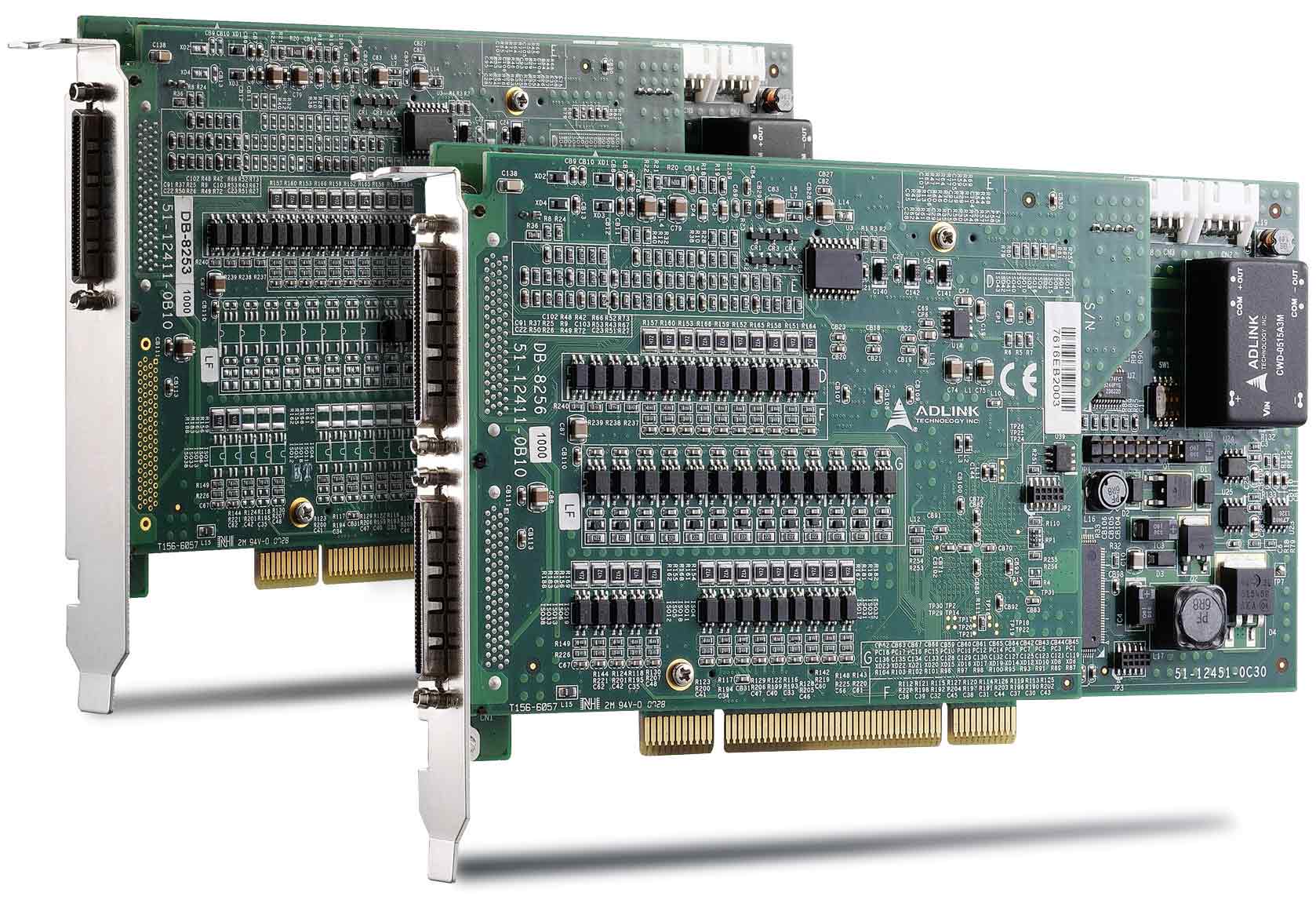
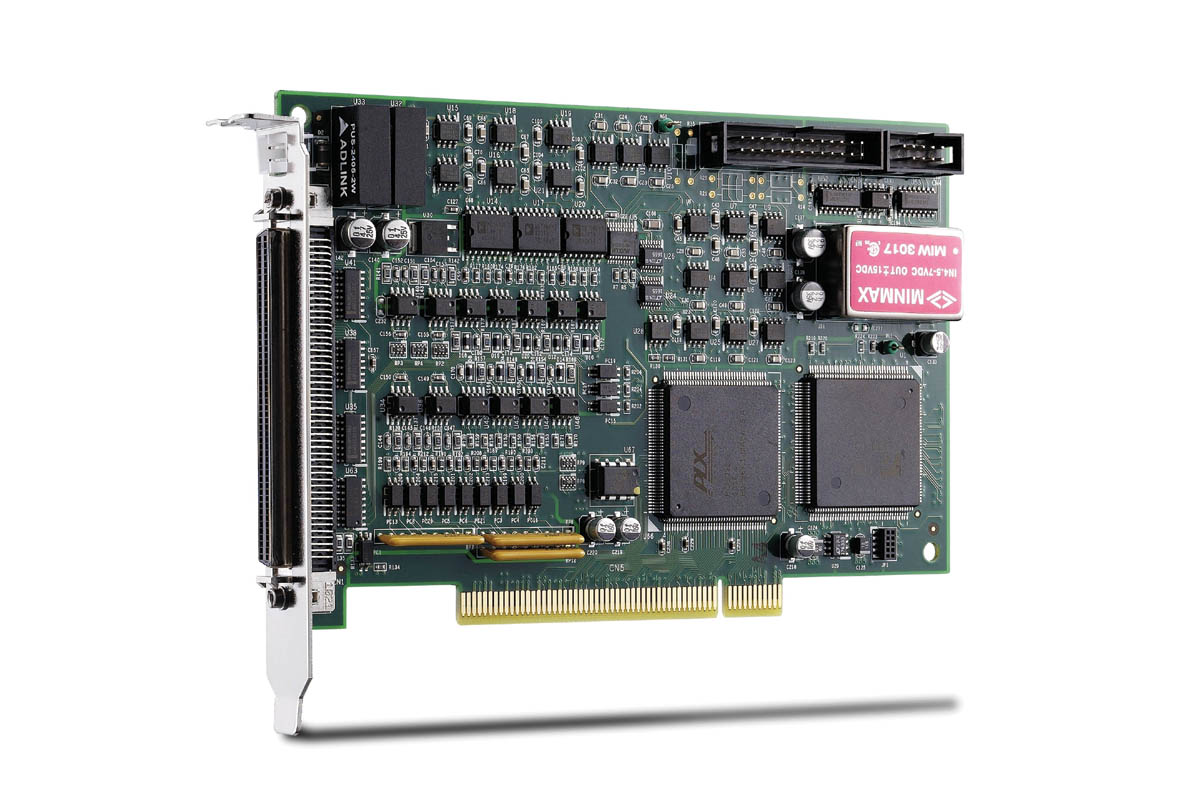
The ADLINK PCI‑8253 is a high‑performance, DSP‑based, 3‑axis analog motion control card designed for precision servo and stepper motor control. It belongs to ADLINK’s PCI‑8253/56 family, which includes both 3‑axis (PCI‑8253) and 6‑axis (PCI‑8256) variants. The card integrates a 250 MHz TI TMS320C6711D digital signal processor (DSP) and ADLINK’s proprietary SoftMotion kernel to deliver deterministic, real‑time motion control for industrial automation, robotics, and precision machinery.
### 2. Key Features
- High‑Performance DSP Core:
Equipped with a 250 MHz TI TMS320C6711D DSP delivering 1500 MFLOPS for real‑time motion computation.
- Multi‑Axis Analog Control:
Supports 3 axes (PCI‑8253) or 6 axes (PCI‑8256) of ±10 V analog command output for servo motor control with differential or single‑ended signal types.
- High‑Speed Feedback and Control:
- Encoder feedback frequency up to 20 MHz (4×AB mode).
- Servo update rate as low as 150 µs (PCI‑8253) or 300 µs (PCI‑8256).
- Position counter resolution: 32‑bit up/down counter per axis.
- Closed‑Loop PID + Feed‑Forward Control:
Built‑in PID controller with adjustable proportional (Kp), integral (Ki), derivative (Kd), and feed‑forward (Aff, Vff) gains (0–32,767 range) for precise trajectory tracking and minimal following error.
- Advanced Motion Functions:
- Point‑to‑point, velocity, and jogging modes.
- 2–4‑axis linear interpolation and 2‑axis circular interpolation.
- Multi‑axis synchronous and continuous interpolation.
- On‑the‑fly speed and position override.
- Gantry and E‑Gear functions for coordinated motion.
- Trigger and Comparison Functions:
- Up to 4 differential trigger outputs (2 high‑speed @ 1 MHz, 2 low‑speed @ 25 kHz).
- Programmable pulse width (0.2 µs – 300 ms).
- FIFO and linear comparison modes for continuous triggering.
- Comprehensive I/O:
- Dedicated motion I/O per axis: PEL/MEL, ORG, ALM, SVON, ZSP, INP.
- General‑purpose isolated I/O: 4 DI/4 DO (PCI‑8253) or 8 DI/8 DO (PCI‑8256).
- One emergency stop input shared across all axes.
- Analog I/O:
- 3/6 × 14‑bit analog inputs (±10 V).
- 3/6 × 16‑bit analog outputs (±10 V, ±5 V programmable).
- Software and Development Tools:
- MotionCreatorPro 2™ graphical configuration and tuning suite.
- Windows DLL libraries for C/C++, Visual Basic, and other languages.
- Real‑time data sampling and PID tuning utilities.
- System Integration:
- 32‑bit PCI Rev 2.2, 33 MHz interface.
- Plug‑and‑Play resource allocation.
- Support for up to 16 cards per system.
- Safety and Reliability:
- Watchdog timer.
- Noise‑resistant encoder input with digital filtering.
- Short‑circuit protection on analog outputs.
- Operating temperature 0 – 55 °C.
### 3. Technical Specifications
Bus Interface:
- PCI Rev 2.2, 33 MHz, 32‑bit
- Bus voltage: 3.3 V / 5 V compatible
- IRQ assigned by PCI controller
DSP Processor:
- TI TMS320C6711D, 250 MHz
- Performance: 1500 MFLOPS
- Memory: 2 M × 32‑bit SDRAM, 512 KB Flash ROM
Power Consumption:
- +3.3 V @ 0.8 A typ.
- +5 V @ 0.8 A typ.
- ±12 V @ 0.5 A typ.
Analog Outputs:
- ±10 V (±5 V selectable), 16‑bit resolution, differential/single‑ended
- Output current ±50 mA typ.
- Settling time 15 µs (full‑scale step)
- Monotonicity guaranteed, accuracy ±1.5 LSB
Analog Inputs:
- 3 (PCI‑8253) / 6 (PCI‑8256) channels, 14‑bit resolution
- Input range ±10 V programmable, bandwidth 100 kHz
- Input coupling DC, max working voltage ±15 V
Encoder Inputs:
- Up to 20 MHz @ 4×AB mode
- Differential ±12 V TTL compatible
- Digital filter included
- 32‑bit up/down counter per axis
Trigger Outputs:
- 4 channels (2 high‑speed 1 MHz, 2 low‑speed 25 kHz)
- Differential TTL outputs, programmable polarity
- Pulse width 0.2 µs – 300 ms
Motion I/O per Axis:
- PEL/MEL (End limits)
- ORG (Home origin)
- ALM (Alarm input)
- SVON (Servo ON output)
- ZSP (Zero speed input)
- INP (In‑position signal)
General‑Purpose I/O:
- PCI‑8253: 4 isolated DI / 4 DO
- PCI‑8256: 8 isolated DI / 8 DO
- Input logic 24 V sink/source configurable
Environmental Conditions:
- Operating temperature: 0 – 55 °C
- Storage temperature: –20 – 80 °C
- Humidity: 5 – 95 % non‑condensing
- Noise resistance: 1500 V p‑p @ 25–60 Hz
- Cooling: Self‑cooled
Physical Interface:
- Main connector: 68‑pin SCSI VHDCI (SP1 for PCI‑8253; SP1/SP2 for PCI‑8256)
- CN1: 4‑pin Pulsar connector (for manual pulse generator)
- CN2/CN3: 4‑pin DSP synchronous signal connectors
- Dimensions (PCI‑8253): approx. 185 × 107 mm
### 4. Functionality
Operating Principle:
The PCI‑8253 generates ±10 V analog command signals to control servo amplifiers. Encoder feedback provides position and velocity data to the DSP, which executes PID + feed‑forward algorithms in real time. The card supports both single‑axis and multi‑axis coordinated motion, enabling complex trajectories such as linear, circular, and contouring paths.
Use Cases:
- CNC machinery and precision positioning systems
- Semiconductor and PCB manufacturing equipment
- Robotics and gantry systems
- Inspection and vision alignment platforms
- Automated test and measurement systems
Compatibility:
- Windows 2000 / XP / Vista (32‑bit)
- ADLINK MotionCreatorPro 2 and Windows DLL libraries
- Compatible terminal boards: DIN‑825‑J3A (for Mitsubishi J3A servo drivers) and DIN‑68S (general purpose)
### 5. Components & Accessories
Included Items:
- PCI‑8253 DSP‑based 3‑Axis Analog Motion Control Card
- ADLINK All‑in‑One Software CD (includes drivers and MotionCreatorPro 2)
- User’s Manual and Documentation
Optional Accessories:
- DIN‑825‑J3A terminal board (for servo driver I/O integration)
- DIN‑68S general‑purpose terminal board
- 68‑pin VHDCI cables for signal connection
Connectors:
- SP1 (68‑pin VHDCI): Main signal connector for axes 1–3
- CN1: Manual pulse generator input (IPA/IPB)
- CN2/CN3: DSP synchronous signal connectors (STA/STP)
### 6. Installation & Setup
Hardware Installation:
1. Power off the PC and remove the cover.
2. Insert the PCI‑8253 into a 32‑bit PCI slot (33 MHz).
3. Secure the card and reassemble the system.
4. Power on and allow BIOS to assign resources (Plug and Play).
Switch Settings:
- (CB) SW1: 4‑bit card index selection (0–15) for multi‑card systems.
- (DB) SW1: Select analog output mode (differential or single‑ended).
Software Installation:
1. Insert ADLINK All‑in‑One CD → Driver Installation → Motion Control → PCI‑8253/6.
2. Follow on‑screen instructions and reboot.
3. Verify installation via Windows Device Manager.
Configuration:
- Use MotionCreatorPro 2 to assign axes, set PID parameters, and test motion.
- Connect servo drivers and encoders per pin assignments in SP1.
### 7. Performance & Capabilities
Motion Control Performance:
- Servo update rate: 150 µs (PCI‑8253) / 300 µs (PCI‑8256)
- Encoder feedback rate: 20 MHz @ 4×AB
- Trigger output frequency: 1 MHz (high‑speed channels)
- Position resolution: 32‑bit counter
- Analog output resolution: 16 bits
- Analog input resolution: 14 bits
Motion Profiles:
- Trapezoidal and S‑curve velocity profiles
- Programmable acceleration/deceleration (32‑bit range)
- Continuous point table motion with 32‑depth buffers per axis
- Linear and arc segment combination for contouring
Advanced Functions:
- Speed and position override on‑the‑fly
- Home move via ORG or EZ index signals
- Jogging (free‑run and step modes)
- Data sampling (4 channels per axis, oscilloscope‑like monitoring)
- Interrupt control for motion events (PEL, MEL, ORG, EZ, INP, etc.)
- Closed‑loop gantry mode for dual‑axis synchronization
Limitations:
- Windows 2000/XP/Vista only (32‑bit environment)
- Not intended for real‑time OS beyond DSP kernel
- Requires external servo amplifiers and encoders
### 8. Standards & Compliance
- PCI Bus Specification Rev 2.2 compliant
- RoHS and CE compliant (manufacturer standard)
- Electrical isolation on digital I/O for industrial environments
- Noise immunity tested to 1500 V p‑p @ 25–60 Hz
- Compatible with Mitsubishi SSCNET servo interfaces via DIN‑825‑J3A
### 9. Additional Information
Warranty & Support:
- Standard ADLINK limited hardware warranty (typically 1 year).
- Technical support via email (service@adlinktech.com) and phone (+886‑2‑82265877).
- Firmware and driver updates available from ADLINK website.
Maintenance:
- Ensure proper ventilation and avoid condensation.
- Use shielded cables for encoder and analog signals.
- Regularly inspect connectors and tighten screws to maintain signal integrity.
Software Updates:
- MotionCreatorPro 2 and driver packages updated periodically for new Windows versions.
- Custom motion kernel services available from ADLINK for specialized applications.
Service & RMA:
- Contact ADLINK for RMA authorization before returning hardware.
- Provide model, serial number, and detailed problem description.
### Summary
The ADLINK PCI‑8253 is a robust, high‑precision 3‑axis DSP‑based analog motion control card engineered for demanding industrial automation and servo control applications. Its 250 MHz DSP, 20 MHz encoder feedback, and 150 µs servo update rate enable deterministic, high‑speed motion with sub‑micron accuracy. The integrated PID + feed‑forward control, multi‑axis interpolation, and real‑time data sampling make it ideal for machine builders requiring both flexibility and precision. With MotionCreatorPro 2 software, developers can configure, tune, and monitor motion systems efficiently, while the card’s comprehensive I/O and trigger functions ensure seamless integration with servo amplifiers, encoders, and automation peripherals.
In short, the PCI‑8253 delivers industrial‑grade performance, deterministic control, and versatile motion functionality in a standard PCI form factor, making it a cornerstone solution for multi‑axis servo motion control in PC‑based automation systems.

### 1. Product Overview
Product Name: PCI‑8253
Model: PCI‑8253
Series: PCI‑8253/56 DSP‑Based Analog Motion Control Series
Article Number: PCI‑8253
Manufacturer: ADLINK Technology Inc.
Part Number: 50‑15057‑1010
Manual Revision: 2.02 (January 5, 2009)
Manufacturer Address: 9F, No. 166, Jian Yi Road, Chungho City, Taipei 235, Taiwan
Website: [www.adlinktech.com](http://www.adlinktech.com)
The ADLINK PCI‑8253 is a high‑performance, DSP‑based, 3‑axis analog motion control card designed for precision servo and stepper motor control. It belongs to ADLINK’s PCI‑8253/56 family, which includes both 3‑axis (PCI‑8253) and 6‑axis (PCI‑8256) variants. The card integrates a 250 MHz TI TMS320C6711D digital signal processor (DSP) and ADLINK’s proprietary SoftMotion kernel to deliver deterministic, real‑time motion control for industrial automation, robotics, and precision machinery.
### 2. Key Features
- High‑Performance DSP Core:
Equipped with a 250 MHz TI TMS320C6711D DSP delivering 1500 MFLOPS for real‑time motion computation.
- Multi‑Axis Analog Control:
Supports 3 axes (PCI‑8253) or 6 axes (PCI‑8256) of ±10 V analog command output for servo motor control with differential or single‑ended signal types.
- High‑Speed Feedback and Control:
- Encoder feedback frequency up to 20 MHz (4×AB mode).
- Servo update rate as low as 150 µs (PCI‑8253) or 300 µs (PCI‑8256).
- Position counter resolution: 32‑bit up/down counter per axis.
- Closed‑Loop PID + Feed‑Forward Control:
Built‑in PID controller with adjustable proportional (Kp), integral (Ki), derivative (Kd), and feed‑forward (Aff, Vff) gains (0–32,767 range) for precise trajectory tracking and minimal following error.
- Advanced Motion Functions:
- Point‑to‑point, velocity, and jogging modes.
- 2–4‑axis linear interpolation and 2‑axis circular interpolation.
- Multi‑axis synchronous and continuous interpolation.
- On‑the‑fly speed and position override.
- Gantry and E‑Gear functions for coordinated motion.
- Trigger and Comparison Functions:
- Up to 4 differential trigger outputs (2 high‑speed @ 1 MHz, 2 low‑speed @ 25 kHz).
- Programmable pulse width (0.2 µs – 300 ms).
- FIFO and linear comparison modes for continuous triggering.
- Comprehensive I/O:
- Dedicated motion I/O per axis: PEL/MEL, ORG, ALM, SVON, ZSP, INP.
- General‑purpose isolated I/O: 4 DI/4 DO (PCI‑8253) or 8 DI/8 DO (PCI‑8256).
- One emergency stop input shared across all axes.
- Analog I/O:
- 3/6 × 14‑bit analog inputs (±10 V).
- 3/6 × 16‑bit analog outputs (±10 V, ±5 V programmable).
- Software and Development Tools:
- MotionCreatorPro 2™ graphical configuration and tuning suite.
- Windows DLL libraries for C/C++, Visual Basic, and other languages.
- Real‑time data sampling and PID tuning utilities.
- System Integration:
- 32‑bit PCI Rev 2.2, 33 MHz interface.
- Plug‑and‑Play resource allocation.
- Support for up to 16 cards per system.
- Safety and Reliability:
- Watchdog timer.
- Noise‑resistant encoder input with digital filtering.
- Short‑circuit protection on analog outputs.
- Operating temperature 0 – 55 °C.
### 3. Technical Specifications
Bus Interface:
- PCI Rev 2.2, 33 MHz, 32‑bit
- Bus voltage: 3.3 V / 5 V compatible
- IRQ assigned by PCI controller
DSP Processor:
- TI TMS320C6711D, 250 MHz
- Performance: 1500 MFLOPS
- Memory: 2 M × 32‑bit SDRAM, 512 KB Flash ROM
Power Consumption:
- +3.3 V @ 0.8 A typ.
- +5 V @ 0.8 A typ.
- ±12 V @ 0.5 A typ.
Analog Outputs:
- ±10 V (±5 V selectable), 16‑bit resolution, differential/single‑ended
- Output current ±50 mA typ.
- Settling time 15 µs (full‑scale step)
- Monotonicity guaranteed, accuracy ±1.5 LSB
Analog Inputs:
- 3 (PCI‑8253) / 6 (PCI‑8256) channels, 14‑bit resolution
- Input range ±10 V programmable, bandwidth 100 kHz
- Input coupling DC, max working voltage ±15 V
Encoder Inputs:
- Up to 20 MHz @ 4×AB mode
- Differential ±12 V TTL compatible
- Digital filter included
- 32‑bit up/down counter per axis
Trigger Outputs:
- 4 channels (2 high‑speed 1 MHz, 2 low‑speed 25 kHz)
- Differential TTL outputs, programmable polarity
- Pulse width 0.2 µs – 300 ms
Motion I/O per Axis:
- PEL/MEL (End limits)
- ORG (Home origin)
- ALM (Alarm input)
- SVON (Servo ON output)
- ZSP (Zero speed input)
- INP (In‑position signal)
General‑Purpose I/O:
- PCI‑8253: 4 isolated DI / 4 DO
- PCI‑8256: 8 isolated DI / 8 DO
- Input logic 24 V sink/source configurable
Environmental Conditions:
- Operating temperature: 0 – 55 °C
- Storage temperature: –20 – 80 °C
- Humidity: 5 – 95 % non‑condensing
- Noise resistance: 1500 V p‑p @ 25–60 Hz
- Cooling: Self‑cooled
Physical Interface:
- Main connector: 68‑pin SCSI VHDCI (SP1 for PCI‑8253; SP1/SP2 for PCI‑8256)
- CN1: 4‑pin Pulsar connector (for manual pulse generator)
- CN2/CN3: 4‑pin DSP synchronous signal connectors
- Dimensions (PCI‑8253): approx. 185 × 107 mm
### 4. Functionality
Operating Principle:
The PCI‑8253 generates ±10 V analog command signals to control servo amplifiers. Encoder feedback provides position and velocity data to the DSP, which executes PID + feed‑forward algorithms in real time. The card supports both single‑axis and multi‑axis coordinated motion, enabling complex trajectories such as linear, circular, and contouring paths.
Use Cases:
- CNC machinery and precision positioning systems
- Semiconductor and PCB manufacturing equipment
- Robotics and gantry systems
- Inspection and vision alignment platforms
- Automated test and measurement systems
Compatibility:
- Windows 2000 / XP / Vista (32‑bit)
- ADLINK MotionCreatorPro 2 and Windows DLL libraries
- Compatible terminal boards: DIN‑825‑J3A (for Mitsubishi J3A servo drivers) and DIN‑68S (general purpose)
### 5. Components & Accessories
Included Items:
- PCI‑8253 DSP‑based 3‑Axis Analog Motion Control Card
- ADLINK All‑in‑One Software CD (includes drivers and MotionCreatorPro 2)
- User’s Manual and Documentation
Optional Accessories:
- DIN‑825‑J3A terminal board (for servo driver I/O integration)
- DIN‑68S general‑purpose terminal board
- 68‑pin VHDCI cables for signal connection
Connectors:
- SP1 (68‑pin VHDCI): Main signal connector for axes 1–3
- CN1: Manual pulse generator input (IPA/IPB)
- CN2/CN3: DSP synchronous signal connectors (STA/STP)
### 6. Installation & Setup
Hardware Installation:
1. Power off the PC and remove the cover.
2. Insert the PCI‑8253 into a 32‑bit PCI slot (33 MHz).
3. Secure the card and reassemble the system.
4. Power on and allow BIOS to assign resources (Plug and Play).
Switch Settings:
- (CB) SW1: 4‑bit card index selection (0–15) for multi‑card systems.
- (DB) SW1: Select analog output mode (differential or single‑ended).
Software Installation:
1. Insert ADLINK All‑in‑One CD → Driver Installation → Motion Control → PCI‑8253/6.
2. Follow on‑screen instructions and reboot.
3. Verify installation via Windows Device Manager.
Configuration:
- Use MotionCreatorPro 2 to assign axes, set PID parameters, and test motion.
- Connect servo drivers and encoders per pin assignments in SP1.
### 7. Performance & Capabilities
Motion Control Performance:
- Servo update rate: 150 µs (PCI‑8253) / 300 µs (PCI‑8256)
- Encoder feedback rate: 20 MHz @ 4×AB
- Trigger output frequency: 1 MHz (high‑speed channels)
- Position resolution: 32‑bit counter
- Analog output resolution: 16 bits
- Analog input resolution: 14 bits
Motion Profiles:
- Trapezoidal and S‑curve velocity profiles
- Programmable acceleration/deceleration (32‑bit range)
- Continuous point table motion with 32‑depth buffers per axis
- Linear and arc segment combination for contouring
Advanced Functions:
- Speed and position override on‑the‑fly
- Home move via ORG or EZ index signals
- Jogging (free‑run and step modes)
- Data sampling (4 channels per axis, oscilloscope‑like monitoring)
- Interrupt control for motion events (PEL, MEL, ORG, EZ, INP, etc.)
- Closed‑loop gantry mode for dual‑axis synchronization
Limitations:
- Windows 2000/XP/Vista only (32‑bit environment)
- Not intended for real‑time OS beyond DSP kernel
- Requires external servo amplifiers and encoders
### 8. Standards & Compliance
- PCI Bus Specification Rev 2.2 compliant
- RoHS and CE compliant (manufacturer standard)
- Electrical isolation on digital I/O for industrial environments
- Noise immunity tested to 1500 V p‑p @ 25–60 Hz
- Compatible with Mitsubishi SSCNET servo interfaces via DIN‑825‑J3A
### 9. Additional Information
Warranty & Support:
- Standard ADLINK limited hardware warranty (typically 1 year).
- Technical support via email (service@adlinktech.com) and phone (+886‑2‑82265877).
- Firmware and driver updates available from ADLINK website.
Maintenance:
- Ensure proper ventilation and avoid condensation.
- Use shielded cables for encoder and analog signals.
- Regularly inspect connectors and tighten screws to maintain signal integrity.
Software Updates:
- MotionCreatorPro 2 and driver packages updated periodically for new Windows versions.
- Custom motion kernel services available from ADLINK for specialized applications.
Service & RMA:
- Contact ADLINK for RMA authorization before returning hardware.
- Provide model, serial number, and detailed problem description.
### Summary
The ADLINK PCI‑8253 is a robust, high‑precision 3‑axis DSP‑based analog motion control card engineered for demanding industrial automation and servo control applications. Its 250 MHz DSP, 20 MHz encoder feedback, and 150 µs servo update rate enable deterministic, high‑speed motion with sub‑micron accuracy. The integrated PID + feed‑forward control, multi‑axis interpolation, and real‑time data sampling make it ideal for machine builders requiring both flexibility and precision. With MotionCreatorPro 2 software, developers can configure, tune, and monitor motion systems efficiently, while the card’s comprehensive I/O and trigger functions ensure seamless integration with servo amplifiers, encoders, and automation peripherals.
In short, the PCI‑8253 delivers industrial‑grade performance, deterministic control, and versatile motion functionality in a standard PCI form factor, making it a cornerstone solution for multi‑axis servo motion control in PC‑based automation systems.
-
PCI-8253+8256_Datasheet_5.pdf
PDF Catalog
- DIN-68S - 68pin SCSI-II termination board DIN rail